
PLoS One. 2019;14(1):e0210490.
Asthma under control is inversely related with erosive esophagitis among healthy adults.
제1저자 임주현 · 교신저자 이동호
소속 (4)
- Seoul National University Hospital, Healthcare System Gangnam Center, Healthcare Research Institute, Seoul, Korea.
- Department of Internal Medicine, Seoul National University Bundang Hospital, Seongnam, Korea.
- Department of Internal Medicine and Liver Research Institute, Seoul National University College of Medicine, Seoul, Korea.
- Department of Internal Medicine Seoul National University College of Medicine, Seoul, Korea.
Abstract
BACKGROUND Some recent studies suggested that reflux esophagitis is positively correlated with asthma. However, there are debates on this issue. The aim of this study is to clarify the true association between reflux esophagitis and asthma in a large population.
METHODS Medical records of subjects who received health surveillance checkup between January 2005 and December 2011 were reviewed. Their endoscopic findings, medical history, body mass index, and smoking history were analyzed. Erosive esophagitis was defined as endoscopically detected mucosal break at the Z-line, irrespective of reflux symptom. Information about asthma history was obtained from their questionnaires and medical records.
RESULTS Out of the total 15,999 patients, 986 had erosive esophagitis and 376 had asthma. In this population, erosive esophagitis was inversely related with asthma in univariable analysis (OR, 0.586; 95% CI, 0.342-1.003, p = 0.049). In multivariable analysis, asthma was demonstrated as an independent negative risk factor for erosive esophagitis (OR, 0.472; 95% CI, 0.257-0.869, p = 0.016), under adjustment with age (OR, 1.000; 95% CI, 0.994-1.006, p = 0.977), male sex (OR, 2.092; 95% CI, 1.683-2.601, p < 0.001), body mass index (OR, 1.115; 95% CI, 1.090-1.141, p < 0.001), smoking (OR, 1.584; 95% CI, 1.318-1.902, p < 0.001), and urban residence (OR, 1.363; 95% CI, 1.149-1.616, p < 0.001). Likewise, erosive esophagitis was shown to be an independent negative risk factor for asthma (OR, 0.558; 95% CI, 0.324-0.960, p = 0.035) under adjustment with age (OR, 1.025; 95% CI, 1.015-1.034, p <0.001), male sex (OR, 0.861; 95% CI, 0.691-1.074, p = 0.185), and body mass index (OR, 1.067; 95% CI, 1.030-1.106, p < 0.001) in multivariable analysis.
CONCLUSIONS Contrary to previous studies, this large scale data showed inverse association between erosive esophagitis and asthma. Further studies investigating the clear mechanism of this phenomenon are warranted.
Figures
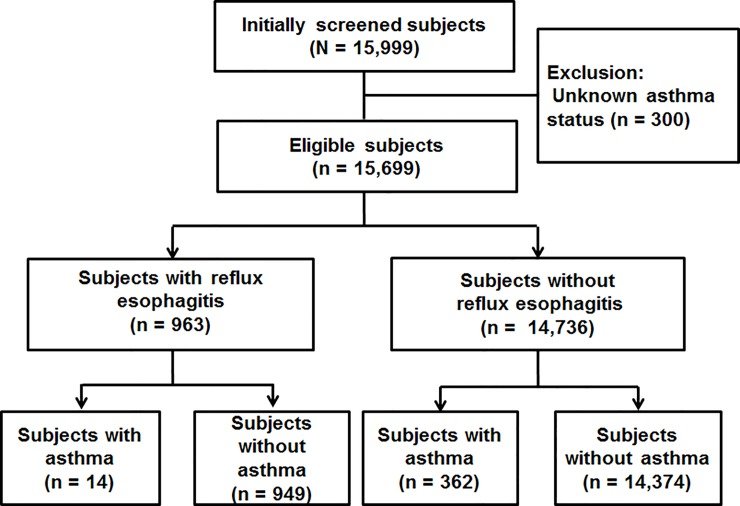
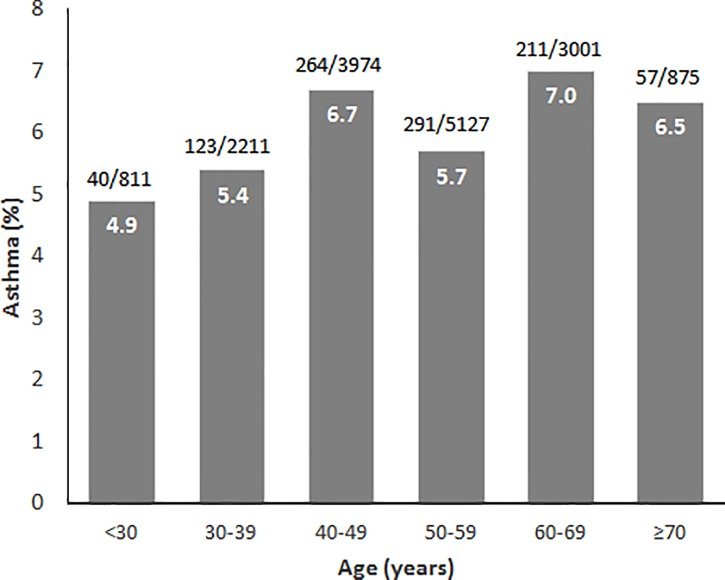
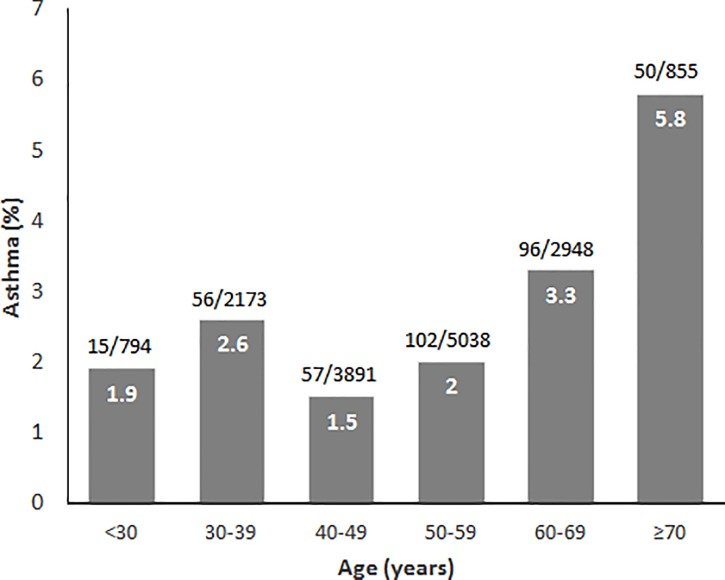
그림 출처: PubMed Central 공개 논문 (PMC6322772)
Conflict of interest statement
The authors have declared that no competing interests exist.
그 밖의 정보
- 출판 형태
- Journal Article
- 저널
- PloS one · eISSN 1932-6203
- 전자 출판
- 2019-01-07
- MeSH
- Adult · Aged · Asthma / diagnosis / drug therapy / epidemiology · Body Mass Index · Bronchodilator Agents / therapeutic use · Comorbidity · Esophagitis, Peptic / diagnostic imaging / epidemiology · Esophagoscopy / methods · Female · Humans · Logistic Models · Male · Middle Aged · Population Surveillance / methods · Republic of Korea / epidemiology · Risk Factors · Sex Factors · Smoking
- Substances
- Bronchodilator Agents
- 참고문헌
- 34편