
Sci Rep. 2024;14(1):25359.
Machine learning-based prediction of pulmonary embolism to reduce unnecessary computed tomography scans in gastrointestinal cancer patients: a retrospective multicenter study.
제1저자 김주성, 권도윤, 김경도, 이승보 · 교신저자 이상협
소속 (11)
- Department of Internal Medicine and Liver Research Institute, Seoul National University Hospital, Seoul National University College of Medicine, Seoul, Korea.
- Department of Internal Medicine, Dongguk University College of Medicine, Dongguk University Ilsan Hospital, Goyang-si, Korea.
- Interdisciplinary Program of Medical Informatics, Seoul National University College of Medicine, Seoul, Korea.
- Department of Biomedical Engineering, Pratt School of Engineering, Duke University, Durham, NC, 27708, USA.
- Transdisciplinary Department of Medicine & Advanced Technology, Seoul National University Hospital, Seoul, Korea.
- Department of Internal Medicine and Liver Research Institute, Seoul National University Hospital, Seoul National University College of Medicine, Seoul, Korea. gidoctor@snu.ac.kr.
- Department of Medical Informatics, Keimyung University School of Medicine, 1095, Dalgubeol-daero, Dalseo-gu, Daegu, 42601, Republic of Korea. koreateam23@gmail.com.
- Department of Medicine, Seoul National University College of Medicine, Seoul, Korea.
- Biomedical Research Institute, Seoul National University Hospital, Seoul, Korea.
- Department of Medicine, Kyung Hee University Gangdong Hospital, Seoul, Korea.
- Department of Internal Medicine, Seoul National University Bundang Hospital, Seongnam-si, Korea.
Abstract
This study aimed to develop a machine learning (ML) model for predicting pulmonary embolism (PE) in patients with gastrointestinal cancers, a group at increased risk for PE. We conducted a retrospective, multicenter study analyzing patients who underwent computed tomographic pulmonary angiography (CTPA) between 2010 and 2020. The study utilized demographic and clinical data, including the Wells score and D-dimer levels, to train a random forest ML model. The model's effectiveness was assessed using the area under the receiver operating curve (AUROC). In total, 446 patients from hospital A and 139 from hospital B were included. The training set consisted of 356 patients from hospital A, with internal validation on 90 and external validation on 139 patients from hospital B. The model achieved an AUROC of 0.736 in hospital A and 0.669 in hospital B. The ML model significantly reduced the number of patients recommended for CTPA compared to the conventional diagnostic strategy (hospital A; 100.0% vs. 91.1%, P < 0.001, hospital B; 100.0% vs. 93.5%, P = 0.003). The results indicate that an ML-based prediction model can reduce unnecessary CTPA procedures in gastrointestinal cancer patients, highlighting its potential to enhance diagnostic efficiency and reduce patient burden.
© 2024. The Author(s).
Keywords
Computed tomographic pulmonary angiographyGastrointestinal cancerMachine learningPulmonary embolismRandom forest model
Figures
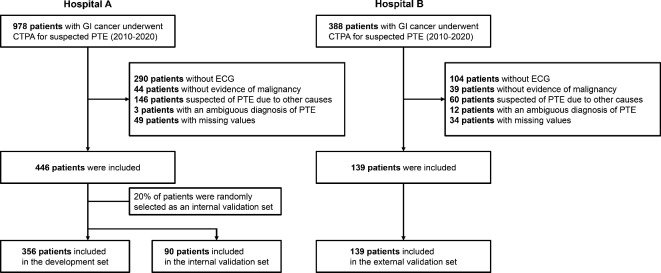
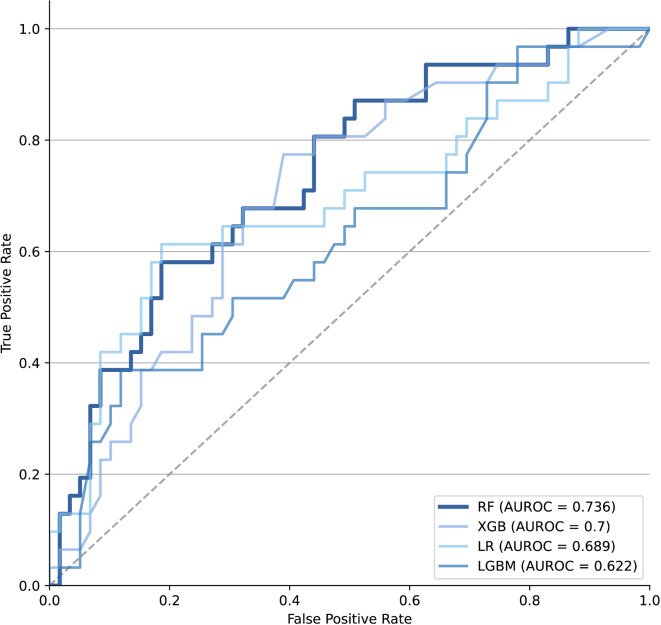
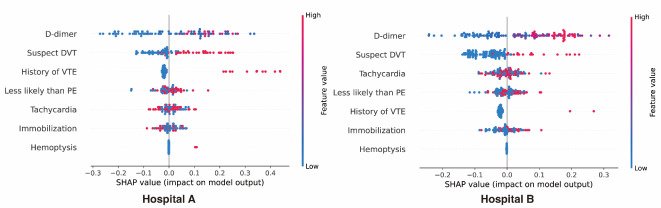
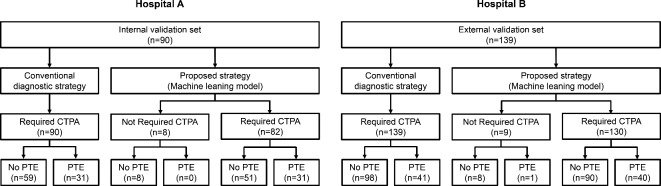
그림 출처: PubMed Central 공개 논문 (PMC11511972)
Conflict of interest statement
The authors declare no competing interests.
그 밖의 정보
- 출판 형태
- Journal Article, Multicenter Study
- 저널
- Scientific reports · eISSN 2045-2322
- 전자 출판
- 2024-10-25
- MeSH
- Humans · Pulmonary Embolism* / diagnostic imaging · Machine Learning* · Male · Female · Retrospective Studies · Middle Aged · Aged · Gastrointestinal Neoplasms* / diagnostic imaging · Tomography, X-Ray Computed / methods · Computed Tomography Angiography / methods · Unnecessary Procedures / statistics & numerical data · ROC Curve
- 연구비
- Seoul National University Hospital 0420212090
- 참고문헌
- 40편