
Sci Rep. 2024;14(1):13885.
Dual T-cell depletion with individually tailored anti-thymocyte globulin and attenuated dose of post-transplant cyclophosphamide in haploidentical peripheral stem cell transplantation.
제1저자 김동현 · 교신저자 변자민, 홍준식
소속 (10)
- Department of Internal Medicine, Seoul National University Hospital, 101, Daehak-Ro, Jongro-Gu, Seoul, 03080, Republic of Korea.
- Seoul National University Hospital, Biomedical Research Institute, Seoul, Korea.
- Cancer Research Institute, Seoul National University College of Medicine, Seoul, Korea.
- Cancer for Medical Innovation, Seoul National University Hospital, Seoul, Korea.
- Department of Internal Medicine, Seoul National University Hospital, 101, Daehak-Ro, Jongro-Gu, Seoul, 03080, Republic of Korea. jaminbyun@snu.ac.kr.
- Seoul National University Hospital, Biomedical Research Institute, Seoul, Korea. jaminbyun@snu.ac.kr.
- Department of Internal Medicine, Seoul National University Hospital, 101, Daehak-Ro, Jongro-Gu, Seoul, 03080, Republic of Korea. hongjblood@snu.ac.kr.
- Seoul National University Hospital, Biomedical Research Institute, Seoul, Korea. hongjblood@snu.ac.kr.
- Cancer Research Institute, Seoul National University College of Medicine, Seoul, Korea. hongjblood@snu.ac.kr.
- Cancer for Medical Innovation, Seoul National University Hospital, Seoul, Korea. hongjblood@snu.ac.kr.
Abstract
This study aimed to assess the efficacy of dual T-cell suppression using individually tailored doses of antithymocyte globulin (ATG) and attenuated dose of post-transplant cyclophosphamide (PTCy) in haploidentical hematopoietic stem cell transplantation (haplo-HSCT). We conducted a retrospective analysis of 78 adults with acute leukemia or myelodysplastic syndrome who underwent haplo-HSCT using intravenous busulfan and fludarabine conditioning. Thirty-two patients received attenuated ATG/PTCy, while 46 patients received ATG (7.5 mg/kg) as GVHD prophylaxis. The 100-day cumulative incidence of grade III-IV (9.7% vs. 32.4%, P = 0.018) acute GVHD, as well as 2-year moderate-severe chronic GVHD (13.9% vs. 43.9%, P = 0.018) in the ATG/PTCy group were significantly lower than those in the ATG group. The 2-year overall survival was comparable between the two groups. However, 2-year GVHD-free, relapse-free survival in the ATG/PTCy group was significantly higher compared to that in the ATG group (38.9% vs. 21.7%, P = 0.021). Moreover, during post-engraftment period, the ATG/PTCy group exhibited lower incidences of life-threatening bacterial (12.5% vs. 37%, P = 0.033) and viral infection (0% vs. 17.4%, P = 0.035) than the ATG group. In conclusion, the combination of individually tailored ATG and low-dose PTCy appears to be a promising strategy in haplo-HSCT.
© 2024. The Author(s).
Keywords
Anti-thymocyte globulinGraft-versus-host diseaseHaploidentical hematopoietic stem cell transplantationPost-transplant cyclophosphamide
Figures
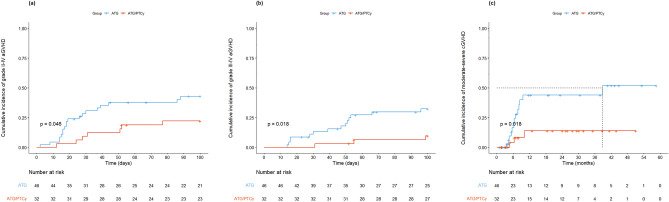
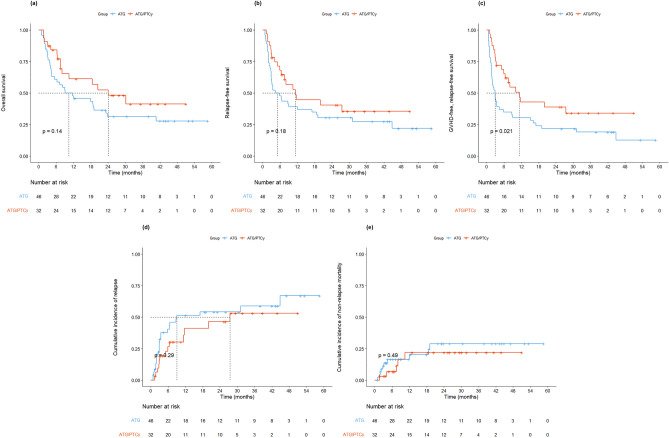
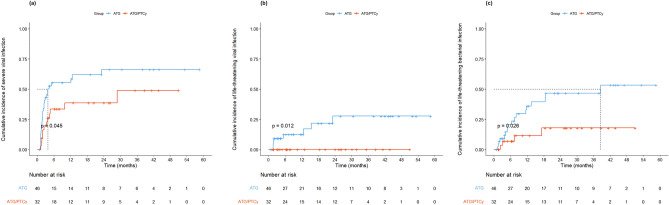
그림 출처: PubMed Central 공개 논문 (PMC11180652)
Conflict of interest statement
The authors declare no competing interests.
그 밖의 정보
- 출판 형태
- Journal Article
- 저널
- Scientific reports · eISSN 2045-2322
- 전자 출판
- 2024-06-16
- MeSH
- Humans · Antilymphocyte Serum* / administration & dosage / therapeutic use · Cyclophosphamide* / therapeutic use / administration & dosage · Male · Female · Adult · Middle Aged · Graft vs Host Disease* / prevention & control / etiology · Retrospective Studies · T-Lymphocytes* / immunology · Lymphocyte Depletion* / methods · Transplantation, Haploidentical* / methods · Transplantation Conditioning* / methods · Young Adult · Peripheral Blood Stem Cell Transplantation / methods · Adolescent · Myelodysplastic Syndromes / therapy · Hematopoietic Stem Cell Transplantation / adverse effects / methods · Immunosuppressive Agents / administration & dosage / therapeutic use
- Substances
- Antilymphocyte Serum · Cyclophosphamide · Immunosuppressive Agents
- 참고문헌
- 34편