
Cardiovasc Diabetol. 2015;14:141.
Comparison of 2-year mortality according to obesity in stabilized patients with type 2 diabetes mellitus after acute myocardial infarction: results from the DIAMOND prospective cohort registry.
제1저자 원기범 · 교신저자 김효수
소속 (27)
- Division of Cardiology, Keimyung University Dongsan Medical Center, Daegu, South Korea. kbwon99@naver.com.
- Division of Cardiology, Keimyung University Dongsan Medical Center, Daegu, South Korea. shur@dsmc.or.kr.
- Division of Cardiology, Keimyung University Dongsan Medical Center, Daegu, South Korea. ds010042@gmail.com.
- Division of Cardiology, Keimyung University Dongsan Medical Center, Daegu, South Korea. hippsons@gmail.com.
- Division of Cardiology, Keimyung University Dongsan Medical Center, Daegu, South Korea. namcwcv@gmail.com.
- Division of Cardiology, Keimyung University Dongsan Medical Center, Daegu, South Korea. k5112@dsmc.or.kr.
- Division of Cardiology, Konyang University Hospital, Daejeon, South Korea. janghobae@yahoo.co.kr.
- Division of Cardiology, Seoul National University Bundang Hospital, Seongnam, South Korea. djchoi@snu.ac.kr.
- Division of Cardiology, Chonnam National University Hospital, Gwangju, South Korea. cecilyk@hanmail.net.
- Division of Cardiology, Yeungnam University Hospital, Daegu, South Korea. pjs@med.yu.ac.kr.
- Division of Cardiology, Seoul National University Hospital, 28 Yeongeon-dong, Chongno-gu, Seoul, 110-744, South Korea. hyosoo@snu.ac.kr.
- Division of Cardiology, Sejong General Hospital, Bucheon, South Korea. yoorimbin@hanmail.net.
- Division of Cardiology, Yonsei University Severance Hospital, Seoul, South Korea. cdhlyj@yuhs.ac.
- Division of Cardiology, Pusan National University Yangsan Hospital, Yangsan, South Korea. junehongk@gmail.com.
- Division of Cardiology, Hallym University Kangdong Sacred Heart Hospital, Seoul, South Korea. krheart@hallym.or.kr.
- Division of Cardiology, Kyungpook National University Hospital, Daegu, South Korea. hspark@knu.ac.kr.
- Division of Cardiology, Ajou University Hospital, Suwon, South Korea. sychoimd@hotmail.com.
- Division of Cardiology, Wonju Severance Christian Hospital, Wonju, South Korea. junghany@me.com.
- Division of Cardiology, Samsung Medical Center, Seoul, South Korea. hcgwon62@gmail.com.
- Division of Cardiology, Korea University Guro Hospital, Seoul, South Korea. swrha617@yahoo.co.kr.
- Division of Cardiology, Chungbuk National University Hospital, Cheongju, South Korea. khyungkyk@cbnu.ac.kr.
- Division of Cardiology, Korea University Anam Hospital, Seoul, South Korea. dslmd@kumc.or.kr.
- Division of Cardiology, Eulji University Hospital, Daejeon, South Korea. jkt@eulji.ac.kr.
- Division of Cardiology, Wonkwang University Hospital, Iksan, South Korea. oskcar@wonkwang.ac.kr.
- Division of Cardiology, Chungnam National University Hospital, Daejeon, South Korea. myheart@cnu.ac.kr.
- Division of Cardiology, Ulsan University Hospital, Ulsan, South Korea. sesim98@yahoo.co.kr.
- Division of Cardiology, Daegu Catholic University Medical Center, Daegu, South Korea. kks7379@cu.ac.kr.
Abstract
BACKGROUND After acute myocardial infarction (AMI), the replicated phenomenon of obesity paradox, i.e., obesity appearing to be associated with increased survival, has not been evaluated in stabilized (i.e., without clinical events within 1 month post AMI) Asian patients with diabetes mellitus (DM).
METHODS Among 1192 patients in the DIabetic Acute Myocardial InfarctiON Disease (DIAMOND) Korean multicenter registry between April 2010 and June 2012, 2-year cardiac and all-cause death were compared according to obesity (body mass index ≥25 kg/m(2)) in 1125 stabilized DM patients.
RESULTS Compared with non-obese DM patients (62% of AMI patients), obese DM patients had: higher incidence of dyslipidemia (31 vs. 24%, P < 0.01); lower incidence of chronic kidney disease (26 vs. 33%) (P < 0.01); higher left ventricular ejection fraction after AMI (53 ± 11 vs. 50 ± 12%, P < 0.001); and lower 2-year cardiac and all-cause death occurrence (0.7 vs. 3.6% and 1.9 vs. 5.2%, both P < 0.01) and cumulative incidence in Kaplan-Meier analysis (P < 0.005, respectively). Likewise, both univariate and multivariate Cox hazard regression analyses adjusted for the respective confounders showed that obesity was associated with decreased risk of both cardiac [HR, 0.18 (95% CI 0.06-0.60), P = 0.005; and 0.24 (0.07-0.78), P = 0.018, respectively] and all-cause death [0.34 (0.16-0.73), P = 0.005; and 0.44 (0.20-0.95), P = 0.038].
CONCLUSIONS In a Korean population of stabilized DM patients after AMI, non-obese patients appear to have higher cardiac and all-cause mortality compared with obese patients after adjusting for confounding factors.
Figures
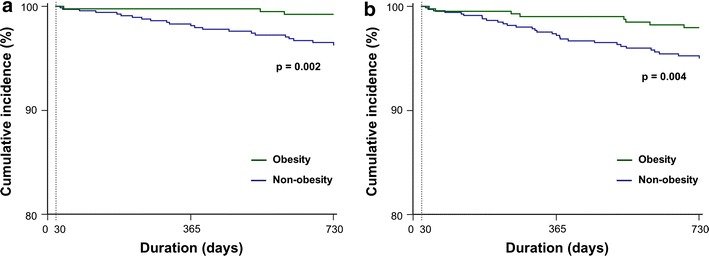
그림 출처: PubMed Central 공개 논문 (PMC4608118)
Comment · 정정
그 밖의 정보
- 출판 형태
- Comparative Study, Journal Article, Observational Study, Research Support, Non-U.S. Gov't
- 저널
- Cardiovascular diabetology · eISSN 1475-2840
- 전자 출판
- 2015-10-15
- MeSH
- Aged · Cohort Studies · Diabetes Mellitus, Type 2 / epidemiology · Dyslipidemias / epidemiology · Female · Humans · Incidence · Kaplan-Meier Estimate · Male · Middle Aged · Mortality* · Multivariate Analysis · Myocardial Infarction / epidemiology · Obesity / epidemiology · Proportional Hazards Models · Prospective Studies · Registries* · Republic of Korea / epidemiology · Stroke Volume · Survival Rate · Ventricular Dysfunction, Left / epidemiology
- 참고문헌
- 42편