
PLoS One. 2019;14(1):e0209593.
Temporal trends in prevalence and antithrombotic treatment among Asians with atrial fibrillation undergoing percutaneous coronary intervention: A nationwide Korean population-based study.
제1저자 박지석 · 교신저자 최의근
소속 (6)
- Department of Internal Medicine, Seoul National University Hospital, Seoul, Republic of Korea.
- Department of Biostatistics, College of Medicine, The Catholic University of Korea, Seoul, Republic of Korea.
- Department of Internal Medicine, Soon Chun Hyang University Hospital, Seoul, Republic of Korea.
- Department of Internal Medicine, Seoul National University Boramae Medical Center, Seoul, Republic of Korea.
- Institute of Cardiovascular Sciences, University of Birmingham, Birmingham, United Kingdom.
- Thrombosis Research Unit, Department of Clinical Medicine, Aalborg University, Aalborg, Denmark.
Abstract
BACKGROUND We investigated the recent 10-year trends in the number of patients with atrial fibrillation (AF) undergoing percutaneous coronary intervention (PCI) in relation to prescription patterns of antithrombotic therapy.
METHODS We analyzed the annual prevalence of PCI and patterns of antithrombotic therapy after PCI, including antiplatelets and oral anticoagulants (vitamin K antagonists and non-vitamin K antagonist oral anticoagulants [NOACs]), in patients with AF between 2006 and 2015 by using the Korean National Health Insurance Service database. Independent factors associated with triple therapy (oral anticoagulant plus dual antiplatelet) prescription were assessed using multivariable logistic regression analysis.
RESULTS The number of patients with AF undergoing PCI increased gradually from 2006 (n = 2,140) to 2015 (n = 3,631) (ptrend<0.001). In 2006, only 22.7% of patients received triple therapy after PCI although 96.2% of them were indicated for anticoagulation (CHA2DS2-VASc score ≥2). The prescription rate of triple therapy increased to 38.3% in 2015 (ptrend<0.001), which was mainly attributed to a recent increment of NOAC-based triple therapy from 2013 (17.5% in 2015). Previous ischemic stroke or systemic embolism, old age, hypertension, and congestive heart failure were significantly associated with a higher triple therapy prescription rate, whereas previous myocardial infarction, PCI, and peripheral arterial disease were associated with triple therapy underuse.
CONCLUSIONS From 2006 to 2015, the number of patients with AF undergoing PCI and the prescription rate of triple therapy increased gradually with a recent increment of NOAC-based antithrombotic therapy from 2013. Previous myocardial infarction, peripheral artery disease, and PCI were associated with underuse of triple therapy.
Figures
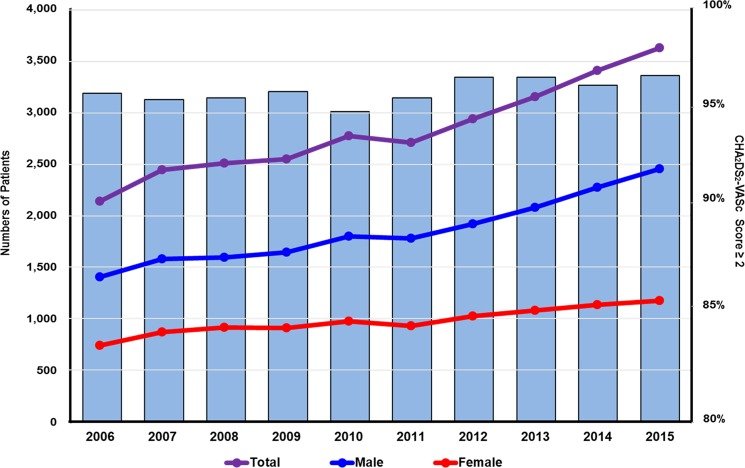
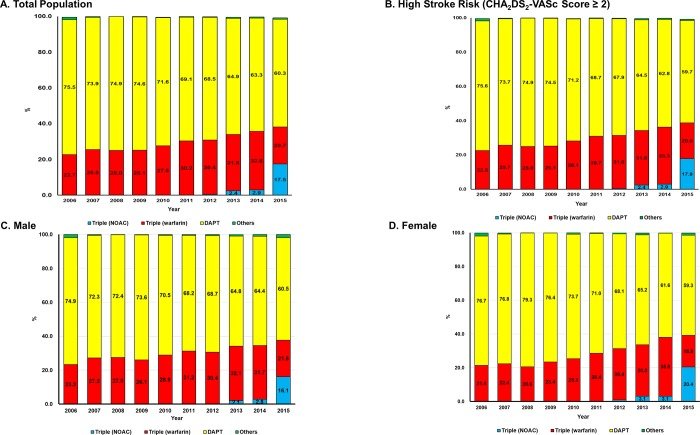
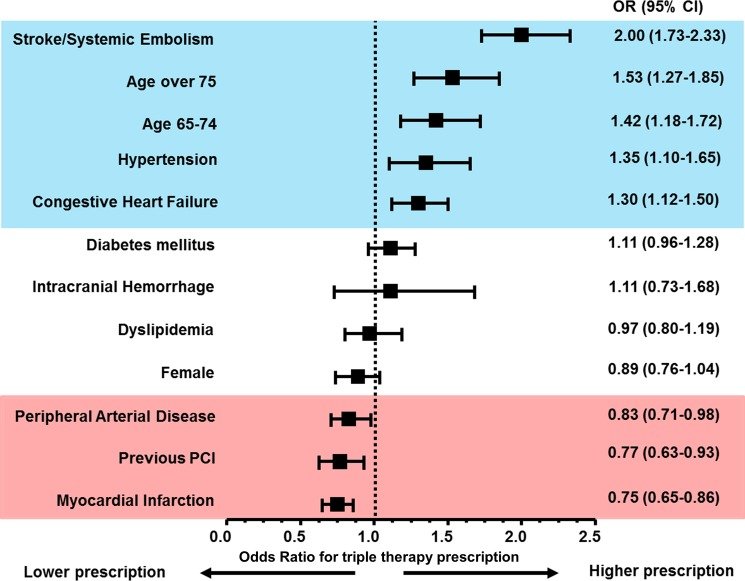
그림 출처: PubMed Central 공개 논문 (PMC6333333)
Conflict of interest statement
The authors have read the journal's policy and the authors of this manuscript have the following competing interests: GYHL is a consultant for Bayer/Janssen, BMS/Pfizer, Medtronic, Boehringer Ingelheim, Novartis, Verseon and Daiichi-Sankyo. GYHL is also a speaker for Bayer, BMS/Pfizer, Medtronic, Boehringer Ingelheim, and Daiichi-Sankyo. EKC was the recipient of grants from Biosense Webster, Daiichi-Sankyo, and BMS/Pfizer. This does not alter our adherence to PLOS ONE policies on sharing data and materials. There are no patents, products in development, or marketed products to declare.
그 밖의 정보
- 출판 형태
- Journal Article, Research Support, Non-U.S. Gov't
- 저널
- PloS one · eISSN 1932-6203
- 전자 출판
- 2019-01-15
- MeSH
- Aged · Aged, 80 and over · Anticoagulants / therapeutic use · Atrial Fibrillation / complications / drug therapy · Blood Coagulation · Community Health Planning / methods · Drug Therapy, Combination · Female · Fibrinolytic Agents / pharmacology · Humans · Male · Myocardial Infarction / complications · Percutaneous Coronary Intervention / adverse effects / methods · Platelet Aggregation Inhibitors / pharmacology / therapeutic use · Prevalence · Republic of Korea / epidemiology · Stroke / complications · Treatment Outcome
- Substances
- Anticoagulants · Fibrinolytic Agents · Platelet Aggregation Inhibitors
- 참고문헌
- 33편