
Oncotarget. 2017;8(63):106499-106510.
Development of a nomogram for screening of hepatitis B virus-associated hepatocellular carcinoma.
제1저자 정정화 · 교신저자 김진욱
소속 (3)
- Department of Medicine, Seoul National University Bundang Hospital, Seongnam, Republic of Korea.
- Department of Internal Medicine, Seoul National University College of Medicine, Seoul, Republic of Korea.
- Department of Radiology, Seoul National University College of Medicine, Seoul, Republic of Korea.
Abstract
Current strategy of hepatocellular carcinoma (HCC) surveillance evaluates individual risks of HCC for defining candidates for surveillance, but estimated risks are not utilized for clinical decision-making during actual screening. We sought to determine whether consideration of individual risks improve the performance of ultrasound (US)-based HCC screening in a real-world chronic hepatitis B (CHB) cohort. This single center retrospective cohort study analyzed 27,722 screening US tests from 4,175 consecutive CHB patients. Logistic regression analysis was performed to identify independent parameters predicting presence of HCC. A nomogram was built based on the independent predictors of HCC and compared with US-only screening by receiver operating characteristics analysis. The cost-effectiveness of the nomogram was assessed by decision curve analysis. HCC developed in 222 patients with the incidence of 0.769 per 1000 person-year during the median follow-up of 63 months. Age, sex, presence of cirrhosis, serum alpha-fetoprotein (AFP) levels and positive US test results were independent predictors of HCC presence. A nomogram based on these predictors showed higher C-statistics compared to US-only screening (0.960 vs. 0.731 and 0.935 vs. 0.691 for derivation and validation cohort, respectively; p < 0.001). Decision curve analysis showed higher net benefit of the HCC nomogram-guided screening model compared to US-only screening in the risk threshold range between 0 and 0.3. A nomogram composed of age, sex, presence of cirrhosis, serum AFP levels and US findings better predicted the presence of HCC compared to US-only screening in CHB on surveillance.
Keywords
chronic hepatitis Bearly diagnosis of cancerhepatocellular carcinomanomogramsultrasonography
Figures

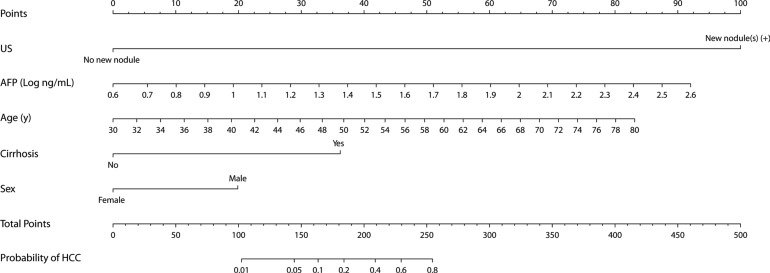
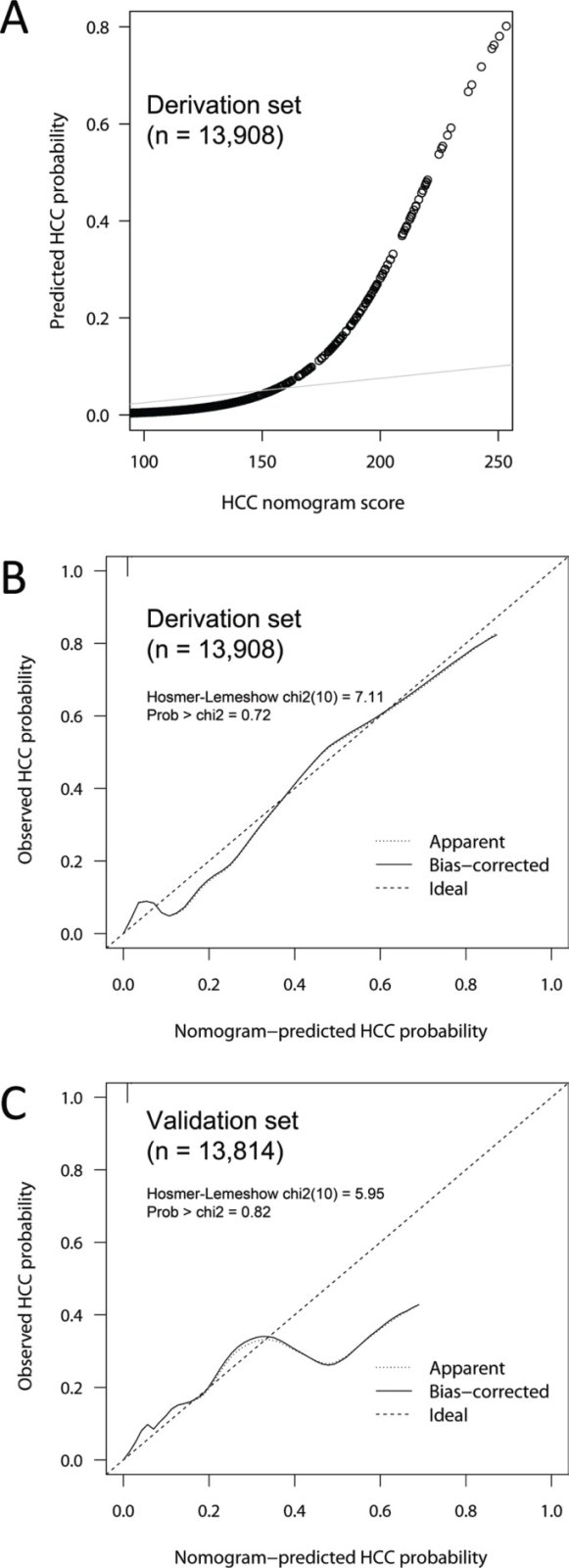
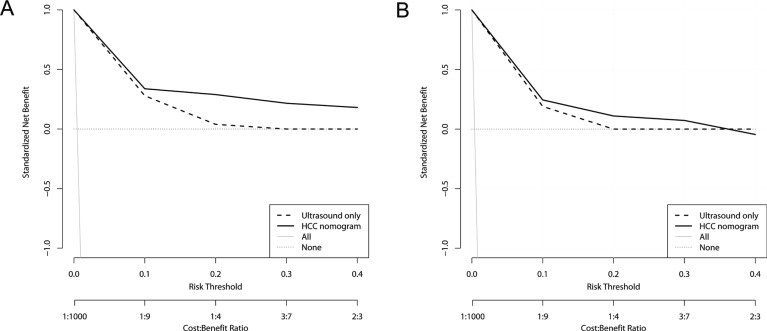
그림 출처: PubMed Central 공개 논문 (PMC5739751)
Conflict of interest statement
CONFLICTS OF INTEREST The authors have nothing to declare.
그 밖의 정보
- 출판 형태
- Journal Article
- 저널
- Oncotarget · eISSN 1949-2553
- 전자 출판
- 2017-11-18
- 참고문헌
- 47편