
Br J Cancer. 2024;130(6):970-975.
Urinary microbiome-based metagenomic signature for the noninvasive diagnosis of hepatocellular carcinoma.
제1저자 조은주, 김보람 · 교신저자 윤정환, 박태성
소속 (5)
- Department of Internal Medicine and Liver Research Institute, Seoul National University College of Medicine, Seoul, 03080, Korea.
- Interdisciplinary Program in Bioinformatics, Seoul National University, Seoul, 08826, Korea.
- Department of Surgery, Seoul National University College of Medicine, Seoul, 03080, Korea.
- Department of Internal Medicine and Liver Research Institute, Seoul National University College of Medicine, Seoul, 03080, Korea. yoonjh@snu.ac.kr.
- Department of Statistics, Seoul National University, Seoul, 08826, Korea. tspark@stats.snu.ac.kr.
Abstract
BACKGROUND Gut microbial dysbiosis is implicated in chronic liver disease and hepatocellular carcinoma (HCC), but the role of microbiomes from various body sites remains unexplored. We assessed disease-specific alterations in the urinary microbiome in HCC patients, investigating their potential as diagnostic biomarkers.
METHODS We performed cross-sectional analyses of urine samples from 471 HCC patients and 397 healthy controls and validated the results in an independent cohort of 164 HCC patients and 164 healthy controls. Urinary microbiomes were analyzed by 16S rRNA gene sequencing. A microbial marker-based model distinguishing HCC from controls was built based on logistic regression, and its performance was tested.
RESULTS Microbial diversity was significantly reduced in the HCC patients compared with the controls. There were significant differences in the abundances of various bacteria correlated with HCC, thus defining a urinary microbiome-derived signature of HCC. We developed nine HCC-associated genera-based models with robust diagnostic accuracy (area under the curve [AUC], 0.89; balanced accuracy, 81.2%). In the validation, this model detected HCC with an AUC of 0.94 and an accuracy of 88.4%.
CONCLUSIONS The urinary microbiome might be a potential biomarker for the detection of HCC. Further clinical testing and validation of these results are needed in prospective studies.
© 2024. The Author(s).
Figures
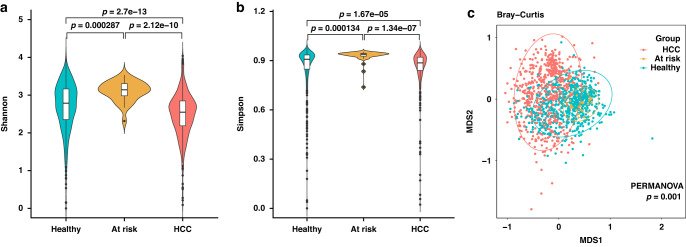
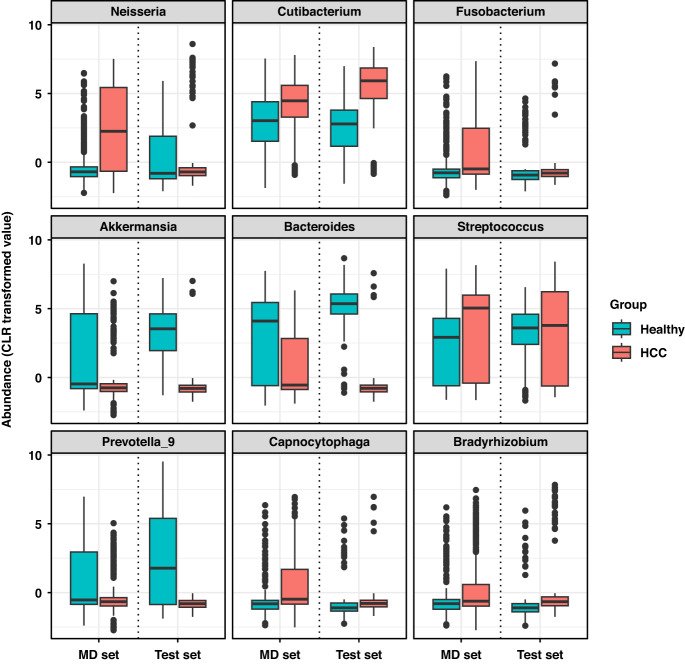
그림 출처: PubMed Central 공개 논문 (PMC10951239)
Conflict of interest statement
The authors declare no competing interests.
그 밖의 정보
- 출판 형태
- Journal Article, Research Support, Non-U.S. Gov't
- 저널
- British journal of cancer · eISSN 1532-1827
- 전자 출판
- 2024-01-26
- MeSH
- Humans · Carcinoma, Hepatocellular* / pathology · Liver Neoplasms* / diagnosis / genetics / pathology · Prospective Studies · Cross-Sectional Studies · RNA, Ribosomal, 16S / genetics · Microbiota* / genetics
- Substances
- RNA, Ribosomal, 16S
- 연구비
- National Research Foundation of Korea (NRF) NRF-2020R1C1C1012749 · Seoul National University Hospital (SNUH) 05-2021-0010 · Ministry of Health and Welfare (Ministry of Health, Welfare and Family Affairs) HI16C2037
- 참고문헌
- 44편