
Gut Liver. 2014;8(6):605-11.
The efficacy of moxifloxacin-containing triple therapy after standard triple, sequential, or concomitant therapy failure for Helicobacter pylori eradication in Korea.
제1저자 정광현 · 교신저자 이동호
소속 (2)
- Department of Internal Medicine and Liver Research Institute, Seoul National University College of Medicine, Seoul, Korea.
- Department of Internal Medicine, Seoul National University Bundang Hospital, Seongnam, Korea.
Abstract
BACKGROUND/AIMS Retreatment after initial treatment failure for Helicobacter pylori is very challenging. The purpose of this study was to evaluate the efficacies of moxifloxacin-containing triple and bismuth-containing quadruple therapy.
METHODS A total of 151 patients, who failed initial H. pylori treatment, were included in this retrospective cohort study. The initial regimens were standard triple, sequential, or concomitant therapy, and the efficacies of the two following second-line treatments were evaluated: 7-day moxifloxacin-containing triple therapy (rabeprazole 20 mg twice a day, amoxicillin 1,000 mg twice a day, and moxifloxacin 400 mg once daily) and 7-day bismuth-containing quadruple therapy (rabeprazole 20 mg twice a day, tetracycline 500 mg 4 times a day, metronidazole 500 mg 3 times a day, and tripotassium dicitrate bismuthate 300 mg 4 times a day).
RESULTS The overall eradication rates after moxifloxacin-containing triple therapy and bismuth-containing quadruple therapy were 69/110 (62.7%) and 32/41 (78%), respectively. Comparison of the two regimens was performed in the patients who failed standard triple therapy, and the results revealed eradication rates of 14/28 (50%) and 32/41 (78%), respectively (p=0.015). The frequency of noncompliance was not different between the two groups, and there were fewer adverse effects in the moxifloxacin-containing triple therapy group (2.8% vs 7.3%, p=0.204 and 25.7% vs 43.9%, p=0.031, respectively).
CONCLUSIONS Moxifloxacin-containing triple therapy, a recommended second-line treatment for initial concomitant or sequential therapy failure, had insufficient efficacy.
Keywords
Anti-bacterial agentsHelicobacter pyloriMoxifloxacinSalvage therapy
Figures
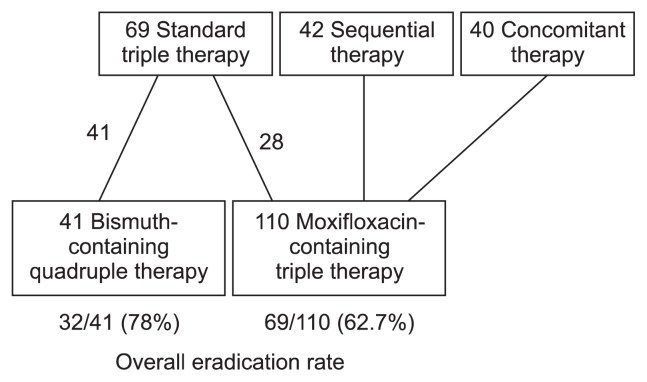
그림 출처: PubMed Central 공개 논문 (PMC4215445)
Comment · 정정
그 밖의 정보
- 출판 형태
- Comparative Study, Journal Article
- 저널
- Gut and liver · eISSN 2005-1212
- 전자 출판
- 2014-11-15
- MeSH
- Aged · Amoxicillin / therapeutic use · Anti-Bacterial Agents / therapeutic use · Anti-Ulcer Agents / therapeutic use · Breath Tests · Cohort Studies · Drug Therapy, Combination · Female · Fluoroquinolones / therapeutic use · Gastroesophageal Reflux / complications · Helicobacter Infections / complications / drug therapy / pathology · Helicobacter pylori · Humans · Male · Metronidazole / therapeutic use · Middle Aged · Moxifloxacin · Organometallic Compounds / therapeutic use · Peptic Ulcer / complications · Rabeprazole / therapeutic use · Republic of Korea · Retrospective Studies · Salvage Therapy · Stomach / pathology · Tetracycline / therapeutic use · Treatment Failure · Treatment Outcome · Urea / analysis
- Substances
- Anti-Bacterial Agents · Anti-Ulcer Agents · Fluoroquinolones · Organometallic Compounds · Metronidazole · Rabeprazole · Amoxicillin · Urea · Tetracycline · bismuth tripotassium dicitrate · Moxifloxacin
- 참고문헌
- 30편