
Gut Liver. 2019;13(3):373-379.
Natural Course and Risk of Cholangiocarcinoma in Patients with Recurrent Pyogenic Cholangitis: A Retrospective Cohort Study.
제1저자 유민수 · 교신저자 이상협
소속 (2)
- Department of Internal Medicine and Liver Research Institute, Seoul National University College of Medicine, Seoul.
- Department of Internal Medicine, Dongguk University Ilsan Hospital, Goyang, Korea.
Abstract
BACKGROUND/AIMS Recurrent pyogenic cholangitis (RPC) is a chronic progressive disease frequently accompanied by cholangiocarcinoma (CCA). This study aimed to investigate the natural course of RPC and identify factors associated with CCA.
METHODS From January 2005 to December 2016, 310 patients diagnosed with RPC at Seoul National University Hospital were included. Complications and management during follow-up were recorded. CCA-free probability was estimated by Kaplan-Meier method, and risk factors associated with CCA were analyzed using log-rank test and Coxs proportional hazard regression model.
RESULTS Mean age at diagnosis was 59.1±10.9 years and mean follow-up duration was 84.0±64.1 months. An intrahepatic duct stone was found in 253 patients (81.6%). Liver atrophy was identified in 185 patients (59.7%) and most commonly located at the left lobe (65.4%). Acute cholangitis, liver abscesses, cirrhotic complications, and CCA developed in 41.3%, 19.4%, 9.7%, and 7.4%, respectively. During follow-up, complete resolution rate after hepatectomy, biliary bypass surgery, and choledocholithotomy with T-tube insertion reached 82.3%, 55.2%, and 42.1%, respectively. None of the patients who maintained complete resolution by the last follow-up day developed CCA. In univariate analysis, female, both-sided intrahepatic duct stones, and liver atrophy at any location were associated with increased risk of CCA. Multivariate analysis revealed that both-sided atrophy significantly increased risk of CCA (hazard ratio, 4.56; 95% confidence interval, 1.48 to 14.09; p=0.008). In 21 patients who developed intrahepatic CCA, tumor was located mostly in the atrophied lobe (p=0.023).
CONCLUSIONS In RPC patients, acute cholangitis, liver abscess, cirrhotic complications, and CCA frequently developed. Both-sided liver atrophy was a significant risk factor for developing CCA.
Keywords
AtrophyCholangiocarcinomaCholangitisCirrhosisPrognosis
Figures
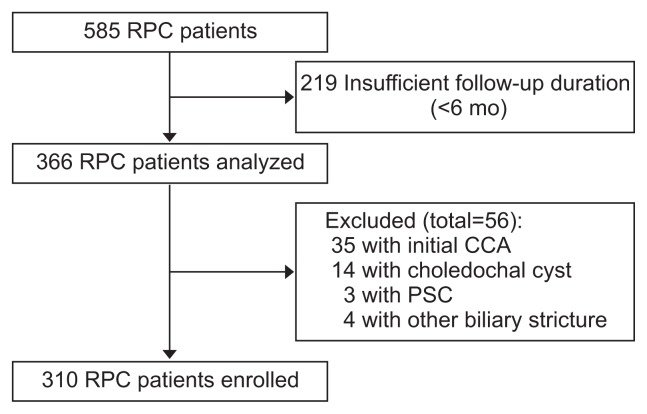
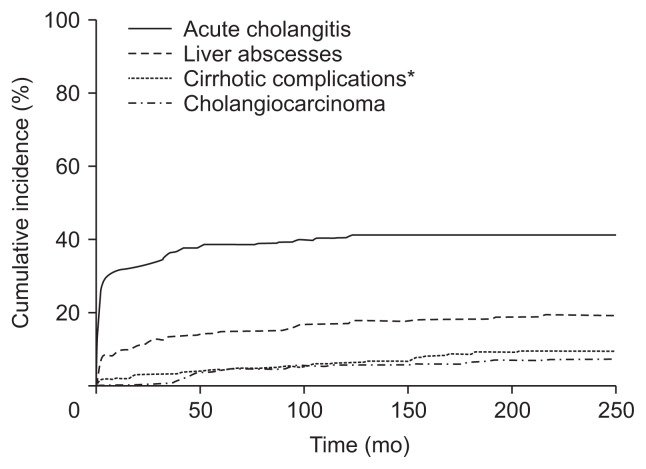
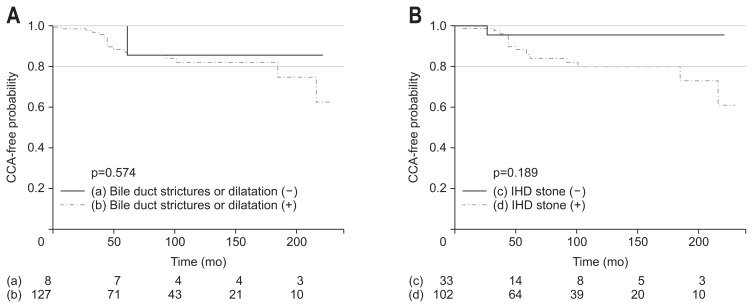
그림 출처: PubMed Central 공개 논문 (PMC6529165)
Conflict of interest statement
CONFLICTS OF INTEREST. No potential conflict of interest relevant to this article was reported.
그 밖의 정보
- 출판 형태
- Evaluation Study, Journal Article
- 저널
- Gut and liver · eISSN 2005-1212
- MeSH
- Aged · Bile Duct Neoplasms / etiology · Cholangiocarcinoma / etiology · Cholangitis / complications / pathology · Female · Humans · Kaplan-Meier Estimate · Liver / pathology · Liver Diseases / etiology · Male · Middle Aged · Proportional Hazards Models · Recurrence · Retrospective Studies · Risk Factors
- 참고문헌
- 25편