
Biol Sex Differ. 2022;13(1):2.
Sex differences in coronary angiographic findings in patients with stable chest pain: analysis of data from the KoRean wOmen'S chest pain rEgistry (KoROSE).
제1저자 김학령 · 교신저자 김명아
소속 (9)
- Division of Cardiology, Department of Internal Medicine, Seoul National University College of Medicine, Boramae Medical Center, Seoul, 07061, Korea.
- Division of Cardiology, Department of Internal Medicine, Hanyang University Guri Hospital, Guri, Korea.
- Division of Cardiology, Department of Internal Medicine, Korea University Anam Hospital, Seoul, Korea.
- Division of Cardiology, Department of Internal Medicine, Nowon Eulji Medical Center, Eulji University, Seoul, Korea.
- Division of Cardiology, Department of Internal Medicine, Chonnam National University Hospital, Gwangju, Korea.
- Division of Cardiology, Department of Internal Medicine, Inje University Sanggye Paik Hospital, Seoul, Korea.
- Division of Cardiology, Department of Internal Medicine, Gachon Medical School Gil Medical Center, Incheon, Korea.
- Division of Cardiology, Department of Internal Medicine, Hallym University Medical Center, Chuncheon, Korea.
- Division of Cardiology, Department of Internal Medicine, Seoul National University College of Medicine, Boramae Medical Center, Seoul, 07061, Korea. kma@snu.ac.kr.
Abstract
BACKGROUND Focused evaluations on potential sex differences in the angiographic findings of the coronary arteries are scarce. This study was performed to compare the angiographic extent and localization of coronary stenosis between men and women.
METHODS A total of 2348 patients (mean age 62.5 years and 60% women) with stable chest pain undergoing invasive coronary angiography (CAG) were recruited from the database of the nation-wide chest pain registry. Obstructive coronary artery disease (CAD) was defined as ≥ 50% stenosis of the left main coronary artery and/or ≥ 70% stenosis of any other epicardial coronary arteries.
RESULTS Although women were older than men (64.4 ± 10.3 vs. 59.5 ± 11.4 years, P < 0.001), men had worse risk profiles including high blood pressure, more frequent smoking and elevated triglyceride and C-reactive protein. The prevalence of obstructive CAD was significantly higher in men than in women (37.0% vs. 28.4%, P < 0.001). Men had a higher prevalence of LM disease (10.3% vs. 3.5%, P < 0.001) and three-vessel disease (16.1% vs. 9.5%, P = 0.007) compared to women. In multiple binary logistic regression analysis, the risk of men having LM disease or three-vessel disease was 7.4 (95% confidence interval 3.48-15.97; P < 0.001) and 2.7 (95% confidence interval 1.57-4.64; P < 0.001) times that of women, respectively, even after controlling for potential confounders.
CONCLUSIONS In patients with chest pain undergoing invasive CAG, men had higher obstructive CAD prevalence and more high-risk angiographic findings such as LM disease or three-vessel disease.
© 2021. The Author(s).
Keywords
Coronary angiographyCoronary artery diseaseLeft main diseaseSex differencesThree-vessel disease
Figures
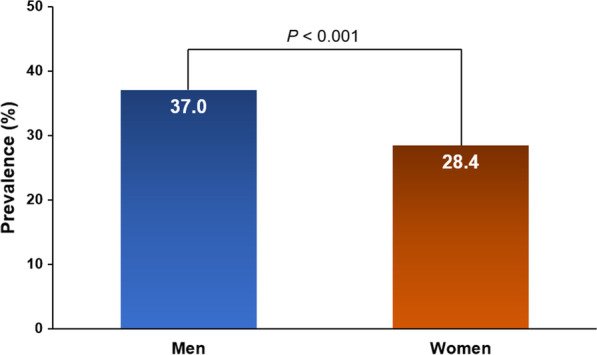
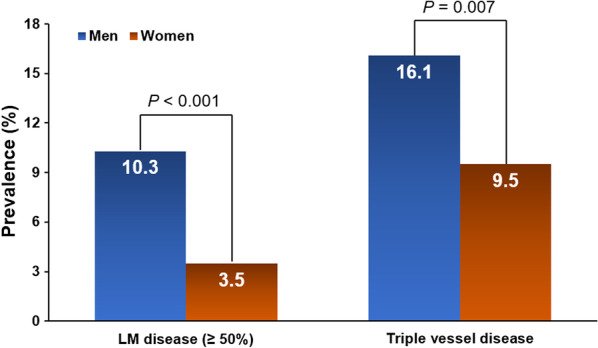
그림 출처: PubMed Central 공개 논문 (PMC8722299)
Conflict of interest statement
The authors declare that there is no competing interests.
그 밖의 정보
- 출판 형태
- Journal Article
- 저널
- Biology of sex differences · eISSN 2042-6410
- 전자 출판
- 2022-01-03
- MeSH
- Chest Pain / diagnostic imaging / epidemiology · Constriction, Pathologic · Coronary Angiography · Coronary Artery Disease* / diagnostic imaging / epidemiology · Female · Humans · Male · Middle Aged · Registries · Republic of Korea / epidemiology · Risk Factors · Sex Characteristics*
- 참고문헌
- 31편