
Sci Rep. 2023;13(1):125.
Prognostic value of reactive hyperemia index using peripheral artery tonometry in patients with heart failure.
제1저자 김학령 · 교신저자 김학령
소속 (2)
- Division of Cardiology, Department of Internal Medicine, Boramae Medical Center, Seoul National University College of Medicine, 20 Boramae-Ro 5-Gil, Dongjak-Gu, Seoul, 07061, Republic of Korea. khl2876@gmail.com.
- Division of Cardiology, Department of Internal Medicine, Boramae Medical Center, Seoul National University College of Medicine, 20 Boramae-Ro 5-Gil, Dongjak-Gu, Seoul, 07061, Republic of Korea.
Abstract
Given the high prevalence and poor prognosis of heart failure (HF), finding prognostic factors for patients with HF is crucial. This study investigated the prognostic value of reactive hyperemia index (RHI), a measure of endothelial function, in HF. A total of 90 HF patients (mean age, 63.7 ± 13.2 years; female, 25.6%) with a history of hospitalization for HF treatment were prospectively enrolled. RHI was measured using digital arterial tonometry in a stable condition. Clinical events, including all-cause death and HF admission, were assessed. During the median follow-up of 3.66 years (interquartile range, 0.91-4.94 years), 26 clinical events (28.9%) occurred. Although there were no significant differences in risk factors and laboratory findings according to the occurrence of clinical events, the RHI value was significantly lower in patients with clinical events than in those without (1.21 ± 0.34 vs. 1.68 ± 0.48; P < 0.001). Kaplan-Meier survival analysis showed that a lower RHI value (< 1.48) was associated with a significantly higher incidence rate of clinical events (log-rank P < 0.001). In multivariable cox regression analysis, a low RHI value (< 1.48) was associated with an increased risk of clinical events (hazard ratio, 14.09; 95% confidence interval, 3.61-54.99; P < 0.001) even after controlling for potential confounders. Our study showed that reduced RHI was associated with an increased risk of adverse clinical outcomes in HF. This suggests that endothelial dysfunction may be an important prognostic marker in patients with HF.
© 2023. The Author(s).
Figures
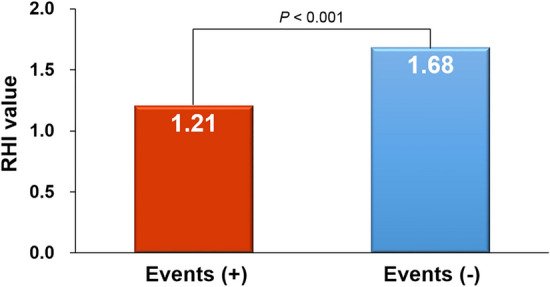
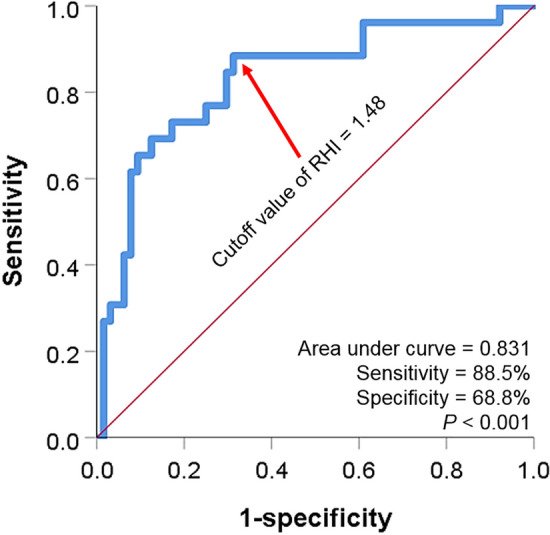
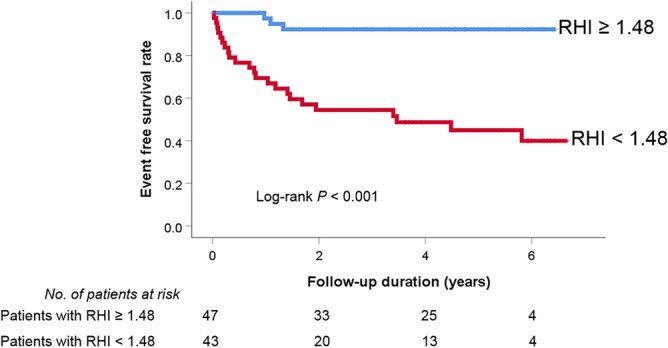
그림 출처: PubMed Central 공개 논문 (PMC9812967)
Conflict of interest statement
The authors declare no competing interests.
그 밖의 정보
- 출판 형태
- Journal Article, Research Support, Non-U.S. Gov't
- 저널
- Scientific reports · eISSN 2045-2322
- 전자 출판
- 2023-01-04
- MeSH
- Humans · Female · Middle Aged · Aged · Prognosis · Hyperemia* · Endothelium, Vascular · Heart Failure* / diagnosis · Risk Factors · Arteries · Manometry
- 참고문헌
- 34편