
Sci Rep. 2023;13(1):3570.
Comparison of outcomes of chronic kidney disease based on etiology: a prospective cohort study from KNOW-CKD.
제1저자 류현진 · 교신저자 오국환
소속 (14)
- Department of Internal Medicine, Seoul National University Hospital, Seoul, Republic of Korea.
- Rehabilitation Medical Research Center, Korea Workers' Compensation and Welfare Service Incheon Hospital, Incheon, Republic of Korea.
- Department of Internal Medicine, Ewha Womans University Medical Center, Seoul, Republic of Korea.
- Medical Research Collaborating Center, Seoul National University Hospital, Seoul, Republic of Korea.
- Department of Internal Medicine, Hallym University Kangnam Sacred Heart Hospital, Seoul, Korea.
- Department of Internal Medicine, Seoul National University Boramae Medical Center, Seoul, Korea.
- Department of Internal Medicine, Seoul National University College of Medicine, Seoul, 03080, Republic of Korea.
- Department of Internal Medicine, Seoul National University Bundang Hospital, Seongnam, Republic of Korea.
- Department of Preventive Medicine, Seoul National University College of Medicine, Seoul, Korea.
- Division of Nephrology, Department of Internal Medicine, Gachon University of Gil Medical Center, Gachon University School of Medicine, Incheon, Korea.
- Department of Internal Medicine, Kangbuk Samsung Hospital, College of Medicine, Sungkyunkwan University, Seoul, Korea.
- Department of Internal Medicine, Eulji Medical Center, Eulji University, Seoul, Korea.
- Department of Internal Medicine, Seoul National University Hospital, Seoul, Republic of Korea. ohchris@hanmail.net.
- Department of Internal Medicine, Seoul National University College of Medicine, Seoul, 03080, Republic of Korea. ohchris@hanmail.net.
Abstract
The causes of chronic kidney disease (CKD) affects its outcomes. However, the relative risks for adverse outcomes according to specific causes of CKD is not well established. In a prospective cohort study from KNOW-CKD, a cohort was analyzed using overlap propensity score weighting methods. Patients were grouped into four categories according to the cause of CKD: glomerulonephritis (GN), diabetic nephropathy (DN), hypertensive nephropathy (HTN), or polycystic kidney disease (PKD). From a total of 2070 patients, the hazard ratio of kidney failure, the composite of cardiovascular disease (CVD) and mortality, and the slope of the estimated glomerular filtration rate (eGFR) decline according to the cause of CKD were compared between causative groups in a pairwise manner. There were 565 cases of kidney failure and 259 cases of composite CVD and death over 6.0 years of follow-up. Patients with PKD had a significantly increased risk for kidney failure compared to those with GN [Hazard ratio (HR) 1.82], HTN (HR 2.23), and DN (HR 1.73). For the composite outcome of CVD and death, the DN group had increased risks compared to the GN (HR 2.07), and HTN (HR 1.73) groups but not to the PKD group. The adjusted annual eGFR change for the DN and PKD groups were - 3.07 and - 3.37 mL/min/1.73 m2 per year, respectively, and all of these values were significantly different than those of the GN and HTN groups (- 2.16 and - 1.42 mL/min/1.73 m2 per year, respectively). In summary, the risk of kidney disease progression was relatively higher in patients with PKD compared to other causes of CKD. However, the composite of CVD and death was relatively higher in patients with DN-related CKD than in those with GN- and HTN-related CKD.
© 2023. The Author(s).
Figures
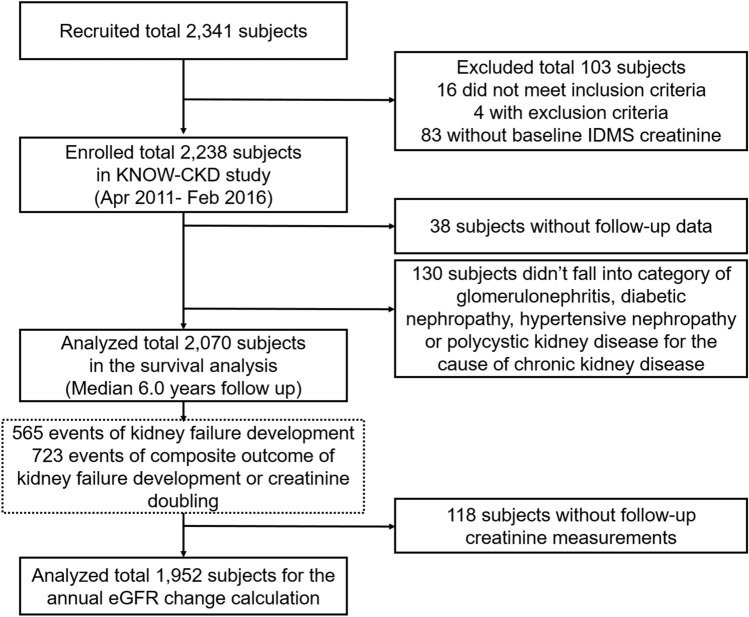
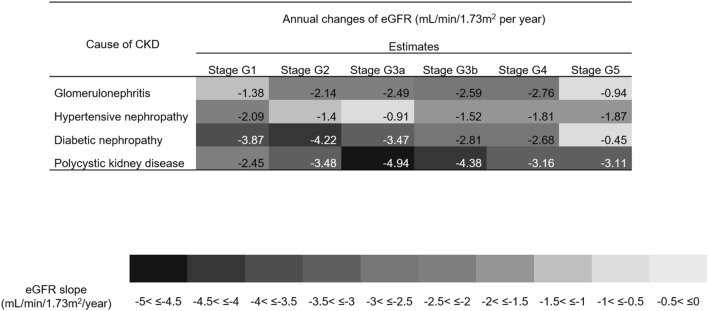
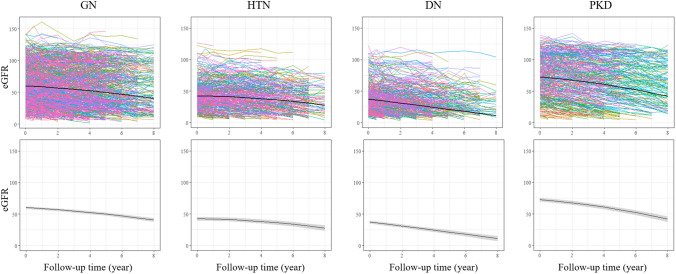
그림 출처: PubMed Central 공개 논문 (PMC9981888)
Comment · 정정
Conflict of interest statement
The authors declare no competing interests.
그 밖의 정보
- 출판 형태
- Journal Article, Research Support, Non-U.S. Gov't
- 저널
- Scientific reports · eISSN 2045-2322
- 전자 출판
- 2023-03-02
- MeSH
- Renal Insufficiency, Chronic* / epidemiology / etiology · Diabetic Nephropathies* · Cardiovascular Diseases* / epidemiology / etiology · Nephritis · Kidney · Prospective Studies · Hypertension, Renal · Renal Insufficiency* · Glomerulonephritis* / complications / epidemiology · Humans · Polycystic Kidney Diseases* / complications
- 참고문헌
- 30편