Division of Cardiology, Department of Internal Medicine, Seoul National University Hospital, Seoul, Republic of Korea.
Division of Cardiology, Department of Internal Medicine, Seoul National University Hospital, Seoul, Republic of Korea. choiek17@snu.ac.kr.
Department of Internal Medicine, Seoul National University College of Medicine, 101 Daehak-ro, Jongno-gu, Seoul, 03080, Republic of Korea. choiek17@snu.ac.kr.
Department of Internal Medicine, Seoul National University College of Medicine, 101 Daehak-ro, Jongno-gu, Seoul, 03080, Republic of Korea.
Department of Urology, Seoul National University Hospital, Seoul, Republic of Korea.
Department of Surgery, Hai Phong University of Medicine and Pharmacy, Hai Phong, Vietnam.
Department of Urology, Seoul National University Hospital, Seoul, Republic of Korea. drboss@snu.ac.kr.
Department of Urology, Seoul National University College of Medicine, 101 Daehak-ro, Jongno-gu, Seoul, 03080, Republic of Korea. drboss@snu.ac.kr.
Abstract
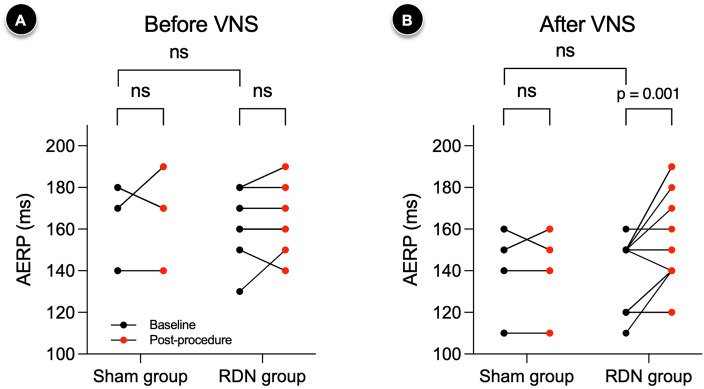
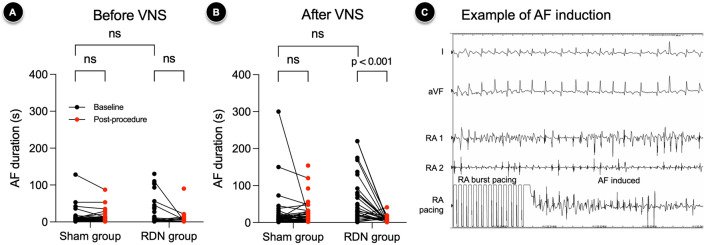
Catheter-based approaches may have inherent limitations in achieving effective renal denervation (RDN) and treatment of atrial fibrillation (AF). This study aimed to investigate the acute effects of novel laparoscopic RDN on modulating AF inducibility using a swine model. Four and five swine were randomly allocated to the sham and RDN groups, respectively. Each swine underwent measurement of the atrial effective refractory period (AERP) and AF induction tests using burst atrial pacing before and immediately after sham or RDN procedures with and without vagal nerve stimulation (VNS). A laparoscopic RDN procedure circumferentially ablated the renal nerves round the renal arteries using radiofrequency energy. There was no significant difference in the baseline AERP between the two groups (p > 0.05). Under VNS, AERP was significantly increased by 20 ms after laparoscopic RDN (95% CI = 0-30, p = 0.004). Compared to the sham group, the RDN group showed significantly reduced AF inducibility [OR (95% CI) = 0.32 (0.13-0.76) and 0.24 (0.11-0.57) with and without VNS, respectively]. After laparoscopic RDN, the duration of inducible AF episodes was significantly shortened from 28 (10-77) s to 7 (3-11) s (p < 0.001). The novel laparoscopic RDN can immediately reduce AF inducibility in a swine model.
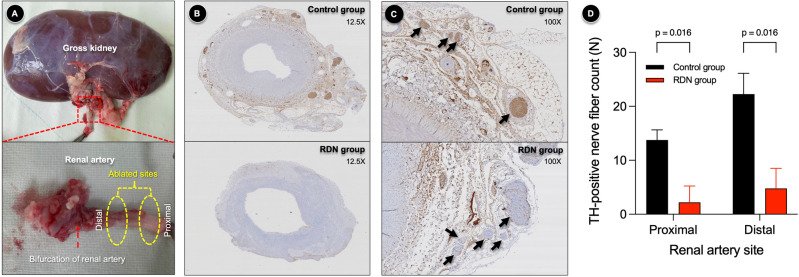
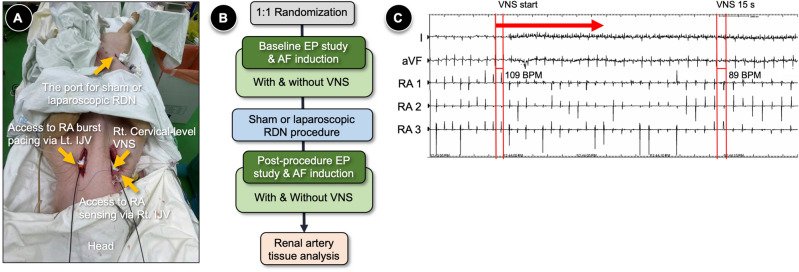
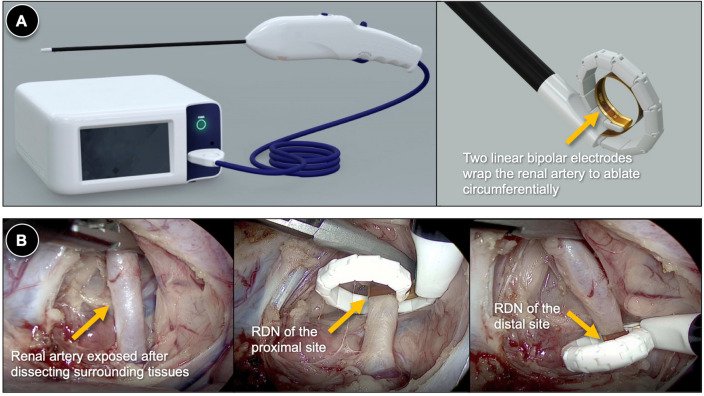
Figure 1Changes in AERPs according to procedures and VNS. Compared to the sham procedure, laparoscopic RDN significantly increased AERP after VNS. The number of data points in each group may not match the number of animals used (n = 4 for the sham group, n = 5 for the RDN group) due to the overlap of data points. The Wilcoxon signed-rank test was performed to compare the pair of AERPs obtained before and after the sham or laparoscopic RDN procedure. ns : p-value ≥ 0.05. AERP atrial effective refractory period, RDN renal denervation, VNS vagal nerve stimulation.Figure 2Durations of inducible AF episodes according to procedures and VNS. Compared to the sham procedure, laparoscopic RDN significantly reduced durations of inducible AF episodes after VNS. (A,B) Inducible AF episodes before and after VNS. (C) An example of AF induction by RA burst pacing. The number of data points in each group may not match the number of animals used (n = 4 for the sham group, n = 5 for the RDN group) due to the overlap of data points. The Wilcoxon signed-rank test was performed to compare the pair of AERPs obtained before and after the sham or laparoscopic RDN procedure. ns : p-value ≥ 0.05. AF atrial fibrillation, RA right atrial, RDN renal denervation, VNS vagal nerve stimulation.Figure 3Renal sympathetic nerves ablated by laparoscopic RDN. (A) Laparoscopic RDN ablated renal sympathetic nerves at the proximal and distal sites of the renal artery. (B) Cross-sectional slides of the renal artery after dissecting periarterial tissues. Despite laparoscopic RDN, there was no significant vessel wall deformity or injury of tunica media. (C) A comparison of the adventitia of the renal artery between the sham and RDN groups. Immunohistochemistry of TH was performed to identify functional renal sympathetic nerves. TH-positive renal nerves were destructed in the RDN group whereas they were intact in the sham group (arrows). (D) Compared to the sham group, the RDN group was associated with a significantly reduced number of TH-positive renal nerve fibers, for both proximally and distally ablated sites. The Mann–Whitney U-test was performed to compare nerve fiber counts between the sham (4 pairs of right and left renal arteries obtained from 4 swine) and RDN (5 pairs of right and left renal arteries obtained from 5 swine) groups. RDN renal denervation, TH tyrosine hydroxylase.Figure 4The experimental setup and study flow. (A) The experimental setup for EP study and sham or laparoscopic RDN procedure. (B) The flowchart of the experiment. (C) An example of right cervical VNS. BPM beat per minute, EP electrophysiology, IJV internal jugular vein, RA right atrium, RDN renal denervation, VNS vagal nerve stimulation.Figure 5Demonstration of the laparoscopic RDN procedure. (A) Schematic illustration of the novel laparoscopic RDN system. The instrument’s tip wraps around the renal artery and delivers radiofrequency energy using a pair of linear bipolar electrodes apart 2 mm away from each other (adapted from Investig Clin Urol. 2020;61(1):107–113, the courtesy of Jeong CW, MD, PhD). (B) Laparoscopic view of the laparoscopic RDN procedure. The renal artery is exposed after cutting peritoneum and dissecting periarterial subcutaneous tissues (the left panel). After exposing the renal artery, RDN is performed at both the proximal and distal sites of the artery (the middle and right panels). RDN renal denervation.
그림 출처: PubMed Central 공개 논문 (PMC10640613)
Conflict of interest statement
EKC: Research grants or speaking fees from Abbott, Bayer, BMS/Pfizer, Biosense Webster, Chong Kun Dang, Daewoong Pharmaceutical Co., Daiichi-Sankyo, DeepQure, Dreamtech Co., Ltd., Jeil Pharmaceutical Co. Ltd, Medtronic, Samjinpharm, Seers Technology, and Skylabs. Stock options from Seers Technology, and Skylabs. Stock from DeepQure. CWJ: Co-founder, major shareholder, and Director (Chief medical officer) of DeepQure Inc. Research fund from DeepQure, Inc. The inventor of the HyperQure™ RDN system. The other authors have nothing to disclose.