
Sci Rep. 2023;13(1):14271.
Etiology and clinical characteristics of acute viral hepatitis in South Korea during 2020-2021: a prospective multicenter study.
제1저자 정찬영, 최광현 · 교신저자 정숙향, 이병석
소속 (14)
- Departments of Internal Medicine, Seoul National University Bundang Hospital, Seoul National University College of Medicine, 82 Gumi-ro 173 Beon-gil, Bundang-gu, Seongnam, 13620, Republic of Korea.
- Department of Internal Medicine, Soonchunhyang University Bucheon Hospital, Bucheon, Republic of Korea.
- Department of Internal Medicine, Inje University Busan Paik Hospital, Busan, Korea.
- Department of Internal Medicine, Jeonbuk National University Hospital, Jeonju, Republic of Korea.
- Department of Internal Medicine, Chonnam National University Hwasun Hospital, Hwasun, Republic of Korea.
- Department of Internal Medicine, Chonnam National University Hospital, Gwangju, Republic of Korea.
- Departments of Internal Medicine, Inje University Ilsan Paik Hospital, Goyang, Republic of Korea.
- Departments of Internal Medicine, Kangwon National University Hospital, Chunchon, Republic of Korea.
- Departments of Internal Medicine, Keimyung University Dongsan Hospital, Daegu, Republic of Korea.
- Departments of Internal Medicine, Gyeongsang National University Hospital, Jinju, Republic of Korea.
- Departments of Internal Medicine, Jeju National University Hospital, Jeju, Republic of Korea.
- Seoul Clinical Laboratories, Yongin, Republic of Korea.
- Departments of Internal Medicine, Chungnam National University Hospital, 282 Munhwa-ro, Jung-gu, Daejeon, 35015, Republic of Korea. gie001@cnuh.co.kr.
- Departments of Internal Medicine, Seoul National University Bundang Hospital, Seoul National University College of Medicine, 82 Gumi-ro 173 Beon-gil, Bundang-gu, Seongnam, 13620, Republic of Korea. jsh@snubh.org.
Abstract
This prospective, 12-center study investigated the etiology and clinical characteristics of acute viral hepatitis (AVH) during 2020-2021 in South Korea, and the performance of different diagnostic methods for hepatitis E virus (HEV). We enrolled 428 patients with acute hepatitis, of whom 160 (37.4%) were diagnosed with AVH according to predefined serologic criteria. The clinical data and risk factors for AVH were analyzed. For hepatitis E patients, anti-HEV IgM and IgG were tested with two commercial ELISA kits (Abia and Wantai) with HEV-RNA real-time RT-PCR. HAV, HEV, HBV, HCV, Epstein-Barr virus (EBV), cytomegalovirus, and herpes simplex virus accounted for AVH in 78.8% (n = 126), 7.5% (n = 12), 3.1% (n = 5), 1.9% (n = 3), 6.9% (n = 11), 1.2% (n = 2), and 0.6% (n = 1) of 160 patients (median age, 43 years; men, 52.5%; median ALT, 2144 IU/L), respectively. Hospitalization, hemodialysis, and intensive care unit admission were required in 137 (86.7%), 5 (3.2%), and 1 (0.6%) patient, respectively. Two patients developed acute liver failure (1.3%), albeit without mortality or liver transplantation. Ingestion of uncooked clams/oysters and wild boars' blood/bile was reported in 40.5% and 16.7% of patients with HAV and HEV, respectively. The concordance rate between the anti-HEV-IgM results of both ELISA kits was 50%. HEV RNA was detected in only 17% of patients with HEV. The diagnosis of HEV needs clinical consideration due to incomplete HEV diagnostics.
© 2023. Springer Nature Limited.
Figures
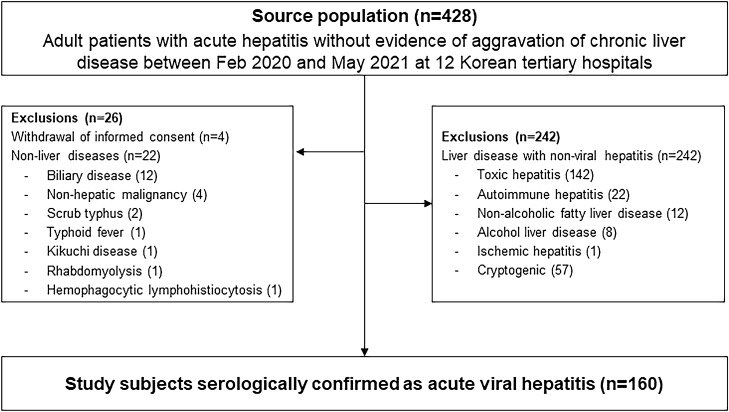
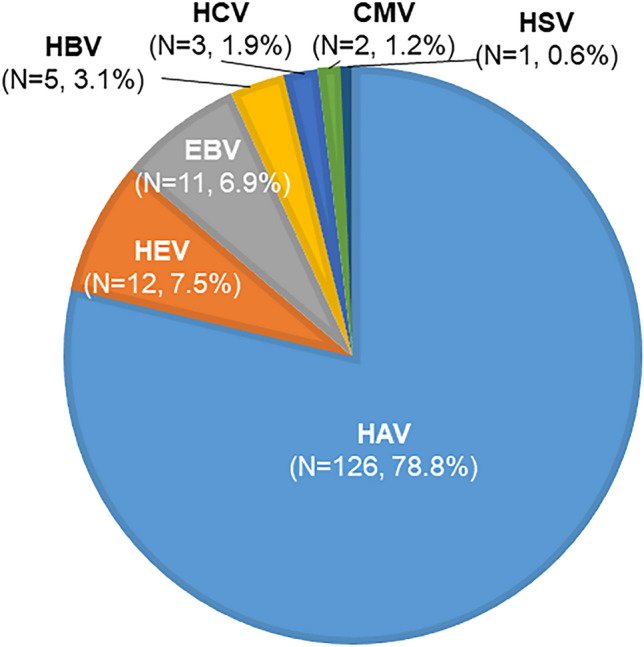
그림 출처: PubMed Central 공개 논문 (PMC10471758)
Comment · 정정
Conflict of interest statement
The authors declare no competing interests.
그 밖의 정보
- 출판 형태
- Journal Article, Multicenter Study, Research Support, Non-U.S. Gov't
- 저널
- Scientific reports · eISSN 2045-2322
- 전자 출판
- 2023-08-31
- MeSH
- Humans · Male · Acute Disease · Epstein-Barr Virus Infections* · Hepatitis Antibodies · Hepatitis E* / diagnosis / epidemiology · Hepatitis E virus* / genetics · Herpesvirus 4, Human · Immunoglobulin M · Prospective Studies · Republic of Korea / epidemiology · Female · Adult
- Substances
- Hepatitis Antibodies · Immunoglobulin M
- 참고문헌
- 22편