
Antimicrob Resist Infect Control. 2024;13(1):95.
Risk of nosocomial coronavirus disease 2019: comparison between single- and multiple-occupancy rooms.
제1저자 조현재 · 교신저자 김남중
소속 (4)
- Department of Internal Medicine, Seoul National University College of Medicine, 101 Daehak-ro Jongno-gu, Seoul, 03080, Republic of Korea.
- Infection Control Office, Seoul National University Hospital, Seoul, Republic of Korea.
- Department of Internal Medicine, Seoul National University College of Medicine, 101 Daehak-ro Jongno-gu, Seoul, 03080, Republic of Korea. njkmd@snu.ac.kr.
- Infection Control Office, Seoul National University Hospital, Seoul, Republic of Korea. njkmd@snu.ac.kr.
Abstract
BACKGROUND There is an ongoing controversy regarding whether single-occupancy rooms are superior to multiple-occupancy rooms in terms of infection prevention. We investigated whether treatment in a multiple-occupancy room is associated with an increased incidence of nosocomial coronavirus disease 2019 (COVID-19) compared with treatment in a single-occupancy room.
METHODS In this retrospective cohort study, every hospitalization period of adult patients aged ≥ 18 years at a tertiary hospital in Korea from January 1, 2022, to December 31, 2022, was analyzed. If COVID-19 was diagnosed more than 5 days after hospitalization, the case was classified as nosocomial. We estimated the association between the number of patients per room and the risk of nosocomial COVID-19 using a Cox proportional hazards regression model.
RESULTS In total, 25,143 hospitalizations per room type were analyzed. The incidence rate of nosocomial COVID-19 increased according to the number of patients per room; it ranged from 3.05 to 38.64 cases per 10,000 patient-days between single- and 6-bed rooms, respectively. Additionally, the hazard ratios of nosocomial COVID-19 showed an increasing trend according to the number of patients per room, ranging from 0.14 (95% confidence interval 0.001-1.03) to 2.66 (95% confidence interval 1.60-4.85) between single- and 6-bed rooms, respectively.
CONCLUSIONS We demonstrated that the incidence of nosocomial COVID-19 increased according to the number of patients per room. To reduce nosocomial infections by respiratory viruses, the use of multiple-occupancy rooms should be minimized.
© 2024. The Author(s).
Keywords
COVID-19HospitalsNosocomialRespiratory virusTransmission
Figures
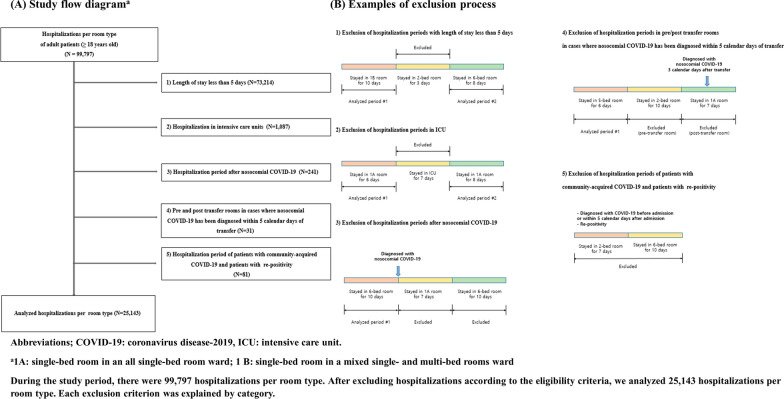
그림 출처: PubMed Central 공개 논문 (PMC11365205)
Conflict of interest statement
The authors declare no competing interests.
그 밖의 정보
- 출판 형태
- Journal Article, Comparative Study, Research Support, Non-U.S. Gov't
- 저널
- Antimicrobial resistance and infection control · eISSN 2047-2994
- 전자 출판
- 2024-08-30
- MeSH
- Humans · COVID-19* / epidemiology / prevention & control · Retrospective Studies · Cross Infection* / epidemiology / prevention & control · Republic of Korea / epidemiology · Male · Middle Aged · Female · Patients' Rooms* · SARS-CoV-2* · Incidence · Aged · Tertiary Care Centers · Adult · Hospitalization / statistics & numerical data · Proportional Hazards Models
- 연구비
- National Research Foundation (NRF), the Korean government (MSIT) 2021M3A9I2080498
- 참고문헌
- 43편