
J Am Heart Assoc. 2019;8(5):e011002.
Influence of Sex on Relationship Between Total Anatomical and Physiologic Disease Burdens and Their Prognostic Implications in Patients With Coronary Artery Disease.
제1저자 김지혜 · 교신저자 구본권
소속 (15)
- 1 Division of Cardiology Department of Internal Medicine VHS Medical Center Seoul Korea.
- 2 Division of Cardiology Department of Internal Medicine Seoul National University Hospital Seoul Korea.
- 3 Institute on Aging Seoul National University Seoul Korea.
- 4 Division of Cardiology Department of Internal Medicine Heart Vascular Stroke Institute Samsung Medical Center Sungkyunkwan University School of Medicine Seoul Korea.
- 5 Department of Cardiology Ulsan University Hospital University of Ulsan College of Medicine Ulsan Korea.
- 6 Division of Cardiology Ulsan Hospital Ulsan Korea.
- 7 Department of Emergency Medicine Samsung Medical Center Sungkyunkwan University School of Medicine Seoul Korea.
- 8 Department of Medicine Inje University Ilsan Paik Hospital Goyang Korea.
- 9 Department of Medicine Keimyung University Dongsan Medical Center Daegu Korea.
- 10 Department of Cardiology The Second Affiliated Hospital School of Medicine Zhejiang University Hangzhou China.
- 11 Department of Cardiology Nanjing First Hospital Nanjing Medical University Nanjing China.
- 12 Department of Cardiology Kokura Memorial Hospital Kitakyushu Japan.
- 13 Department of Cardiology Tokyo Medical University Tokyo Japan.
- 14 Department of Cardiology Gifu Heart Center Gifu Japan.
- 15 Department of Cardiology Wakayama Medical University Wakayama Japan.
Abstract
Background Total atherosclerosis disease burden is associated with clinical outcomes in patients with coronary artery disease. However, the influence of sex on the relationship between total anatomical and physiologic disease burdens and their prognostic implications have not been well defined. Methods and Results A total of 1136 patients who underwent fractional flow reserve (FFR) measurement in all 3 major coronary arteries were included in this study. Anatomical and physiologic total disease burden was assessed by SYNTAX (Synergy Between Percutaneous Coronary Intervention With Taxus and Cardiac Surgery) score, residual SYNTAX score, a total sum of FFR in 3 vessels (3-vessel FFR), and functional SYNTAX score. The primary end point was major adverse cardiac events, a composite of cardiac death, myocardial infarction, and ischemia-driven revascularization at 2 years. There were no differences in angiographic diameter stenosis, SYNTAX score, or residual SYNTAX score between women and men. However, both per-vessel FFR (0.89±0.10 versus 0.87±0.11, P<0.001) and 3-vessel FFR (2.72±0.13 versus 2.69±0.15, P<0.001) were higher in women. Multivariable Cox regression analyses showed that total anatomical and physiologic disease burdens were significantly associated with 2-year major adverse cardiac events, and there was no significant interaction between sex and total disease burden for clinical outcomes. Conclusions Despite similar angiographic disease severity, both per-vessel and per-patient physiologic disease severity was less in women than in men. There was no influence of sex on prognostic implications of total anatomical and physiologic disease burdens in patients with coronary artery disease. Clinical Trial Registration URL: https://www.clinicaltrials.gov . Unique identifier: NCT01621438.
Keywords
SYNTAX scorecoronary artery diseasefractional flow reserveprognosissextotal disease burden
Figures

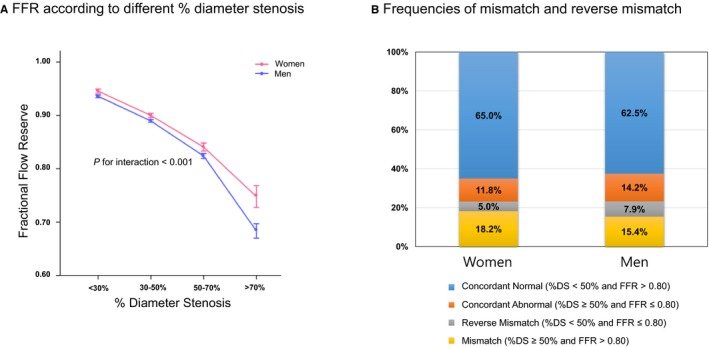

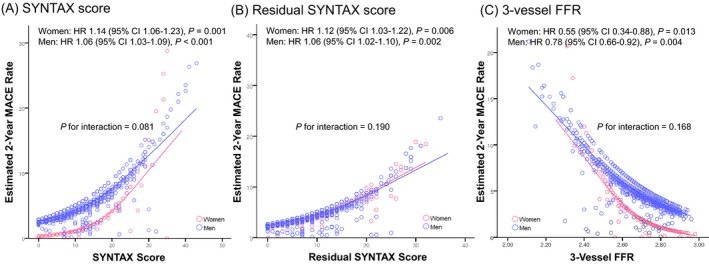
그림 출처: PubMed Central 공개 논문 (PMC6474930)
그 밖의 정보
- 출판 형태
- Comparative Study, Journal Article, Multicenter Study, Research Support, Non-U.S. Gov't
- 저널
- Journal of the American Heart Association · eISSN 2047-9980
- MeSH
- Aged · Asia · Cardiac Catheterization* · Coronary Angiography* · Coronary Artery Disease / diagnostic imaging / mortality / physiopathology / therapy · Coronary Stenosis / diagnostic imaging / mortality / physiopathology / therapy · Coronary Vessels / diagnostic imaging / physiopathology · Female · Fractional Flow Reserve, Myocardial* · Health Status Disparities · Humans · Male · Middle Aged · Predictive Value of Tests · Prognosis · Registries · Risk Factors · Severity of Illness Index · Sex Factors
- 데이터
- ClinicalTrials.gov: NCT01621438
- 참고문헌
- 30편