
Int J Chron Obstruct Pulmon Dis. 2018;13:101-107.
Comparison of COPD Assessment Test and Clinical COPD Questionnaire to predict the risk of exacerbation.
제1저자 조용숙 · 교신저자 이창훈
소속 (3)
- Division of Pulmonary and Critical Care Medicine, Department of Internal Medicine, Seoul National University Hospital, Seoul.
- Division of Pulmonary and Critical Care Medicine, Department of Internal Medicine, Seoul National University Bundang Hospital, Seongnam, Gyeonggi.
- Division of Pulmonary and Critical Care Medicine, Department of Internal Medicine, Seoul Metropolitan Government-Seoul National University Boramae Medical Center, Seoul, Republic of Korea.
Abstract
BACKGROUND AND OBJECTIVE Guidelines recommend the use of simple but comprehensive tools such as COPD Assessment Test (CAT) and Clinical COPD Questionnaire (CCQ) to assess health status in COPD patients. We aimed to compare the ability of CAT and CCQ to predict exacerbation in COPD patients.
METHODS We organized a multicenter prospective cohort study that included COPD patients. The relationships between CAT, CCQ, and other clinical measurements were analyzed by correlation analysis, and the impact of CAT and CCQ scores on exacerbation was analyzed by logistic regression analyses and receiver operating characteristic curve.
RESULTS Among 121 COPD patients, CAT and CCQ score correlated with other symptom measures, lung function and exercise capacity as well. Compared with patients who did not experience exacerbation, those who experienced exacerbation (n=45; 38.2%) exhibited more severe airflow limitation, were more likely to have a history of exacerbation in the year prior to enrollment, and demonstrated higher CAT scores. CCQ scores were not significantly associated with exacerbations. A CAT score of ≥15 was an independent risk factor for exacerbation (adjusted odds ratio [aOR], 2.40; 95% CI, 1.03-6.50; P=0.04). Furthermore, CAT scores of ≥15 demonstrated an increased predictive ability for exacerbation compared with currently accepted guidelines for the use of CAT (≥10) and CCQ (≥1) in the assessment of COPD patients (area under the curve for CAT ≥15, CAT ≥10, and CCQ ≥1 was 0.61±0.04, 0.53±0.03, and 0.50±0.03, respectively; P=0.03).
CONCLUSION A CAT score of ≥15 indicates increased risk of exacerbation in COPD patients, whereas there is no evidence for increased risk based on CCQ score.
Keywords
COPDexacerbationquestionnaire
Figures
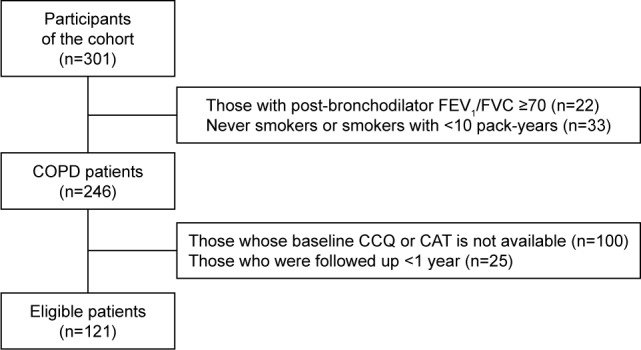
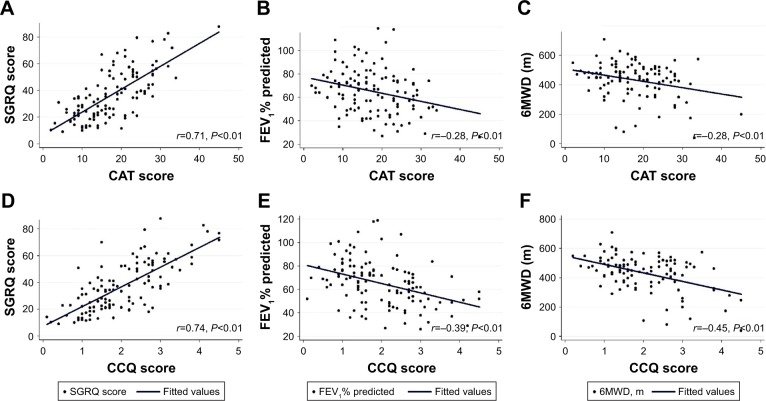
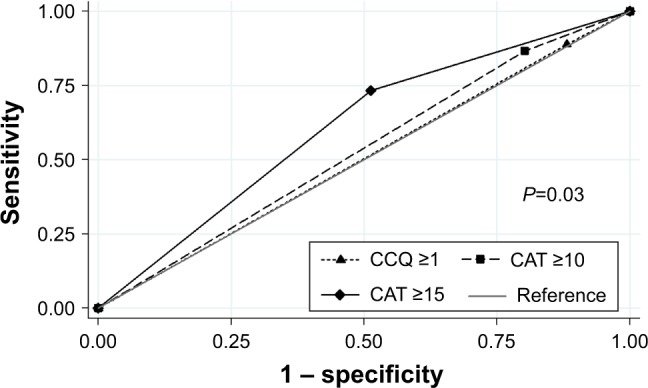
그림 출처: PubMed Central 공개 논문 (PMC5744740)
Conflict of interest statement
Disclosure The authors report no conflicts of interest in this work.
그 밖의 정보
- 출판 형태
- Comparative Study, Journal Article, Multicenter Study, Observational Study
- 저널
- International journal of chronic obstructive pulmonary disease · eISSN 1178-2005
- 전자 출판
- 2017-12-22
- MeSH
- Aged · Area Under Curve · Chi-Square Distribution · Disease Progression · Exercise Tolerance · Female · Health Status · Humans · Logistic Models · Lung / physiopathology · Male · Middle Aged · Multivariate Analysis · Odds Ratio · Predictive Value of Tests · Prognosis · Prospective Studies · Pulmonary Disease, Chronic Obstructive / diagnosis / physiopathology · ROC Curve · Registries · Reproducibility of Results · Republic of Korea · Risk Factors · Surveys and Questionnaires* · Time Factors
- 참고문헌
- 38편