
PLoS One. 2018;13(5):e0197244.
Association between perfluoroalkyl substances exposure and thyroid function in adults: A meta-analysis.
제1저자 김민주,문신제 · 교신저자 박영주
소속 (6)
- Department of Internal Medicine, Seoul National University College of Medicine, Seoul, Republic of Korea.
- Division of Endocrinology and Metabolism, Department of Internal Medicine, Hallym University College of Medicine, Seoul, Republic of Korea.
- Department of Physiology, Lee Gil Ya Cancer and Diabetes Institute, Gachon University College of Medicine, Incheon, Republic of Korea.
- Division of Environmental Health, Korea Environment Institute, Sejong, Republic of Korea.
- Department of Occupational and Environmental Health, Yongin University, Yongin, Republic of Korea.
- School of Public Health, Seoul National University, Seoul, Republic of Korea.
Abstract
OBJECTIVE Many people are exposed to perfluoroalkyl substances (PFASs) because these substances are widely used as industrial products. Although epidemiological studies suggest that PFASs can disrupt thyroid hormones, the association between PFAS exposure and thyroid function remains inconclusive. Therefore, we performed a comprehensive meta-analysis to investigate the association between PFASs exposure and thyroid hormones.
METHODS We searched medical literature databases for articles on the association between PFASs-perfluorooctanesulfonic acid (PFOS), perfluorooctanoic acid (PFOA), and perfluorohexane sulfonic acid (PFHxS)-and thyroid hormone levels in adults. Twelve articles were included in the meta-analysis, and the pooled z values were calculated with correlation or regression coefficients.
RESULTS The blood PFOS concentration was positively correlated with free T4. The pooled z value was 0.05 (95% confidence interval (CI): 0.03, 0.08). PFOS was negatively correlated with total T4 and total T3 when excluding outlier studies. In a subgroup analysis stratified by mean PFOS concentration, PFOS was observed to be positively associated with free T4 and TSH and negatively associated with total T3 in the intermediate concentration group (8-16 ng/mL). PFOA concentration was negatively correlated with total T4 (z value, -0.06; 95% CI: -0.09, -0.03) after omitting one outlier study. PFHxS also showed a negative correlation with total T4 (z value, -0.04; 95% CI: -0.07, -0.01). A subgroup analysis of pregnant women showed that there was no association between PFASs and thyroid hormones.
CONCLUSIONS Our meta-analysis suggests that PFASs are negatively associated with total T4, and their effect can be different depending on the PFAS concentration.
Figures

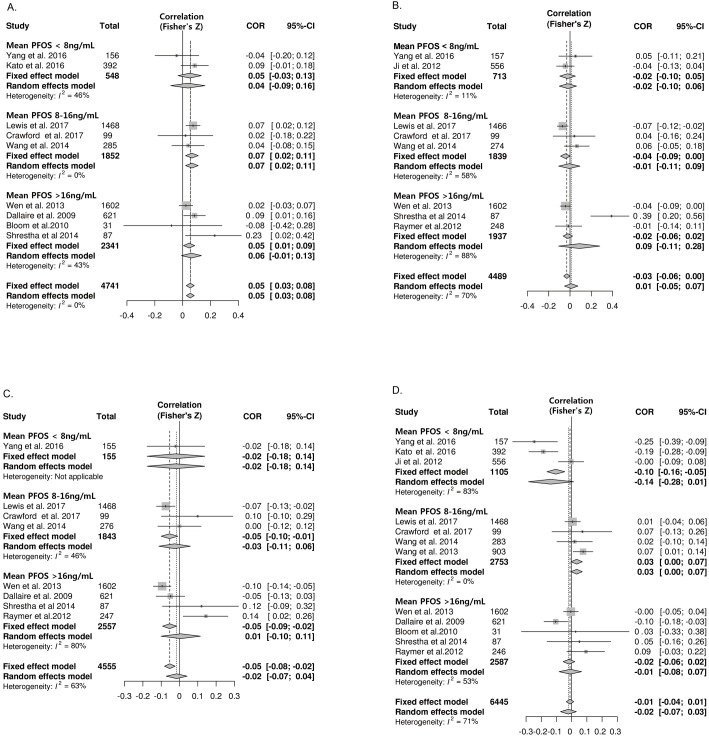
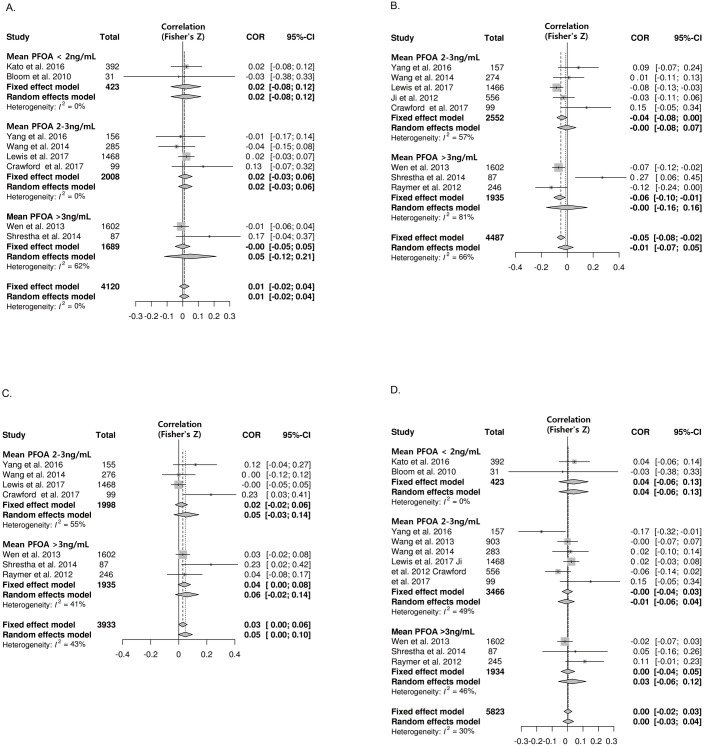
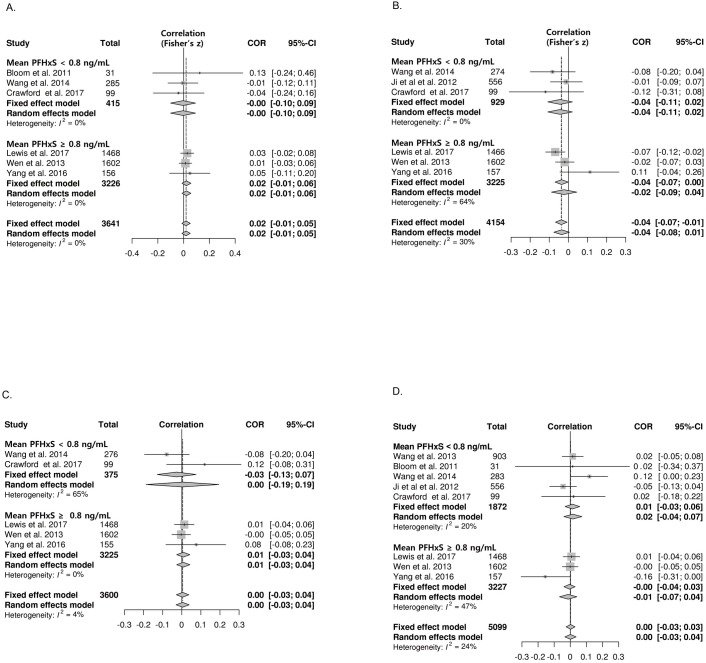
그림 출처: PubMed Central 공개 논문 (PMC5945046)
Conflict of interest statement
Competing Interests:The authors have declared that no competing interests exist.
그 밖의 정보
- 출판 형태
- Journal Article, Meta-Analysis, Research Support, Non-U.S. Gov't
- 저널
- PloS one · eISSN 1932-6203
- 전자 출판
- 2018-05-10
- MeSH
- Alkanesulfonic Acids / adverse effects · Caprylates / adverse effects · Environmental Exposure* · Fluorocarbons / adverse effects · Humans · Sulfonic Acids / adverse effects · Thyroid Diseases / blood / epidemiology · Thyroid Hormones / blood
- Substances
- Alkanesulfonic Acids · Caprylates · Fluorocarbons · Sulfonic Acids · Thyroid Hormones · perfluorohexanesulfonic acid · perfluorooctanoic acid · perfluorooctane sulfonic acid
- 참고문헌
- 65편