
PLoS One. 2018;13(10):e0204762.
Trends in the seroprevalence of Helicobacter pylori infection and its putative eradication rate over 18 years in Korea: A cross-sectional nationwide multicenter study.
제1저자 임선희 · 교신저자 김나영
소속 (12)
- Departments of Internal Medicine, Healthcare System Gangnam Center Seoul National University Hospital, and Healthcare Research Institute, Seoul, Korea.
- Department of Internal Medicine, Seoul National University Bundang Hospital, Seongnam, Gyeonggi-do, Korea.
- Department of Internal Medicine and Liver Research Institute, Seoul National University College of Medicine, Seoul, Korea.
- College of Pharmacy, Kyungpook National University, Daegu, Korea.
- Department of Internal Medicine, Kosin University College of Medicine, Busan, Korea.
- Department of Internal Medicine, Hallym University Medical Center Chuncheon Sacred Heart Hospital, Chuncheon, Gangwon-do, Korea.
- Department of Internal Medicine, Keimyung University School of Medicine, Daegu, Korea.
- Department of Internal Medicine, Dankook University Hospital, Cheonan, Chungcheongnam-do, Korea.
- Department of Internal Medicine, Jeju National University Hospital, Jeju, Jeju-do, Korea.
- Department of Internal Medicine, Chonnam National University Hwasun Hospital, Hwasun, Jeollanam-do, Korea.
- Department of Internal Medicine, Wonkwang University College of Medicine, Iksan, Chollabuk-do, Korea.
- Department of Internal Medicine and Institute of Health Science, Gyeongsang National University School of Medicine, Jinju, Gyeongsangnam-do, Korea.
Abstract
The aims of this study were to demonstrate the trends in seropositivity and the eradication therapy rate for Helicobacter pylori (H. pylori) over an 18-year period in an asymptomatic Korean population and to explore the factors associated with H. pylori seropositivity and its eradication therapy. In total, 23,770 subjects (aged 17-97 years) from a health examination center participated in this cross-sectional study from January 2016 to June 2017. Questionnaires that included questions about the participants' H. pylori eradication therapy history were collected, and anti-H. pylori IgG antibodies were measured. Among the eligible subjects, the seroprevalence of H. pylori infection was 41.5%. The H. pylori eradication therapy rate increased continuously from 2005 (13.9%) to 2011 (19.3%) and then increased again until the first half of 2017 (23.5%) (P < 0.001). After exclusion of subjects with a history of gastric surgery, gastric cancer, H. pylori eradication therapy, or gastric symptoms, H. pylori seropositivity was 43.9% in 16,885 subjects, which was significantly lower than the seropositivities in 1998 (66.9%), 2005 (59.6%), and 2011 (54.4%). The risk factors associated with H. pylori seropositivity according to multivariable analysis were male sex (odds ratio (OR) 1.34, 95% confidence interval (CI): 1.23-1.46), medium educational level (OR 1.17, 95% CI: 1.05-1.31), medium household income level (OR 1.10, 95% CI: 1.03-1.19), and age of 60-69 years (OR 8.78, 95% CI: 6.41-11.85). The observed downward trend in H. pylori seroprevalence and increase in H. pylori eradication over the 18-year period will affect upper gastrointestinal disorders in South Korea.
Figures
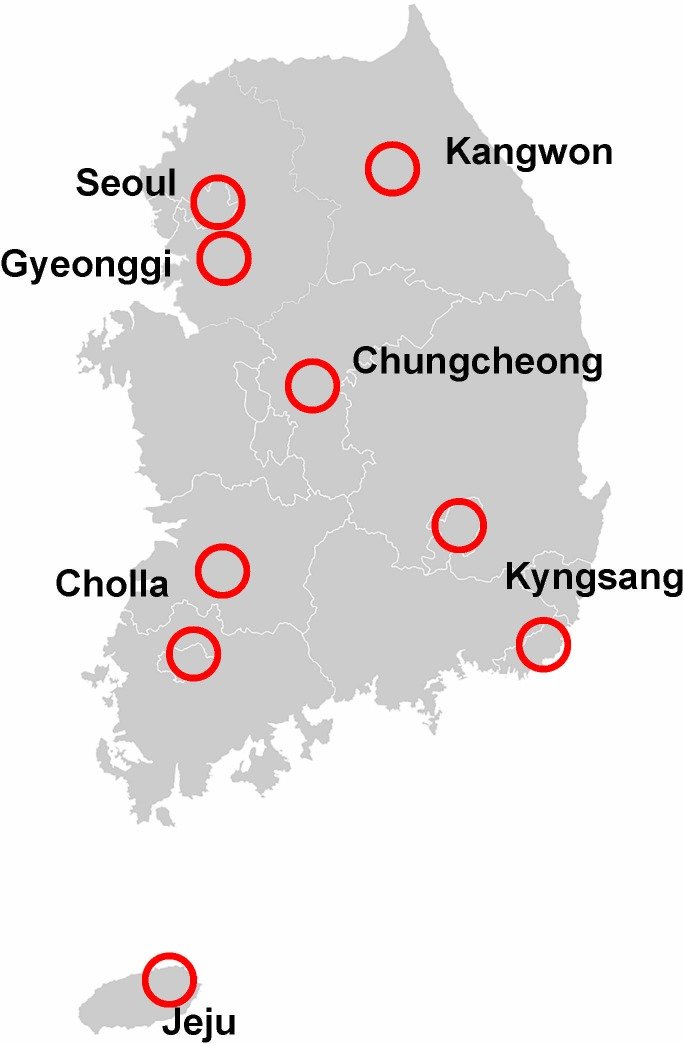
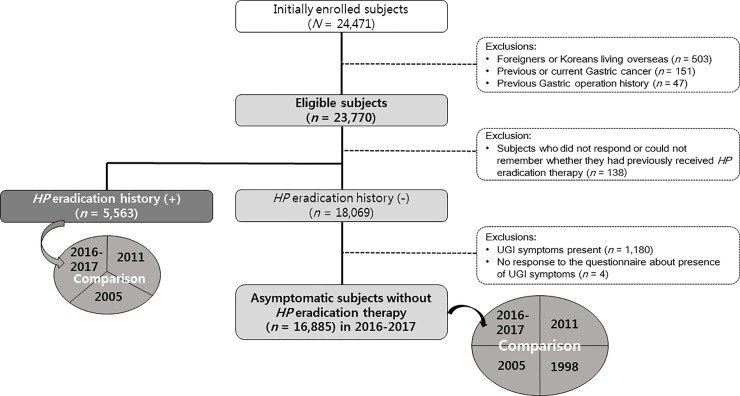
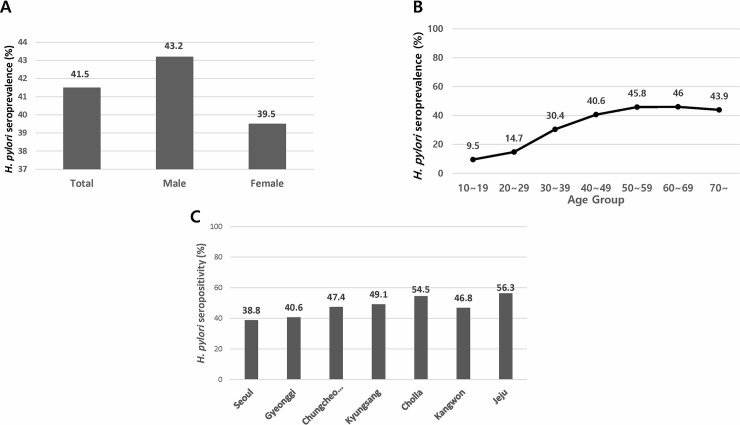
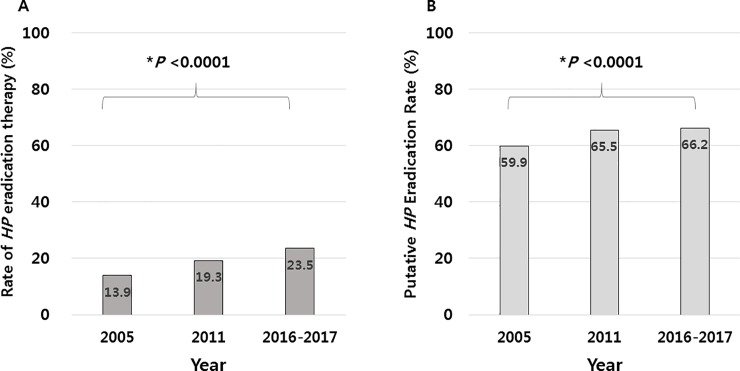
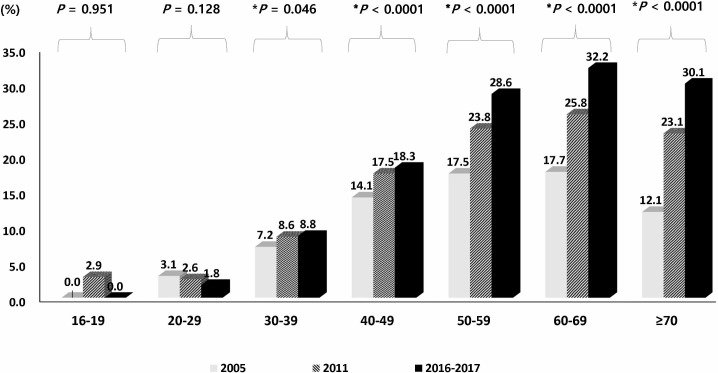
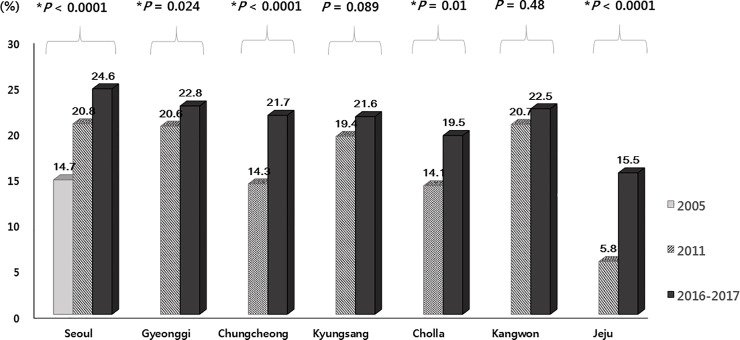
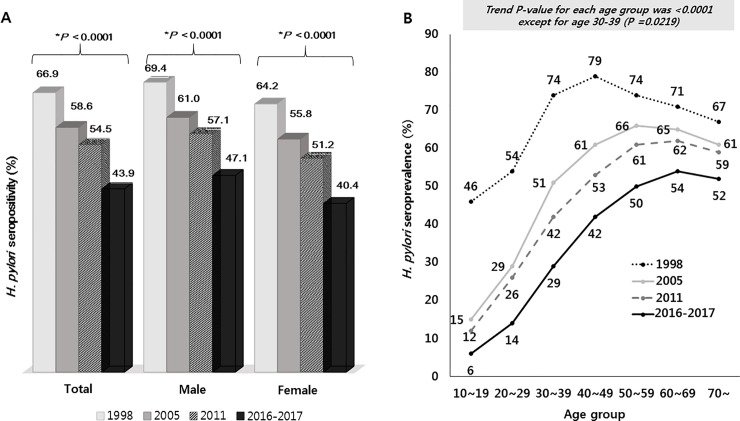
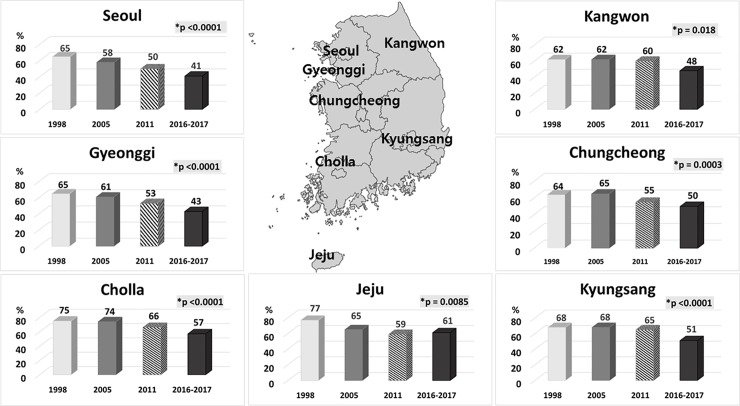
그림 출처: PubMed Central 공개 논문 (PMC6192591)
Conflict of interest statement
The authors have declared that no competing interests exist.
그 밖의 정보
- 출판 형태
- Journal Article, Multicenter Study, Research Support, Non-U.S. Gov't
- 저널
- PloS one · eISSN 1932-6203
- 전자 출판
- 2018-10-17
- MeSH
- Adolescent · Adult · Aged · Aged, 80 and over · Antibodies, Bacterial / blood · Cross-Sectional Studies · Female · Helicobacter Infections / epidemiology / immunology / therapy · Helicobacter pylori* / immunology · Humans · Male · Middle Aged · Republic of Korea / epidemiology · Risk Factors · Seroepidemiologic Studies · Socioeconomic Factors · Time Factors · Young Adult
- Substances
- Antibodies, Bacterial
- 참고문헌
- 32편