
J Am Heart Assoc. 2019;8(4):e011121.
β-Blockers and 1-Year Postdischarge Mortality for Heart Failure and Reduced Ejection Fraction and Slow Discharge Heart Rate.
제1저자 박진주 · 교신저자 최동주
소속 (12)
- 1 Division of Cardiology Cardiovascular Center Seoul National University Bundang Hospital Seongnam Republic of Korea.
- 2 Department of Family Medicine Inje University Seoul Paik Hospital Seoul Republic of Korea.
- 3 Department of Internal Medicine Seoul National University Hospital Seoul Republic of Korea.
- 4 Heart Research Center of Chonnam National University Gwangju Republic of Korea.
- 5 Yonsei University Wonju College of Medicine Wonju Republic of Korea.
- 6 Yonsei University College of Medicine Seoul Republic of Korea.
- 7 Department of Internal Medicine The Catholic University of Korea Seoul Republic of Korea.
- 8 Department of Internal Medicine Sungkyunkwan University College of Medicine Seoul Republic of Korea.
- 9 Division of Cardiology Asan Medical Center Seoul Republic of Korea.
- 10 Chungbuk National University College of Medicine Cheongju Republic of Korea.
- 11 Kyungpook National University College of Medicine Daegu Republic of Korea.
- 12 Mediplex Sejong Hospital Incheon Republic of Korea.
Abstract
Background Many hospitalized patients with heart failure and reduced ejection fraction ( HF r EF ) have a slow heart rate at discharge, and the effect of β-blockers may be reduced in those patients. We sought to examine the variable effect of β-blockers on clinical outcomes according to the discharge heart rate of hospitalized HF r EF patients. Methods and Results The KorAHF (Korean Acute Heart Failure) registry consecutively enrolled 5625 patients hospitalized for acute heart failure. In this analysis, we included patients with HF r EF (left ventricular ejection fraction ≤40%). Slow heart rate was defined as <70 beats per minute regardless of the use of β-blockers. The primary outcome was 1-year all-cause postdischarge death according to heart rate. Among 2932 patients with HF r EF , 840 (29%) had a slow heart rate and 56% received β-blockers at discharge. Patients with slow heart rates were older and had lower 1-year mortality than those with high heart rates ( P<0.001). A significant interaction between discharge heart rate and β-blocker use was observed ( P<0.001 for interaction). When stratified, only patients without a β-blocker prescription and with a high heart rate showed higher 1-year mortality. In a Cox-proportional hazards regression analysis, β-blocker prescription at discharge was associated with 24% reduced risk for 1-year mortality in patients with high heart rates (hazard ratio: 0.76; 95% CI, 0.61-0.95) but not in those with slow heart rates (hazard ratio: 1.02; 95% CI, 0.68-1.55). Conclusions Many patients with acute heart failure have slow discharge heart rates, and β-blockers may have a limited effect on HF r EF and slow discharge heart rate. Clinical Trial Registration URL : http://www.clinicaltrial.gov . Unique identifier: NCT 01389843.
Keywords
heart failureheart rateoutcomeβ‐blocker
Figures


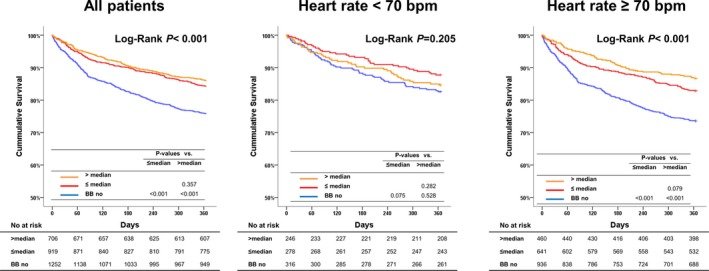

그림 출처: PubMed Central 공개 논문 (PMC6405672)
그 밖의 정보
- 출판 형태
- Journal Article, Multicenter Study, Research Support, Non-U.S. Gov't
- 저널
- Journal of the American Heart Association · eISSN 2047-9980
- MeSH
- Adrenergic beta-Antagonists / therapeutic use · Aged · Bisoprolol / therapeutic use · Carvedilol / therapeutic use · Female · Follow-Up Studies · Heart Failure / drug therapy / mortality / physiopathology · Heart Rate / drug effects / physiology · Humans · Male · Metoprolol / therapeutic use · Nebivolol / therapeutic use · Patient Discharge* · Prospective Studies · Republic of Korea / epidemiology · Stroke Volume / drug effects / physiology · Survival Rate / trends · Time Factors · Treatment Outcome
- Substances
- Adrenergic beta-Antagonists · Nebivolol · Carvedilol · Metoprolol · Bisoprolol
- 데이터
- ClinicalTrials.gov: NCT01389843
- 참고문헌
- 28편