
PLoS One. 2017;12(9):e0184300.
Clinical impact of depression and anxiety in patients with idiopathic pulmonary fibrosis.
제1저자 이예진 · 교신저자 박종선
소속 (2)
- Division of Pulmonary and Critical Care Medicine, Department of Internal Medicine, Seoul National University College of Medicine, Seoul National University Hospital, Seoul, Korea.
- Division of Pulmonary and Critical Care Medicine, Department of Internal Medicine, Seoul National University College of Medicine, Seoul National University Bundang Hospital, Seongnam, Korea.
Abstract
BACKGROUND Although depression and anxiety represent significant yet treatable comorbidities in patients with idiopathic pulmonary fibrosis (IPF), their impact on the clinical course and prognosis of IPF remain unclear.
PURPOSE We investigated the prevalence and clinical significance of depression and anxiety in patients with IPF.
METHODS The present study included a prospective cohort comprising 112 Korean patients with IPF who had completed the Hospital Anxiety and Depression Scale (HADS) questionnaire.
RESULTS Symptoms of depression and anxiety were present in 25.9% and 21.4% of patients with IPF, respectively (HADS scores ≥8). No significant differences in demographic data, age, sex, smoking status, Modified Medical Research Council Dyspnea Scale (MMRC) scores, pulmonary function tests, or Gender-Age-Physiology Index for IPF were observed between patients with depression or anxiety and those without. However, in patients with anxiety, St. George's Respiratory Questionnaire (SGRQ) scores were significantly higher than those of patients without anxiety (40.5 versus 23.5; p = 0.003). The survival rate and total number of hospital admissions did not significantly differ between patients with depression/anxiety and those without.
CONCLUSIONS Our findings indicate that depression and anxiety are relatively common in patients with IPF. Although no significant differences were noted with regard to survival rate and hospitalization, the present study suggests that depression and anxiety significantly influence quality of life in patients with IPF.
Figures

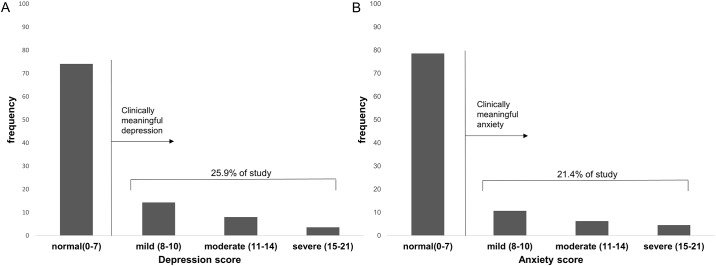


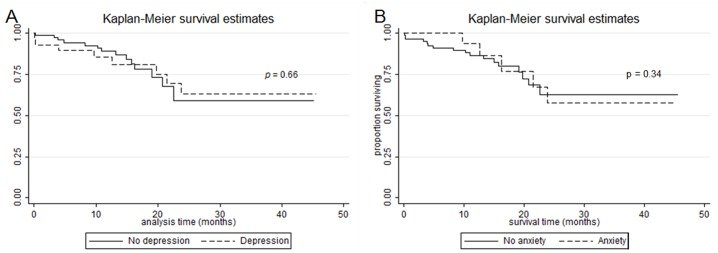
그림 출처: PubMed Central 공개 논문 (PMC5593186)
Conflict of interest statement
Competing Interests:The authors have declared that no competing interests exist.
그 밖의 정보
- 출판 형태
- Journal Article
- 저널
- PloS one · eISSN 1932-6203
- 전자 출판
- 2017-09-11
- MeSH
- Aged · Aged, 80 and over · Anxiety / epidemiology / psychology · Comorbidity · Depression / epidemiology / psychology · Follow-Up Studies · Hospitalization · Humans · Idiopathic Pulmonary Fibrosis / epidemiology / physiopathology / psychology · Middle Aged · Mortality · Prevalence · Proportional Hazards Models · Republic of Korea / epidemiology · Respiratory Function Tests · Risk Factors · Surveys and Questionnaires
- 참고문헌
- 31편