
Clin Transl Allergy. 2022;12(9):e12193.
HLA-A*24:02 increase the risk of allopurinol-induced drug reaction with eosinophilia and systemic symptoms in HLA-B*58:01 carriers in a Korean population; a multicenter cross-sectional case-control study.
제1저자 김미영 · 교신저자 강혜련
소속 (14)
- Department of Internal Medicine Busan Paik Hospital Inje University College of Medicine Busan Korea.
- Department of Immunology and Rheumatology Nepean Hospital The University of Sydney Sydney Australia.
- Drug Safety Monitoring Center Seoul National University Hospital Seoul Korea.
- Department of Pharmacology Inje University College of Medicine Busan Korea.
- Department of Internal Medicine Haeundae Paik Hospital Inje University College of Medicine Busan Korea.
- Department of Internal Medicine Chungbuk National University Hospital Cheongju Korea.
- Department of Internal Medicine Dong-A University College of Medicine Busan Korea.
- Department of Internal Medicine Hallym University Dongtan Sacred Heart Hospital Hallym University College of Medicine Hwaseong Korea.
- Department of Internal Medicine SMG-SNU Boramae Medical Center Seoul Korea.
- Department of Internal Medicine Seoul National University College of Medicine Seoul Korea.
- Department of Internal Medicine Yonsei University College of Medicine Severance Hospital Seoul Korea.
- Department of Internal Medicine Chung-Ang University College of Medicine Seoul Korea.
- Department of Information Medicine Asan Medical Center Seoul Korea.
- Institute of Allergy and Clinical Immunology Seoul National University Medical Research Center Seoul National University College of Medicine Seoul Korea.
Abstract
BACKGROUND HLA-B*58:01 is a well-known risk factor for allopurinol-induced severe cutaneous adverse reactions (SCARs). However, only a minority of HLA-B*58:01 carriers suffer SCARs after taking allopurinol. The aim of this study was to investigate subsidiary genetic markers that could identify those at further increased risk of developing allopurinol-induced drug reaction with eosinophilia and systemic symptoms (DRESS) in subjects with HLA-B*58:01.
METHODS Subjects with B*58:01 were enrolled (21 allopurinol-induced DRESS and 52 allopurinol-tolerant control). HLA-A, -B, -C and -DRB1 alleles were compared. Comparison of risk between HLAs and allopurinol-induced SCAR in separate populations was performed to support the results. Kruskal-Wallis test, Pearson's chi-square test, Fisher's exact test and binary logistic regression were used to analyze the risk of SCAR development.
RESULTS Frequencies of A*24:02 (71.4 vs. 17.3%, p < 0.001, odds ratio [OR] = 12.0; 95% confidence interval [CI], 3.6-39.2) were significantly higher in B*58:01 (+) DRESS than B*58:01 (+) tolerant controls. In addition, DRB1*13:02 further increased the risk of DRESS. The phenotype frequency of A*24:02/DRB1*13:02 was significantly higher in the B*58:01 (+) DRESS group than in the B*58:01 (+) tolerant controls (52.4% vs. 5.8%, p < 0.001, OR, 66.0; 95% CI, 6.1-716.2). In 2782 allopurinol user cohort, the overall prevalence of DRESS was 0.22%, which increased to 1.62% and 2.86% in the presence of B*58:01 and B*58:01/A*24:02, respectively.
CONCLUSION The additional secondary screening with A*24:02 and DRB1*13:02 alleles may identify those at further increased risk of allopurinol-induced DRESS in B*58:01 carriers.
© 2022 The Authors. Clinical and Translational Allergy published by John Wiley and Sons Ltd on behalf of European Academy of Allergy and Clinical Immunology.
Keywords
HLA‐A24 antigenKoreansallopurinoldrug hypersensitivity syndromehistocompatibility antigens class I
Figures
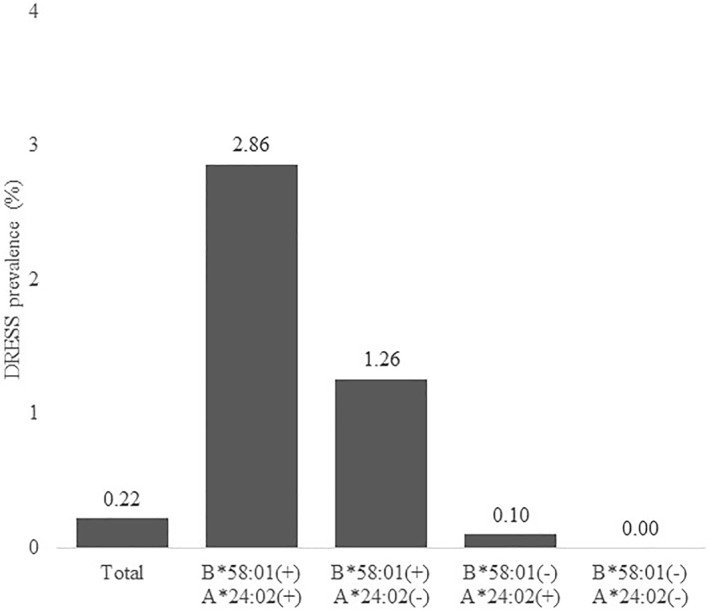
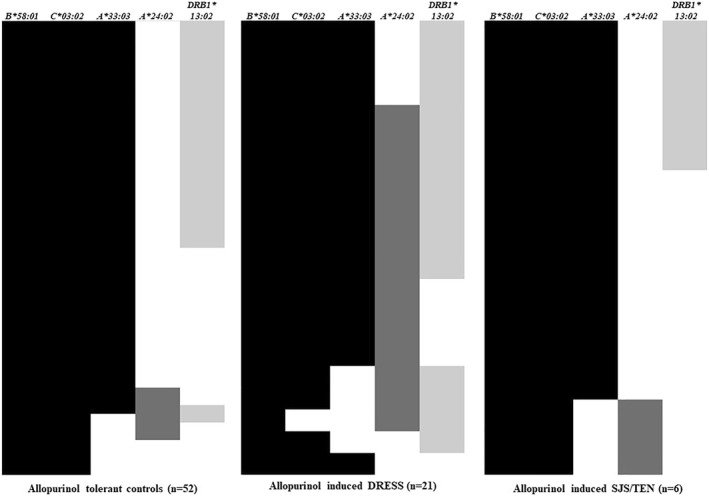
그림 출처: PubMed Central 공개 논문 (PMC9478421)
Comment · 정정
Conflict of interest statement
The authors declare that they have no competing interests.
그 밖의 정보
- 출판 형태
- Journal Article
- 저널
- Clinical and translational allergy · ISSN 2045-7022
- 전자 출판
- 2022-09-15
- 참고문헌
- 32편