
Gut Liver. 2018;12(6):704-713.
Balloon-Occluded Retrograde Transvenous Obliteration versus Transjugular Intrahepatic Portosystemic Shunt for the Management of Gastric Variceal Bleeding.
제1저자 김근우 · 교신저자 김윤준
소속 (4)
- Seoul National University College of Medicine, Seoul, Korea.
- Department of Internal Medicine and Liver Research Institute, Seoul National University College of Medicine, Seoul, Korea.
- Department of Radiology, Seoul National University College of Medicine, Seoul, Korea.
- Department of Preventive Medicine, Seoul National University College of Medicine, Seoul, Korea.
Abstract
BACKGROUND/AIMS Gastric varices (GVs) are a major cause of upper gastrointestinal bleeding in patients with liver cirrhosis. The current treatments of choice are balloon-occluded retrograde transvenous obliteration (BRTO) and the placement of a transjugular intrahepatic portosystemic shunt (TIPS). We aimed to compare the efficacy and outcomes of these two methods for the management of GV bleeding.
METHODS This retrospective study included consecutive patients who received BRTO (n=157) or TIPS (n=19) to control GV bleeding from January 2005 to December 2014 at a single tertiary hospital in Korea. The overall survival (OS), immediate bleeding control rate, rebleeding rate and complication rate were compared between patients in the BRTO and TIPS groups.
RESULTS Patients in the BRTO group showed higher immediate bleeding control rates (p=0.059, odds ratio [OR]=4.72) and lower cumulative rebleeding rates (log-rank p=0.060) than those in the TIPS group, although the difference failed to reach statistical significance. There were no significant differences in the rates of complications, including pleural effusion, aggravation of esophageal varices, portal hypertensive gastropathy, and portosystemic encephalopathy, although the rate of the progression of ascites was significantly higher in the BRTO group (p=0.02, OR=7.93). After adjusting for several confounding factors using a multivariate Cox analysis, the BRTO group had a significantly longer OS (adjusted hazard ratio [aHR]=0.44, p=0.01) and a longer rebleeding-free survival (aHR=0.34, p=0.001) than the TIPS group.
CONCLUSIONS BRTO provides better bleeding control, rebleeding-free survival, and OS than TIPS for patients with GV bleeding.
Keywords
Balloon-occluded retrograde transvenous obliterationPortasystemic shunt, transjugular intrahepaticVariceal bleeding
Figures
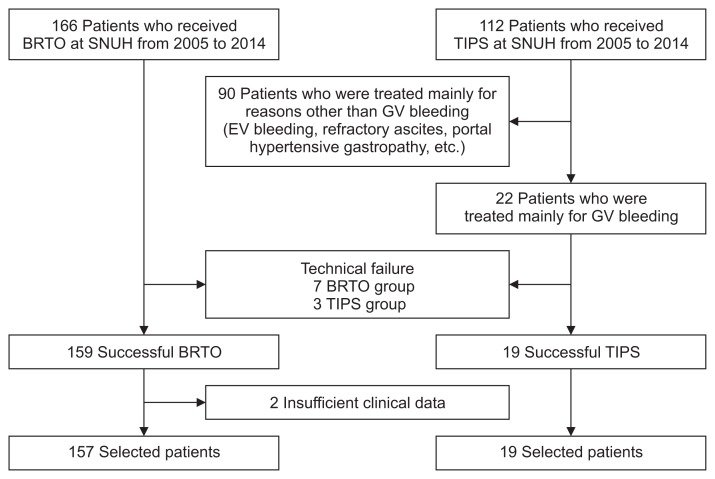
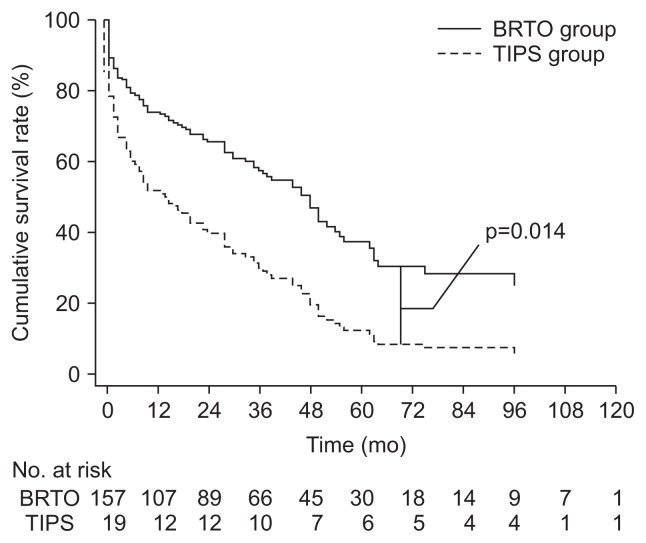
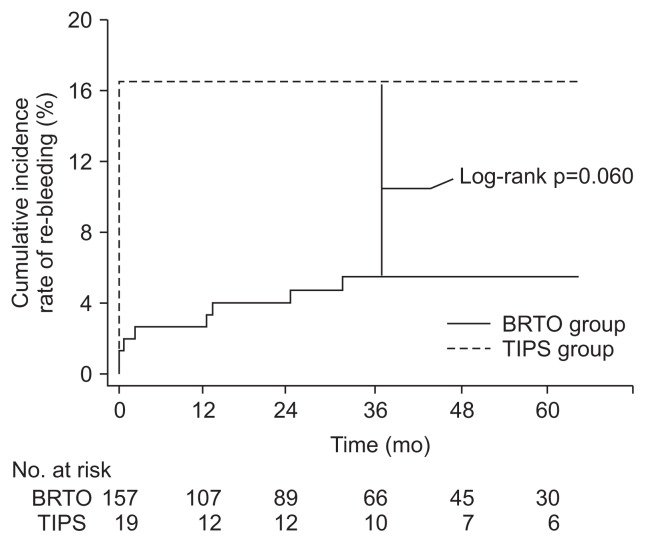
그림 출처: PubMed Central 공개 논문 (PMC6254622)
Comment · 정정
Conflict of interest statement
CONFLICTS OF INTEREST. No potential conflict of interest relevant to this article was reported.
그 밖의 정보
- 출판 형태
- Comparative Study, Journal Article
- 저널
- Gut and liver · eISSN 2005-1212
- MeSH
- Balloon Occlusion / methods · Esophageal and Gastric Varices / complications / surgery · Female · Gastrointestinal Hemorrhage / etiology / surgery · Hemostatic Techniques* · Humans · Male · Middle Aged · Multivariate Analysis · Portasystemic Shunt, Transjugular Intrahepatic / methods · Proportional Hazards Models · Retrospective Studies · Treatment Outcome
- 참고문헌
- 27편