
PLoS One. 2017;12(5):e0178419.
Clinical implications of pre-existing adenoma in endoscopically resected early gastric cancers.
제1저자 최지민 · 교신저자 김상균
소속 (3)
- Department of Internal Medicine, Healthcare Research Institute, Seoul National University Hospital Healthcare System Gangnam Center, Seoul, Korea.
- Department of Internal Medicine and Liver Research Institute, Seoul National University College of Medicine, Seoul, Korea.
- Department of Pathology, Seoul National University College of Medicine, Seoul, Korea.
Abstract
BACKGROUND Although gastric adenoma is widely accepted as a precursor of gastric cancer, pre-existing adenoma is not always detected in gastric cancer patients.
OBJECTIVE To investigate the clinical characteristics of early gastric cancer (EGC) arising from adenoma, compared with those of EGC without pre-existing adenoma.
METHODS Patients who underwent endoscopic resection for EGC at a single tertiary hospital were divided into two groups based on the presence (ex-adenoma group) or absence (de novo group) of pre-existing adenoma on pathologic specimens. Clinicopathologic characteristics, endoscopic features and long-term outcomes were analyzed.
RESULTS Of 1,509 patients, 236 (15.6%) were included in the ex-adenoma group. Mean age (P = 0.003) and Helicobacter pylori infection rate (P = 0.040) were significantly higher in the ex-adenoma than in the de novo group. Mean endoscopic size was significantly larger, elevated lesions were more prevalent (both P < 0.001), and carcinomas were more differentiated in the ex-adenoma group than in the de novo group (P = 0.037). The degree of atrophy (P = 0.025) or intestinal metaplasia (P < 0.001) was more advanced in the ex-adenoma group. Synchronous gastric neoplasia was significantly more prevalent in the ex-adenoma group (P < 0.001), whereas metachronous cancer recurrence rate was not significantly different between the two groups.
CONCLUSIONS EGCs with pre-existing adenoma show a greater association with H. pylori-related chronic inflammation than those without, which could explain the differences in the characteristics between groups. Potential differences in carcinogenic mechanisms between the groups were explored.
Figures

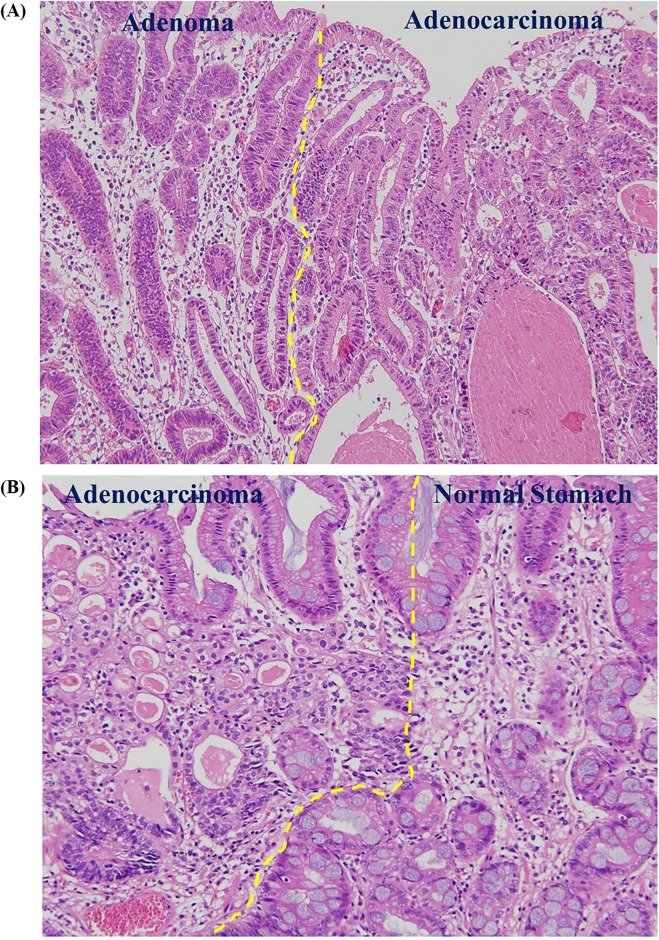

그림 출처: PubMed Central 공개 논문 (PMC5444828)
Conflict of interest statement
Competing Interests:The authors have declared that no competing interests exist.
그 밖의 정보
- 출판 형태
- Journal Article
- 저널
- PloS one · eISSN 1932-6203
- 전자 출판
- 2017-05-25
- MeSH
- Adenoma / pathology · Adenomatous Polyps / pathology · Aged · Atrophy / pathology · Early Detection of Cancer / methods · Female · Gastric Mucosa / pathology · Gastroscopy / methods · Helicobacter Infections / pathology · Humans · Incidence · Male · Metaplasia / pathology · Middle Aged · Neoplasm Recurrence, Local / pathology · Neoplasms, Multiple Primary / pathology · Neoplasms, Second Primary / pathology · Prevalence · Risk Factors · Stomach Neoplasms / pathology
- 참고문헌
- 28편