
PLoS One. 2017;12(5):e0176786.
Early onset hyperuricemia is a prognostic marker for kidney graft failure: Propensity score matching analysis in a Korean multicenter cohort.
제1저자 한미연 · 교신저자 오윤규, 김영훈
소속 (5)
- Department of Internal Medicine, Seoul National University College of Medicine, Seoul, Korea.
- Department of Internal Medicine, Seoul National University Boramae Medical Center, Seoul, Korea.
- Department of Surgery, Asan Medical Center and University of Ulsan College of Medicine, Seoul, Korea.
- Department of Surgery, Seoul National University College of Medicine, Seoul, Korea.
- Department of Surgery, Seoul National University Boramae Medical Center, Seoul, Korea.
Abstract
It remains inconclusive whether hyperuricemia is a true risk factor for kidney graft failure. In the current study, we investigated the association of hyperuricemia and graft outcome. We performed a multi-center cohort study that included 2620 kidney transplant recipients. The patients were classified as either normouricemic or hyperuricemic at 3 months after transplantation. Hyperuricemia was defined as a serum uric acid level ≥ 7.0 mg/dL in males or ≥ 6.0 mg/dL in females or based on the use of urate-lowering medications. The two groups were compared before and after propensity score matching. A total of 657 (25.1%) patients were classified as hyperuricemic. The proportion of hyperuricemic patients increased over time, reaching 44.2% of the total cohort at 5 years after transplantation. Estimated glomerular filtration rate and donor type were independently associated with hyperuricemia. Hyperuricemia was associated with graft loss according to multiple Cox regression analysis before propensity score matching (hazard ratio [HR] = 1.56, 95% confidence interval [CI] = 1.14-2.13, P = 0.005) as well as after matching (HR = 1.65, 95% CI = 1.13-2.42, p = 0.010). Cox regression models using time-varying hyperuricemia or marginal structural models adjusted with time-varying eGFR also demonstrated significant hazards of hyperuricemia for graft loss. Cardiovascular events and recipient survival were not associated with hyperuricemia. Overall, hyperuricemia, especially early onset after transplantation, showed an increased risk for graft failure. Further studies are warranted to determine whether lowering serum uric acid levels would be beneficial to graft survival.
Figures

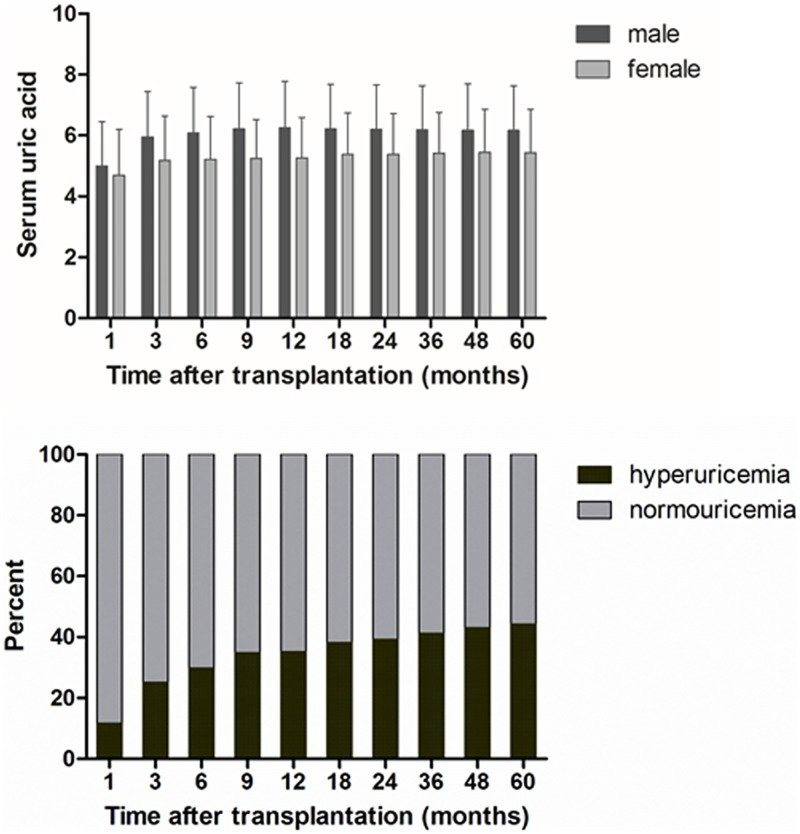

그림 출처: PubMed Central 공개 논문 (PMC5415138)
Comment · 정정
Conflict of interest statement
Competing Interests:The authors have declared that no competing interests exist.
그 밖의 정보
- 출판 형태
- Journal Article, Multicenter Study
- 저널
- PloS one · eISSN 1932-6203
- 전자 출판
- 2017-05-03
- MeSH
- Adult · Biomarkers / blood · Female · Graft Rejection / blood / diagnosis / etiology · Humans · Hyperuricemia / blood / diagnosis / etiology · Kidney Transplantation / adverse effects · Male · Prognosis · Propensity Score · Proportional Hazards Models · Republic of Korea · Risk Factors · Uric Acid / blood
- Substances
- Biomarkers · Uric Acid
- 참고문헌
- 44편