
Gut Liver. 2018;12(5):571-582.
Assessment of the Surveillance Interval at 1 Year after Curative Treatment in Hepatocellular Carcinoma: Risk Stratification.
제1저자 이민종 · 교신저자 김윤준
소속 (5)
- Department of Internal Medicine and Liver Research Institute, Seoul National University College of Medicine, Seoul, Korea.
- Department of Internal Medicine, Kangwon National University Hospital, Chuncheon, Korea.
- Department of Biostatistics, Seoul Metropolitan Government Seoul National University Boramae Medical Center, Seoul, Korea.
- Department of Surgery, Seoul National University College of Medicine, Seoul, Korea.
- Department of Radiology, Seoul National University College of Medicine, Seoul, Korea.
Abstract
BACKGROUND/AIMS Guidelines recommend surveillance for hepatocellular carcinoma (HCC) recurrence at 3-month intervals during the first year after curative treatment and 6-month intervals thereafter in all patients. This strategy does not reflect individual risk of recurrence. We aimed to stratify risk of recurrence to optimize surveillance intervals 1 year after treatment.
METHODS We retrospectively analyzed 1,316 HCC patients treated with resection/radiofrequency ablation at Barcelona Clinic Liver Cancer stage 0/A. In patients without 1-year recurrence under 3-monthly surveillance, a new model for recurrence was developed using backward elimination methods: training (n=582)/validation cohorts (n=291). Overall survival (OS) according to risk stratified by the new model was compared according to surveillance intervals: 3-monthly versus 6-monthly (n=401) after lead time bias correction and propensity-score matching analyses.
RESULTS Among patients without 1-year recurrence, age and international normalized ratio values were significant factors for recurrence (hazard ratio [HR], 1.03; 95% confidence interval [CI], 1.00 to 1.03; p=0.009 and HR, 5.63; 95% CI, 2.24 to 14.18; p<0.001; respectively). High-risk patients stratified by the new model showed significantly higher recurrence rates than low-risk patients in the validation cohort (HR, 1.73; 95% CI, 1.18 to 2.53; p=0.005). After propensity-score matching between the 3-monthly and 6-monthly surveillance groups, OS in high-risk patients under 3-monthly surveillance was significantly higher than that under 6-monthly surveillance (p=0.04); however, OS in low-risk patients under 3-monthly surveillance was not significantly different from that under 6-monthly surveillance (p=0.17).
CONCLUSIONS In high-risk patients, 3-monthly surveillance can prolong survival compared to 6-monthly surveillance. However, in low-risk patients, 3-monthly surveillance might not be beneficial for survival compared to 6-monthly surveillance.
Keywords
Carcinoma, hepatocellularCurative treatmentRisk stratificationSurveillance interval
Figures
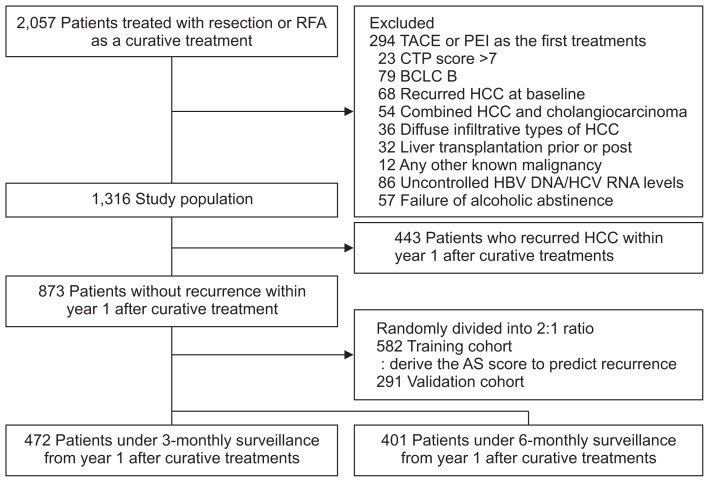
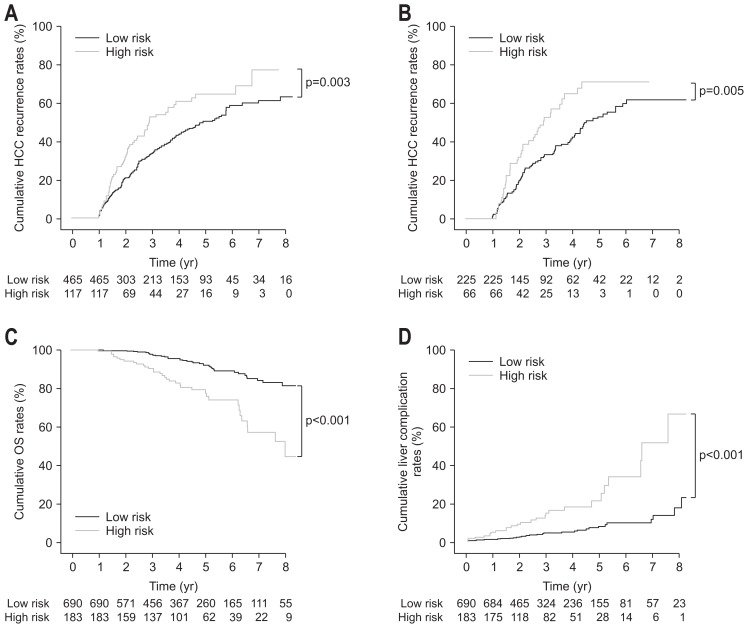
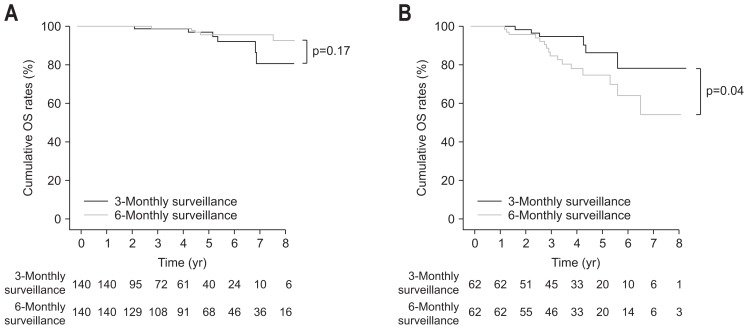
그림 출처: PubMed Central 공개 논문 (PMC6143446)
Conflict of interest statement
CONFLICTS OF INTEREST. No potential conflict of interest relevant to this article was reported.
그 밖의 정보
- 출판 형태
- Evaluation Study, Journal Article
- 저널
- Gut and liver · eISSN 2005-1212
- MeSH
- Aged · Carcinoma, Hepatocellular / diagnosis / surgery · Female · Hepatectomy / statistics & numerical data · Humans · Liver Neoplasms / diagnosis / surgery · Male · Middle Aged · Neoplasm Recurrence, Local / diagnosis · Population Surveillance / methods · Propensity Score · Proportional Hazards Models · Radiofrequency Ablation / statistics & numerical data · Retrospective Studies · Risk Assessment / methods · Time Factors*
- 참고문헌
- 28편