
PLoS One. 2017;12(4):e0175830.
Early dialysis initiation does not improve clinical outcomes in elderly end-stage renal disease patients: A multicenter prospective cohort study.
제1저자 박재윤 · 교신저자 이정표
소속 (8)
- Department of Internal Medicine, Dongguk University Ilsan Hospital, Gyeonggi-do, Korea.
- Department of Internal Medicine, Dongguk University Medical Center, Gyeongsangbuk-do, Korea.
- Department of Internal Medicine, Seoul National University College of Medicine, Seoul, Korea.
- Department of Internal Medicine, Yonsei University College of Medicine, Seoul, Korea.
- Department of Internal Medicine, The Catholic University of Korea College of Medicine, Seoul, Korea.
- Department of Internal Medicine, Chonnam National University Medical School, Gwangju, Korea.
- Department of Internal Medicine, Kyungpook National University School of Medicine, Daegu, Korea.
- Department of Internal Medicine, Seoul National University Boramae Medical Center, Seoul, Korea.
Abstract
BACKGROUND The optimal timing for initiating dialysis in end-stage renal disease (ESRD) is controversial, especially in the elderly.
METHODS 665 patients ≥65 years old who began dialysis from August 2008 to February 2015 were prospectively enrolled in the Clinical Research Center for End-Stage Renal Disease cohort study. Participants were divided into 2 groups based on the median estimated glomerular filtration rate at the initiation of dialysis. Propensity score matching (PSM) was used to compare the overall survival rate, cardiovascular events, Kidney Disease Quality of Life Short Form 36 (KDQOL-36) results, Karnofsky performance scale values, Beck's depression inventory values, and subjective global assessments.
RESULTS The mean patient age was 72.0 years, and 61.7% of the patients were male. Overall, the cumulative survival rates were lower in the early initiation group, although the difference was not significant after PSM. Additionally, the survival rates of the 2 groups did not differ after adjusting for age, sex, Charlson comorbidity index and hemoglobin, serum albumin, serum calcium and phosphorus levels. Although the early initiation group showed a lower physical component summary score on the KDQOL-36 3 months after dialysis, the difference in scores was not significant 12 months after dialysis. Furthermore, the difference was not significant after PSM. The Karnofsky performance scale, Beck's depression inventory, and subjective global assessments were not significantly different 3 and 12 months after dialysis initiation.
CONCLUSIONS The timing of dialysis initiation is not associated with clinical outcomes in elderly patients with ESRD.
Figures

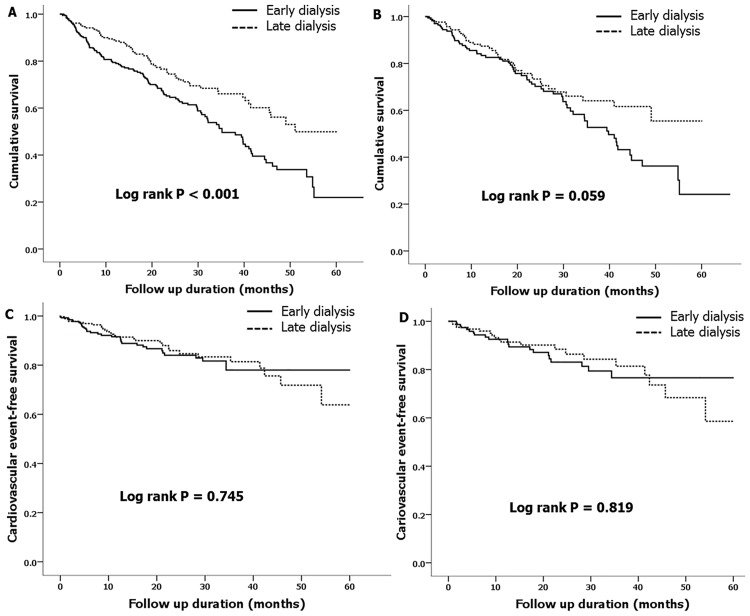
그림 출처: PubMed Central 공개 논문 (PMC5393880)
Conflict of interest statement
Competing Interests:The authors have declared that no competing interests exist.
그 밖의 정보
- 출판 형태
- Journal Article, Multicenter Study
- 저널
- PloS one · eISSN 1932-6203
- 전자 출판
- 2017-04-17
- MeSH
- Aged · Calcium / blood · Female · Glomerular Filtration Rate / physiology · Hemoglobins / metabolism · Humans · Karnofsky Performance Status · Kidney Failure, Chronic / blood / metabolism / physiopathology / therapy · Male · Phosphorus / blood · Propensity Score · Prospective Studies · Quality of Life · Renal Dialysis / methods · Renal Insufficiency, Chronic / blood / metabolism / pathology / therapy · Serum Albumin / metabolism · Survival Rate
- Substances
- Hemoglobins · Serum Albumin · Phosphorus · Calcium
- 참고문헌
- 35편