
PLoS One. 2017;12(3):e0171842.
Lower serum potassium associated with increased mortality in dialysis patients: A nationwide prospective observational cohort study in Korea.
제1저자 이선화 · 교신저자 이하정
소속 (8)
- Department of Internal Medicine, Seoul National University Hospital, Seoul, Republic of Korea.
- Department of Internal Medicine, Dongguk University Gyeongju Hospital, Gyeongju, Republic of Korea.
- Seoul National University Hospital, Medical Research Collaborating Center, Seoul, Republic of Korea.
- Seoul National University Kidney Research Institute, Seoul, Republic of Korea.
- Department of Internal Medicine, Kyungpook National University Hospital, Daegu, Republic of Korea.
- Department of Internal Medicine, Yonsei University College of Medicine, Seoul, Republic of Korea.
- Department of Internal Medicine, Seoul St. Mary's Hospital, Seoul, Republic of Korea.
- Department of Internal Medicine, Chonnam National University Hospital, Gwangju, Republic of Korea.
Abstract
BACKGROUND Abnormal serum potassium concentration has been suggested as a risk factor for mortality in patients undergoing dialysis patients. We investigated the impact of serum potassium levels on survival according to dialysis modality.
METHODS A nationwide, prospective, observational cohort study for end stage renal disease patients has been ongoing in Korea since August 2008. Our analysis included patients whose records contained data regarding serum potassium levels. The relationship between serum potassium and mortality was analyzed using competing risk regression.
RESULTS A total of 3,230 patients undergoing hemodialysis (HD, 64.3%) or peritoneal dialysis (PD, 35.7%) were included. The serum potassium level was significantly lower (P < 0.001) in PD (median, 4.5 mmol/L; interquartile range, 4.0-4.9 mmol/L) than in HD patients (median, 4.9 mmol/L; interquartile range, 4.5-5.4 mmol/L). During 4.4 ± 1.7 years of follow-up, 751 patients (23.3%) died, mainly from cardiovascular events (n = 179) and infection (n = 120). In overall, lower serum potassium level less than 4.5 mmol/L was an independent risk factor for mortality after adjusting for age, comorbidities, and nutritional status (sub-distribution hazard ratio, 1.30; 95% confidence interval 1.10-1.53; P = 0.002). HD patients showed a U-shaped survival pattern, suggesting that both lower and higher potassium levels were deleterious, although insignificant. However, in PD patients, only lower serum potassium level (<4.5 mmol/L) was an independent predictor of mortality (sub-distribution hazard ratio, 1.35; 95% confidence interval 1.00-1.80; P = 0.048).
CONCLUSION Lower serum potassium levels (<4.5 mmol/L) occur more commonly in PD than in HD patients. It represents an independent predictor of survival in overall dialysis, especially in PD patients. Therefore, management of dialysis patients should focus especially on reducing the risk of hypokalemia, not only that of hyperkalemia.
Figures

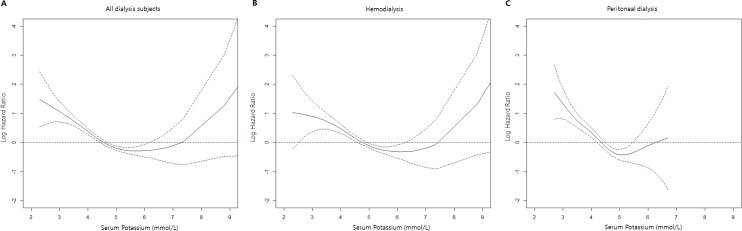
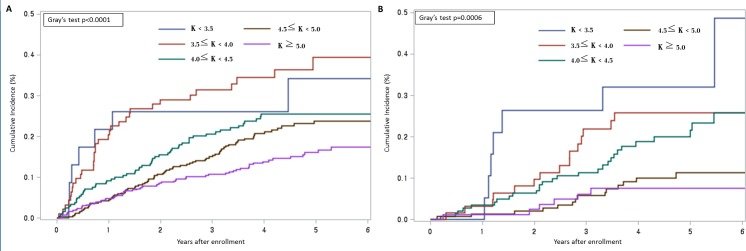
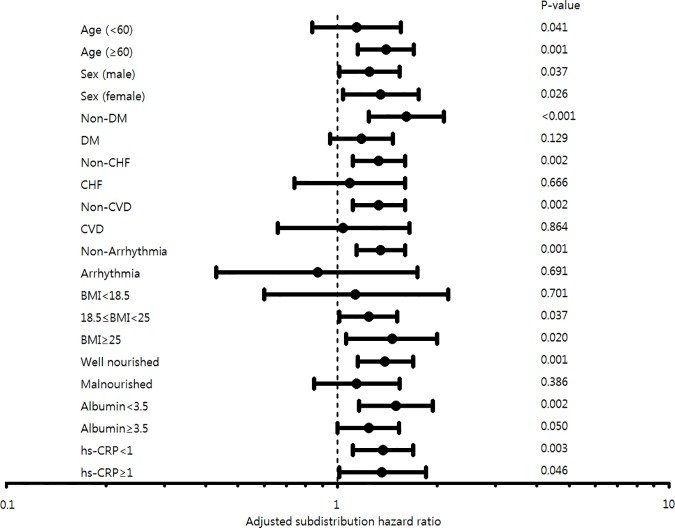
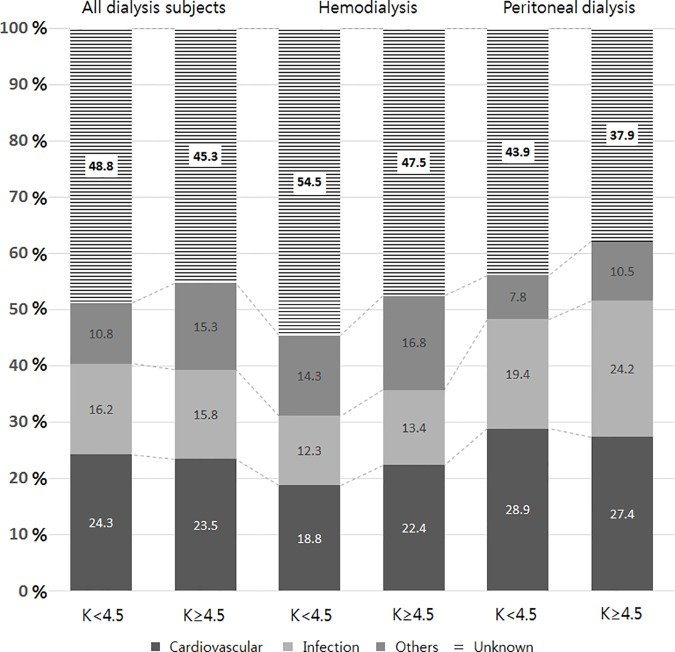
그림 출처: PubMed Central 공개 논문 (PMC5338775)
Conflict of interest statement
Competing Interests:The authors have declared that no competing interests exist.
그 밖의 정보
- 출판 형태
- Journal Article, Multicenter Study, Observational Study
- 저널
- PloS one · eISSN 1932-6203
- 전자 출판
- 2017-03-06
- MeSH
- Cause of Death · Female · Humans · Incidence · Kidney Failure, Chronic / blood / epidemiology / mortality / therapy · Male · Middle Aged · Potassium / blood · Proportional Hazards Models · Prospective Studies · Renal Dialysis / mortality · Republic of Korea / epidemiology
- Substances
- Potassium
- 참고문헌
- 52편