
PLoS One. 2017;12(11):e0188375.
Short-term anti-proteinuric effect of tacrolimus is not related to preservation of the glomerular filtration rate in IgA nephropathy: A 5-year follow-up study.
제1저자 유미연 · 교신저자 진호준
소속 (5)
- Department of Internal Medicine, Seoul National University Hospital, Seoul, Korea.
- Department of Internal Medicine, Inje University Seoul Paik Hospital, Seoul, Korea.
- Department of Internal Medicine, Seoul National University Bundang Hospital, Seong-Nam, Korea.
- Department of Internal Medicine, Seoul National University College of Medicine, Seoul, Korea.
- Renal Institute, Seoul National University Medical Research Center, Seoul, Korea.
Abstract
BACKGROUND The immunosuppressive drug tacrolimus has the short-term effect of reducing proteinuria in patients with immunoglobulin A nephropathy (IgAN). Our study investigated the effects on proteinuria and kidney function after discontinuation of tacrolimus.
METHODS Patients with biopsy-proven IgAN were included in the study and randomly divided into two treatment groups. There was a corresponding control group for each treatment group. The first group included patients treated with tacrolimus (Tac vs non-Tac group) and the second group included patients with a renin angiotensin system blocker (RASi vs non-RASi group). The Tac group received treatment for up to 16 weeks, with the administration of tacrolimus being ceased at the final visit (trial phase). We tracked the patients at 12, 24, 52, and 240 weeks (observational phase). The primary outcomes examined were the percentage change (from the trial phase to the observational phase) of time-averaged proteinuria (TA-proteinuria; g/g creatinine [cr]) and the estimated glomerular filtration rate (eGFR). Time-averaged proteinuria was defined as the average of urine protein to creatinine ratio (UPCR), measured every 3 months during both the trial and observational phases of the study.
RESULTS A significant reduction in UPCR was observed in the Tac group compared to non-Tac group at the 4 and 8 week visits during the trial phase (p = 0.023 and p = 0.003, respectively). However, the difference between the Tac group and non-Tac group was not evident in the other review periods, estimated by linear mixed effect model. The percentage change in TA-proteinuria was greater in the Tac group than that in the corresponding control group (116 ± 96% vs. 63 ± 239%, p = 0.004). Therefore, during the observational phase, TA-proteinuria was not significantly different between the Tac group and the non-Tac group (1.150 ± 0.733 g/g cr vs. 1.455 ± 2.017 g/g cr, p = 0.775). The levels of eGFR throughout the observational phase were not significantly different between the two groups. Furthermore, the mean rate of eGFR change throughout both phases of the study was -6.4 ± 5.9 mL/min/1.73 m2/year in the non-Tac group and -5.4 ± 7.9 mL/min/1.73 m2/year in the Tac group (p = 0.988).
CONCLUSION The anti-proteinuric effect of tacrolimus was promptly reversed 3 months after discontinuing the drug. The use of tacrolimus for a short period of time for patients with IgAN temporarily reduces proteinuria, but the data showed no long-term efficacy regarding proteinuria reduction and improvement of renal function.
Figures
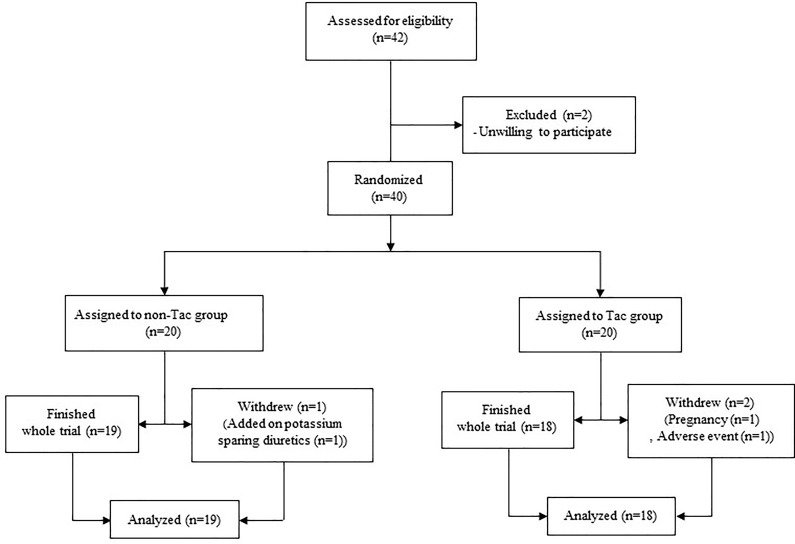
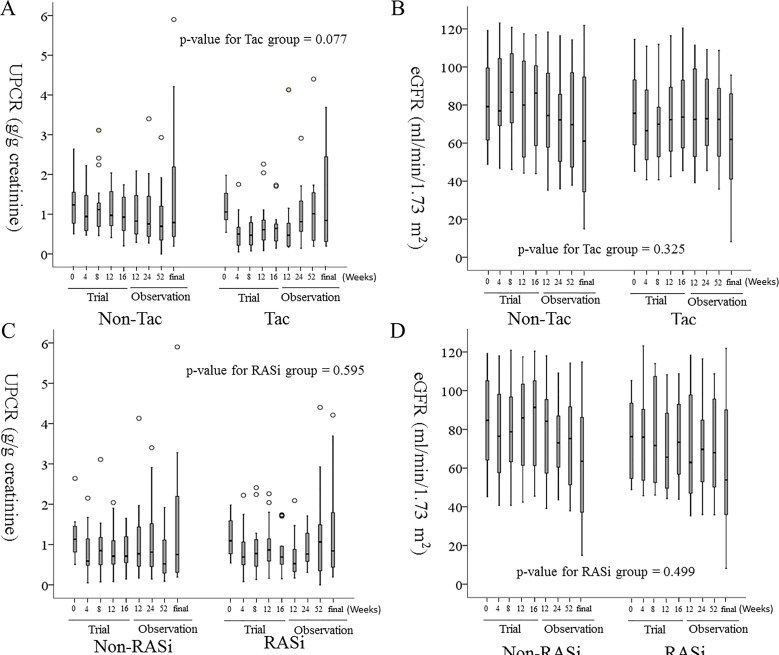
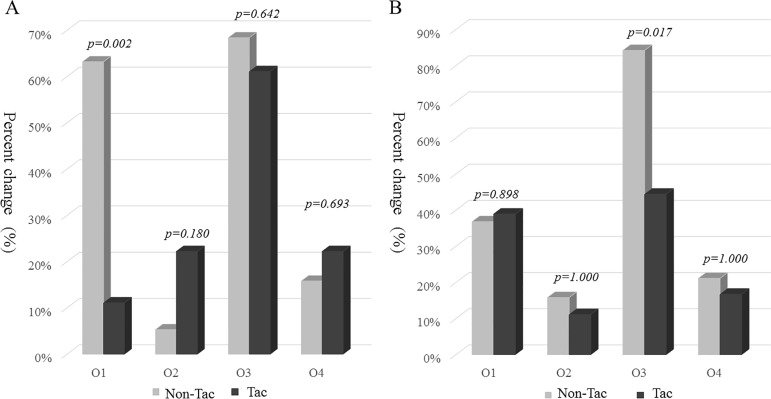
그림 출처: PubMed Central 공개 논문 (PMC5695802)
Comment · 정정
Conflict of interest statement
Competing Interests:The authors have declared that no competing interests exist.
그 밖의 정보
- 출판 형태
- Journal Article, Randomized Controlled Trial
- 저널
- PloS one · eISSN 1932-6203
- 전자 출판
- 2017-11-20
- MeSH
- Adult · Antihypertensive Agents / therapeutic use · Captopril / therapeutic use · Creatinine / urine · Double-Blind Method · Drug Administration Schedule · Drug Therapy, Combination · Female · Follow-Up Studies · Glomerular Filtration Rate / drug effects · Glomerulonephritis, IGA / drug therapy / physiopathology / urine · Humans · Immunosuppressive Agents / therapeutic use · Male · Middle Aged · Proteinuria / drug therapy / physiopathology / urine · Renin-Angiotensin System / drug effects · Tacrolimus / therapeutic use · Treatment Outcome · Valsartan / therapeutic use
- Substances
- Antihypertensive Agents · Immunosuppressive Agents · Valsartan · Captopril · Creatinine · Tacrolimus
- 참고문헌
- 29편