
PLoS One. 2017;12(1):e0169063.
Lower Education Level Is a Risk Factor for Peritonitis and Technique Failure but Not a Risk for Overall Mortality in Peritoneal Dialysis under Comprehensive Training System.
제1저자 김효진 · 교신저자 오국환
소속 (4)
- Department of Internal Medicine, Dongguk University Gyeongju Hospital, Gyeongju-si, Gyeongsangbuk-do, Korea.
- Medical Research Collaborating Center, Seoul National University Hospital, Seoul, Korea.
- Department of Internal Medicine, Seoul National University Hospital, Seoul, Korea.
- Department of Internal Medicine, Hongseong Medical Center, Hongseong, Korea.
Abstract
BACKGROUND Lower education level could be a risk factor for higher peritoneal dialysis (PD)-associated peritonitis, potentially resulting in technique failure. This study evaluated the influence of lower education level on the development of peritonitis, technique failure, and overall mortality.
METHODS Patients over 18 years of age who started PD at Seoul National University Hospital between 2000 and 2012 with information on the academic background were enrolled. Patients were divided into three groups: middle school or lower (academic year≤9, n = 102), high school (9<academic year≤12, n = 229), and higher than high school (academic year>12, n = 324). Outcomes were analyzed using Cox proportional hazards models and competing risk regression.
RESULTS A total of 655 incident PD patients (60.9% male, age 48.4±14.1 years) were analyzed. During follow-up for 41 (interquartile range, 20-65) months, 255 patients (38.9%) experienced more than one episode of peritonitis, 138 patients (21.1%) underwent technique failure, and 78 patients (11.9%) died. After adjustment, middle school or lower education group was an independent risk factor for peritonitis (adjusted hazard ratio [HR], 1.61; 95% confidence interval [CI], 1.10-2.36; P = 0.015) and technique failure (adjusted HR, 1.87; 95% CI, 1.10-3.18; P = 0.038), compared with higher than high school education group. However, lower education was not associated with increased mortality either by as-treated (adjusted HR, 1.11; 95% CI, 0.53-2.33; P = 0.788) or intent-to-treat analysis (P = 0.726).
CONCLUSIONS Although lower education was a significant risk factor for peritonitis and technique failure, it was not associated with increased mortality in PD patients. Comprehensive training and multidisciplinary education may overcome the lower education level in PD.
Figures
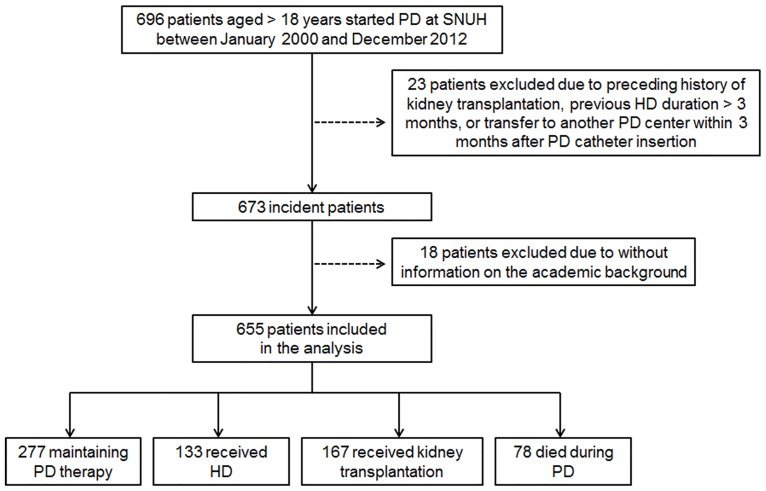
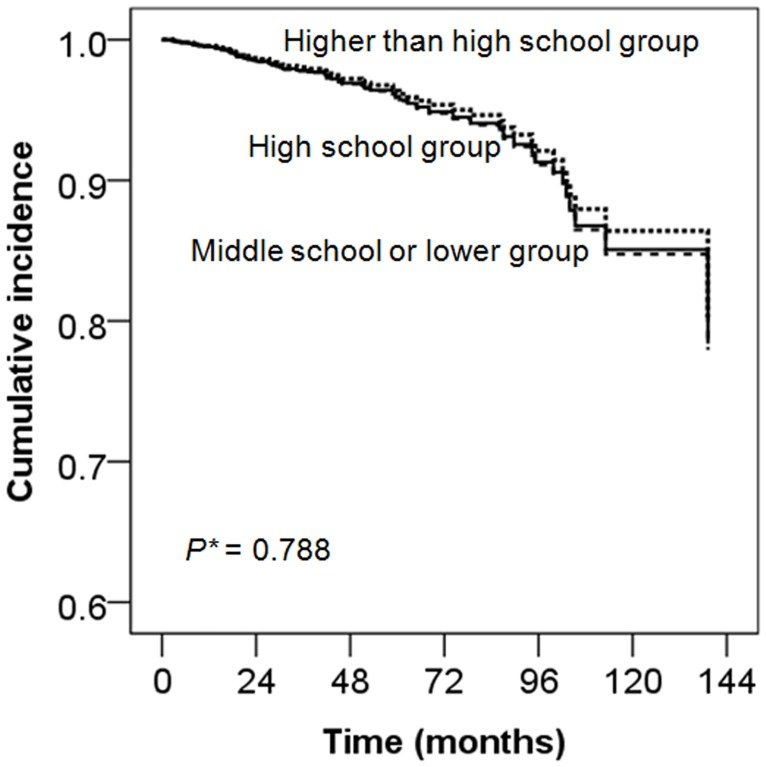
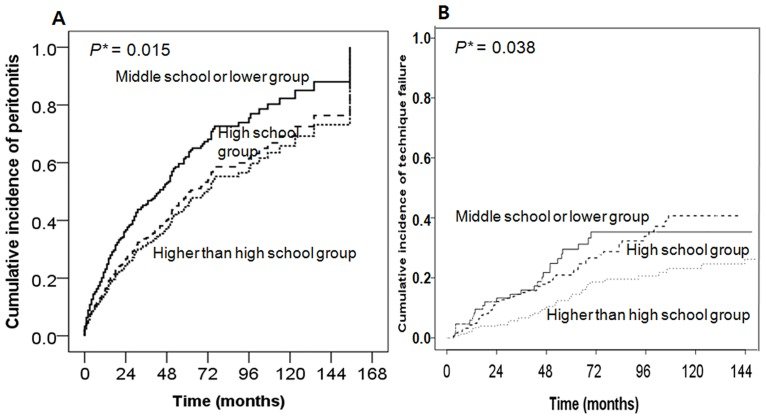
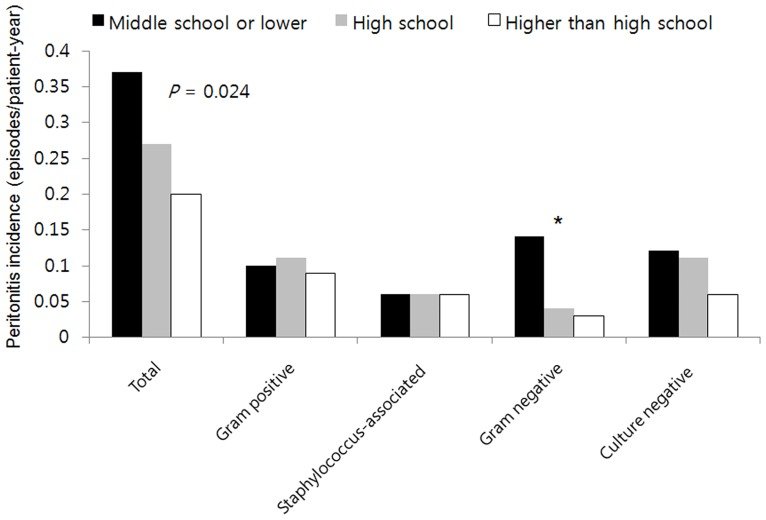
그림 출처: PubMed Central 공개 논문 (PMC5215932)
Conflict of interest statement
The authors have declared that no competing interests exist.
그 밖의 정보
- 출판 형태
- Journal Article
- 저널
- PloS one · eISSN 1932-6203
- 전자 출판
- 2017-01-05
- MeSH
- Adult · Educational Status* · Female · Humans · Male · Middle Aged · Peritoneal Dialysis / adverse effects · Peritonitis / epidemiology / etiology · Proportional Hazards Models · Risk Factors
- 참고문헌
- 27편