
PLoS One. 2017;12(1):e0170394.
Validation of a Modified Child-Turcotte-Pugh Classification System Utilizing Insulin-Like Growth Factor-1 for Patients with Hepatocellular Carcinoma in an HBV Endemic Area.
제1저자 이동현 · 교신저자 이정훈, 정용진
소속 (6)
- Department of Internal Medicine, Seoul Metropolitan Government Seoul National University Boramae Medical Center, Seoul, Republic of Korea.
- Department of Internal Medicine and Liver Research Institute, Seoul National University College of Medicine, Seoul National University Hospital, Seoul, Republic of Korea.
- Institute of Health and Environment, Seoul National University, Seoul, Republic of Korea.
- Department of Internal Medicine, CHA Gangnam Medical Center, CHA University, Seoul, Republic of Korea.
- Department of Gastroenterology and Hepatology, Soonchunhyang University School of Medicine, Bucheon, Republic of Korea.
- Department of Internal Medicine, Kangwon National University Hospital, Chuncheon, Republic of Korea.
Abstract
BACKGROUND Recently, a modified insulin-like growth factor-1 (IGF)-Child-Turcotte-Pugh (CTP) classification was proposed to improve the original CTP classification. This study aimed to validate the new IGF-CTP classification system as a prognostic maker for patients with hepatocellular carcinoma (HCC) in a hepatitis B virus endemic area.
METHODS We conducted a post-hoc analysis of a prospective cohort study. We used Harrell's C-index and U-statistics to compare the prognostic performance of both IGF-CTP and CTP classifications for overall survival. We evaluated the relationship between HCC stage and the four components of the IGF-CTP classification (serum levels of IGF-1, albumin, and total bilirubin and prothrombin time [PT]) using nonparametric trend analysis.
RESULTS We included a total of 393 patients in this study. In all, 55 patients died during the median follow-up of 59.1 months. There was a difference between IGF-CTP class and CTP class in 14% of patients. Overall, the IGF-CTP classification system had a higher prognostic value (C-index = 0.604, 95% confidence interval [CI] = 0.539-0.668) than the CTP system (C-index = 0.558, 95% CI = 0.501-0.614), but the difference was not statistically significant (P = .07 by U-statistics). A lower serum level of IGF-1 was related to a more advanced cancer stage (P < .01). The remaining components of the IGF-CTP classification were not significantly related to tumor stage (P = .11 for total bilirubin; P = .33 for albumin; and P = .39 for PT).
CONCLUSIONS The IGF-CTP classification was slightly better than the original CTP classification for predicting survival of patients with HCC in a chronic hepatitis B endemic area. This is most likely due to the fact that serum IGF-1 levels reflect underlying HCC status.
Figures

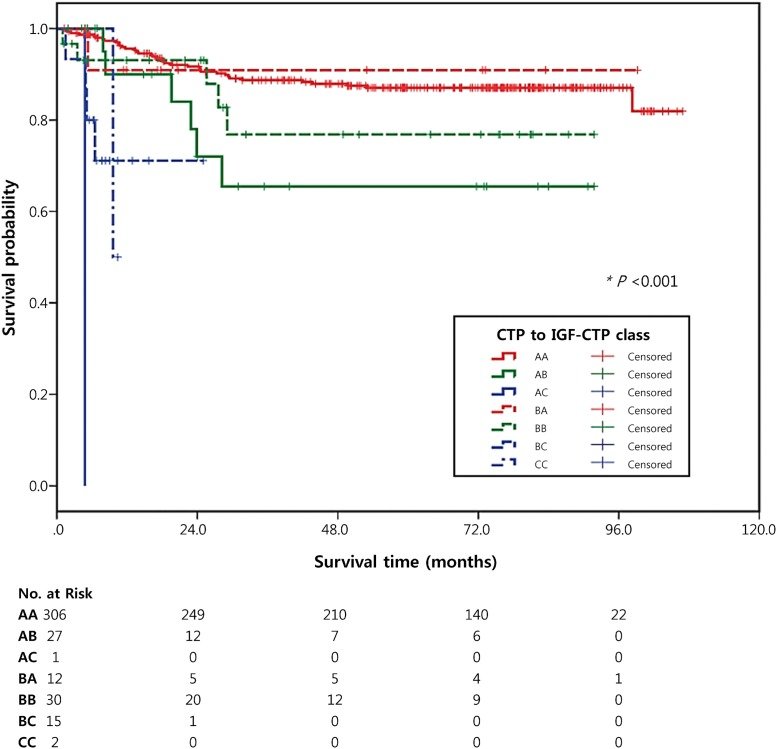
그림 출처: PubMed Central 공개 논문 (PMC5249174)
Conflict of interest statement
The authors have declared that no competing interests exist.
그 밖의 정보
- 출판 형태
- Journal Article, Validation Study
- 저널
- PloS one · eISSN 1932-6203
- 전자 출판
- 2017-01-20
- MeSH
- Aged · Carcinoma, Hepatocellular / metabolism · Endemic Diseases · Female · Hepatitis B virus / pathogenicity · Humans · Insulin-Like Growth Factor I / metabolism · Liver Neoplasms / metabolism · Male · Middle Aged
- Substances
- Insulin-Like Growth Factor I
- 참고문헌
- 36편