
J Am Heart Assoc. 2019;8(23):e012771.
Low Lipid Levels and High Variability are Associated With the Risk of New-Onset Atrial Fibrillation.
제1저자 이현정, 이소령 · 교신저자 최의근
소속 (2)
- Department of Internal Medicine Seoul National University Hospital Seoul Republic of Korea.
- Department of Medical Statistics College of Medicine The Catholic University of Korea Seoul Republic of Korea.
Abstract
Background While high levels of lipids and lipid variability are established risk factors for atherosclerotic cardiovascular disease, their roles in the development of atrial fibrillation (AF) are unclear, with previous studies suggesting a "cholesterol paradox." Methods and Results A nationwide population-based cohort of 3 660 385 adults (mean age 43.4 years) from the Korean National Health Insurance Service database, with ≥3 annual lipid measurements from 2009 to 2012 and without a history of AF or prescription of lipid-lowering medication before 2012, were identified. Total cholesterol, low-density lipoprotein cholesterol, high-density lipoprotein cholesterol, and triglycerides levels were measured, and lipid variability was calculated using variability independent of the mean. The cohort was divided into quartiles by lipid levels and lipid variability and followed up for incident AF. During a median 5.4 years of follow-up, AF was newly diagnosed in 27 581 (0.75%). AF development was inversely associated with high lipid levels (for top versus bottom quartile; total cholesterol, HR 0.78, 95% CI 0.76-0.81; low-density lipoprotein cholesterol, HR 0.81, 95% CI 0.78-0.84; high-density lipoprotein cholesterol, HR 0.94, 95% CI 0.91-0.98; triglycerides, HR 0.88, 95% CI 0.85-0.92). Meanwhile, AF development was associated with high lipid variability (for top versus bottom quartile; total cholesterol, HR 1.09, 95% CI 1.06-1.13; low-density lipoprotein cholesterol, HR 1.12, 95% CI 1.08-1.16; high-density lipoprotein cholesterol, HR 1.08, 95% CI 1.04-1.12; triglycerides, HR 1.05, 95% CI 1.01-1.08). Men showed greater risk reduction with high triglyceride levels and greater risk with high triglyceride variability for incident AF. Conclusions Low cholesterol levels and high cholesterol variability were associated with a higher risk of AF development.
Keywords
atrial fibrillationcholesterolhypercholesterolemialipidvariability
Figures

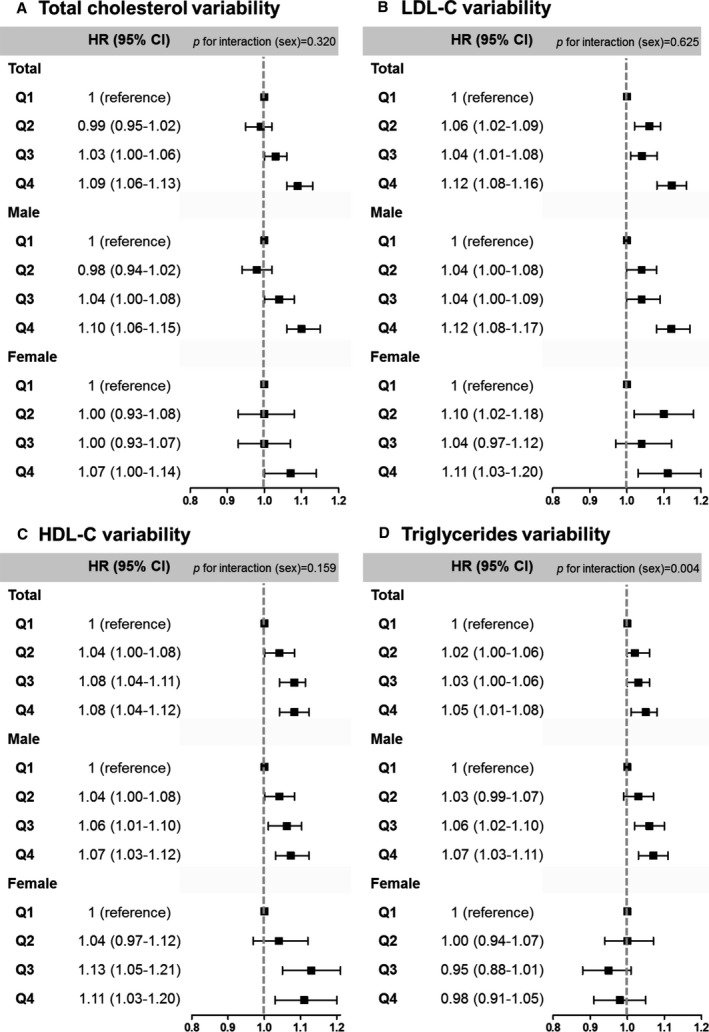
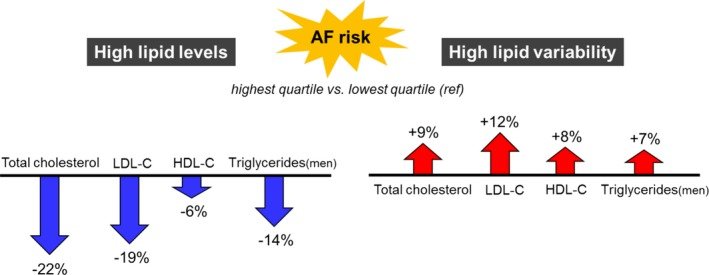
그림 출처: PubMed Central 공개 논문 (PMC6912974)
그 밖의 정보
- 출판 형태
- Journal Article, Research Support, Non-U.S. Gov't
- 저널
- Journal of the American Heart Association · eISSN 2047-9980
- 전자 출판
- 2019-11-27
- MeSH
- Adult · Atrial Fibrillation / blood / epidemiology · Cholesterol / blood · Female · Humans · Male · Middle Aged · Retrospective Studies · Risk Assessment · Triglycerides / blood
- Substances
- Triglycerides · Cholesterol
- 참고문헌
- 44편