
Sci Rep. 2022;12(1):22224.
Association of body composition fat parameters and breast density in mammography by menopausal status.
제1저자 추아정, 성파멜라 · 교신저자 정지봉
소속 (5)
- Department of Radiology, Seoul Metropolitan Government Seoul National University Boramae Medical Center, Seoul, Republic of Korea.
- Department of Surgery, Seoul Metropolitan Government Seoul National University Boramae Medical Center, Seoul, Republic of Korea.
- Department of Surgery, Seoul National University College of Medicine, Seoul, Republic of Korea.
- Division of Gastroenterology, Department of Internal Medicine, Seoul Metropolitan Government Seoul National University Boramae Medical Center, 20, Boramae-ro 5-gil, Dongjak-gu, Seoul, 07061, Republic of Korea.
- Division of Gastroenterology, Department of Internal Medicine, Seoul Metropolitan Government Seoul National University Boramae Medical Center, 20, Boramae-ro 5-gil, Dongjak-gu, Seoul, 07061, Republic of Korea. jibjeong@snu.ac.kr.
Abstract
We investigated the relationship between body fat-driven obesity and breast fat density in mammography according to menopausal status. We retrospectively analyzed 8537 women (premenopausal, n = 4351; postmenopausal, n = 4186). Body fat parameters included BMI (body mass index), waist circumference (WC), waist-hip ratio (WHR), fat mass index (FMI), Percentage of body fat (PBF), and visceral fat area (VFA). Body fat-driven obesity was defined as follows: overall obesity, BMI ≥ 25 kg/m2; central obesity, WC > 85 cm; abdominal obesity, WHR > 0.85; excessive FMI, the highest quartile (Q4) of FMI; excessive PBF, the highest quartile (Q4) of VFA; visceral obesity, and the highest quartile (Q4) of VFA). Breast density was classified according to BI-RADS (grade a, b, c, and d), which defined as an ordinal scale (grade a = 1, grade b = 2, grade c = 3, and grade d = 4). All body fat-driven obesity parameters were negatively associated with the grade of breast density in both groups of women (p < 0.001): The more fatty parameters are, the less dense breast is. In multivariable binary logistic regression, all body fat-driven obesity parameters also showed a negative association with grade d density (vs. grade a, b, or c). In premenopausal women, BMI was a more associated parameter with grade d density than those of the other fat-driven parameters (OR 0.265, CI 0.204-0.344). In postmenopausal women, WC was more associated with grade d density than the others (OR 0.315, CI 0.239-0.416). We found that BMI, WC, WHR, FMI, PBF and VFA were negatively correlated with dense breast, and the association degree pattern between body fat-driven obesity and dense breast differs according to menopausal status.
© 2022. The Author(s).
Figures
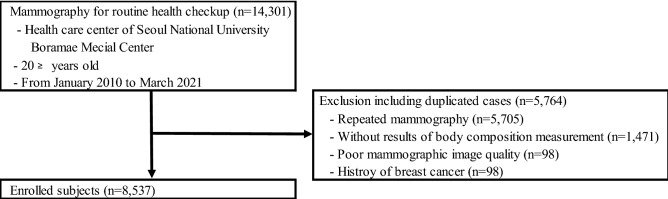
그림 출처: PubMed Central 공개 논문 (PMC9789058)
Conflict of interest statement
The authors declare no competing interests.
그 밖의 정보
- 출판 형태
- Journal Article
- 저널
- Scientific reports · eISSN 2045-2322
- 전자 출판
- 2022-12-23
- MeSH
- Humans · Female · Breast Density* · Retrospective Studies · Mammography · Breast Neoplasms* · Body Composition · Adipose Tissue / diagnostic imaging · Obesity · Body Mass Index · Waist Circumference · Obesity, Abdominal · Menopause
- 참고문헌
- 28편