Division of Pulmonology and Critical Care Medicine, Department of Internal Medicine and Respiratory Center, Seoul National University Bundang Hospital, Seongnam, Republic of Korea.
Toolgen Inc., Seoul, Republic of Korea.
Department of Internal Medicine, Seoul National University College of Medicine, Seoul, Republic of Korea.
Department of Pathology, Seoul National University Bundang Hospital, Seongnam, Republic of Korea.
Department of Internal Medicine, Korea Cancer Center Hospital, Seoul, Republic of Korea.
Abstract
Tyrosine kinase inhibitors (TKIs) such as gefitinib and erlotinib are effective against lung adenocarcinomas harboring epidermal growth factor receptor (EGFR) mutations. However, cancer cells can develop resistance to these agents with prolonged exposure; in over 50% of cases, this is attributable to the EGFR T790M mutation. Moreover, additional resistance mutations can arise with the use of new drugs. Cancer cell lines with specific mutations can enable the study of resistance mechanisms. In this study, we introduced the EGFR T790M mutation into the PC9 human lung cancer cell line-which has a deletion in exon 19 of the EGFR gene-by clustered regularly interspaced short palindromic repeats (CRISPR)/CRISPR-associated (Cas)9-mediated genome editing. EGFR pyrosequencing and peptide nucleic acid clamping revealed that PC9 cells with EGFR T790M generated by CRISPR/Cas 9 had a higher T790M mutation rate than those with the same mutation generated by long-term exposure to gefitinib (PC9-G); moreover, resistance to gefitinib in these clones was higher than that in PC9-G cells. The clones were also highly sensitive to the 3rd-generation EGFR TKI AZD9291, which is cytotoxic to lung cancer cells with EGFR T790M. The CRISPR/Cas9 programmable nuclease system can be used to generate various cancer cell lines with specific mutations that can facilitate studies on resistance mechanisms and drug efficacy.
Keywords
CRISPR/Cas9EGFR T790Mlung cancerresistance
Figures
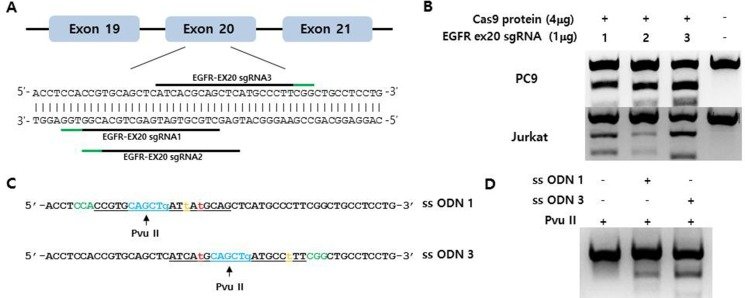
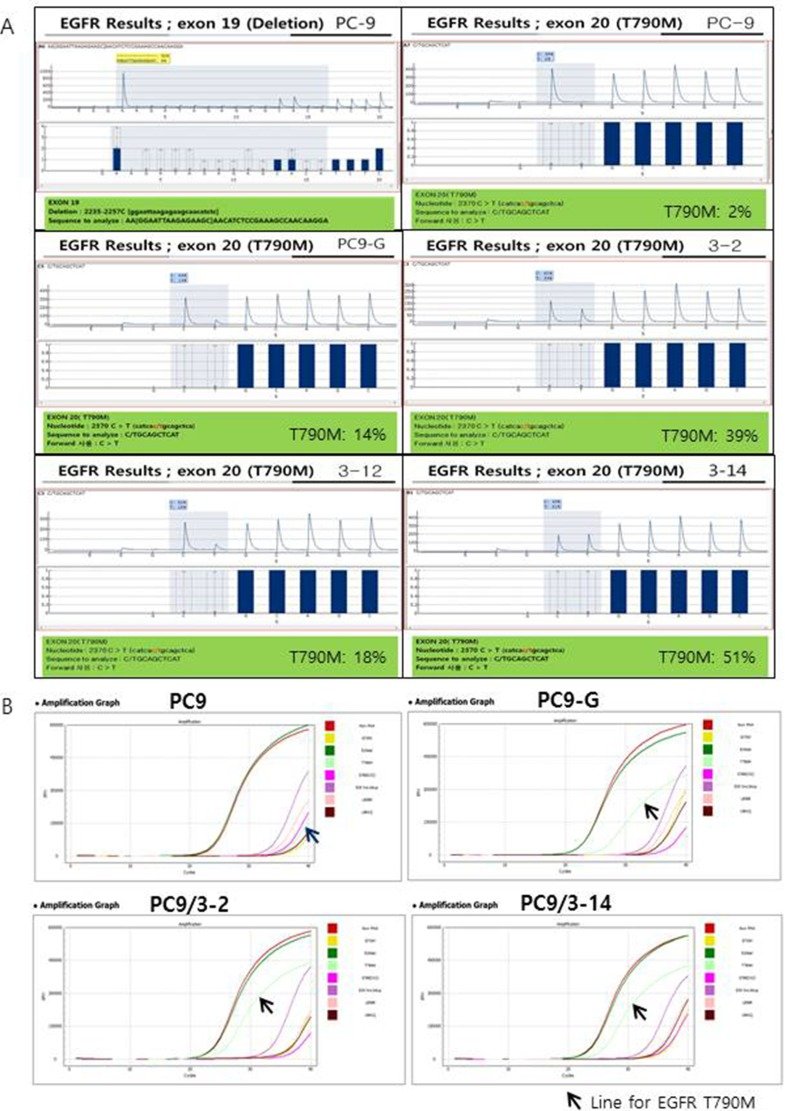
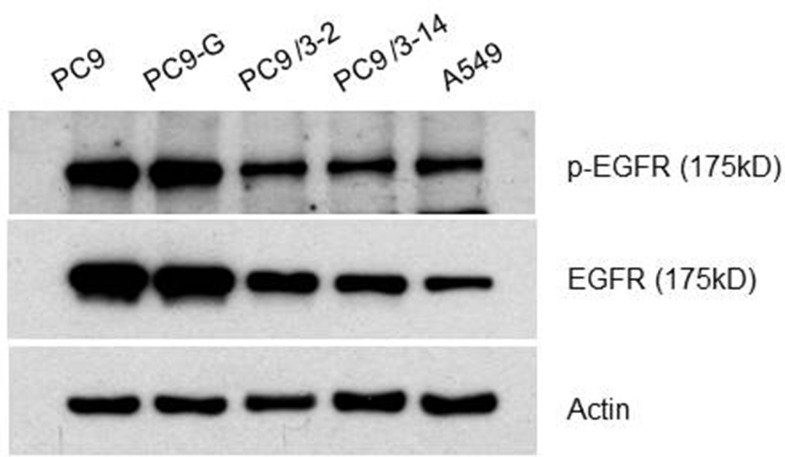
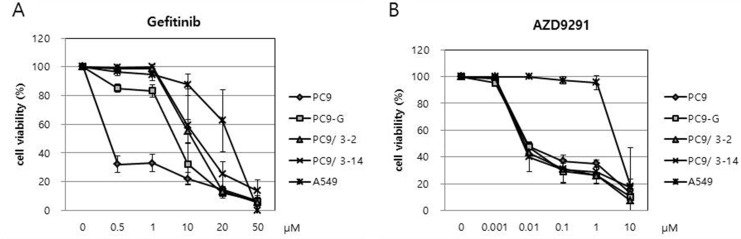
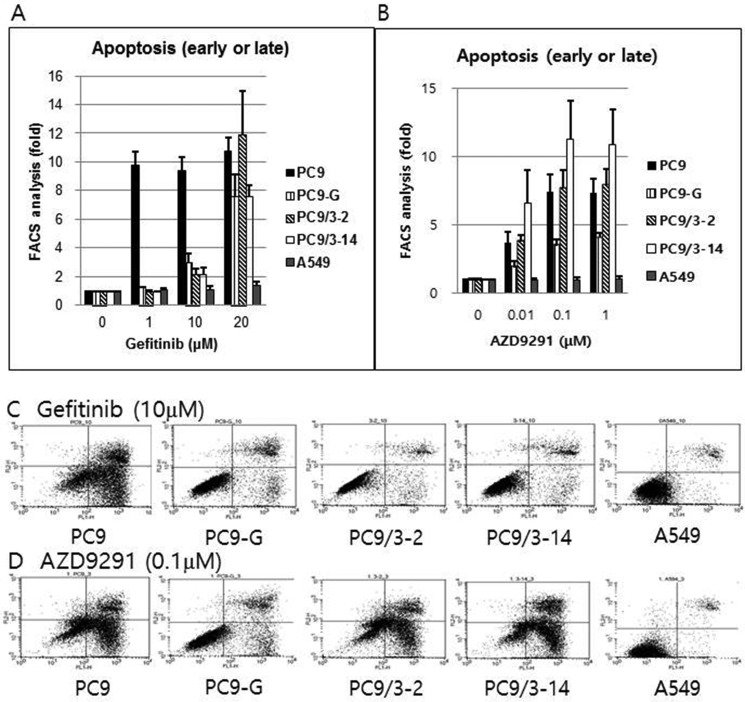
Figure 1(A) Schematic representation of the CRISPR target site around the human EGFR T790 locus. The three tested target sequences are indicated by horizontal lines. Protospacer adjacent motifs (PAMs) are marked in green. (B) Indel mutation induced by EGFR-specific sgRNA/Cas9 protein electroporation into PC9 and Jurkat cells, as assessed by the T7E1 assay. (C) Single-stranded oligodeoxynucleotides (ssODNs) for specific knock-in of the T790M mutation (green, PAM sequences; orange, template mutation; blue, PvuII restriction enzyme site; red, threonine 790 codon; underlined, sgRNA sequences). (D) Efficient homology-directed repair by CRISPR at the EGFR T790 locus. The ssODN donor along with the sgRNA/Cas9 complex was electroporated into PC9 cells. Specific knock-in alleles were assessed by PvuII enzyme cleavage of the amplified EGFR T790M locus.Figure 2(A) Pyrosequencing for EGFR exon 19 and T790M. Exon 19 deletion (2235-2257C) was found in PC9 cells and all other cell lines tested (data not shown except for PC9). No T790M mutation was found in PC9 cells; however, high proportions of T790M mutations were found in PC9-G, PC9/3-2, PC9/3-12, and PC9/3-14 cells (14%, 39%, 18%, and 51%, respectively). (B) Peptide nucleic acid (PNA) clamping for EGFR exon 19 and T790M. ∆Ct-1 for E19del: 9.7 (PC9), 10.7 (PC9-G), 9.7 (PC9/3-2), and 9.8 (PC9/3-14): ∆Ct-1 for T790M: -3.5 (PC9), 6.2 (PC9-G), 7.7 (PC9/3-2), and 7.6 (PC9/3-14). The sample is considered to contain a mutation when ∆Ct-1 is more than 2.Figure 3 Western blot analysis for the EGFR protein All EGFR proteins from PC9, PC9-G, PC9/3-2,-14 and A549 were of the same size.Figure 4(A) Reduced sensitivities of PC9-G, PC9/3-2, and PC9/3-14 cells to gefitinib compared to that of PC9 cells. PC9/3-2 and PC9/3-14 cells were more resistant to gefitinib than PC9-G cells. IC50: PC9 vs PC9-G, PC9/3-2, PC9/3-14 p < 0.01; PC9-G vs PC9/3-2, PC9/3-14 p < 0.05; PC9/3-2 vs PC9/3-14, not significant, (B) PC9, PC9-G, PC9/3-2 and PC9/3.14 were similarly sensitive to AZD9291, a 3rd generation EGFR tyrosine kinase inhibitor. IC50: PC9 vs PC9-G vs PC9/3-2 vs PC9/3-14, not significant.Figure 5Proportion of early or late apoptotic cell death after gefitinib (A) or AZD9291 (B) treatment, as measured by flow cytometry after staining with Annexin V and propidium iodide. Gefitinib treatment failed to induce significant apoptosis in PC9-G, PC9/3-2, and PC9/3-14 cells up to a concentration of 10 μM. However, AZD9291 treatment showed strong apoptosis induction in PC9-G, PC9/3-2, and PC9/3-14 cells, similar to that observed in PC9 cells. A549 cells (harboring wild type EGFR) were not affected by gefitinib or AZD9291 treatment. (fold increase in the proportion of apoptotic cells compared to that in control treated with 0 μM concentration) Actual flow cytometry data of early or late apoptotic cell death after gefitinib (10 μM) (C) or AZD9291 (0.1 μM) treatment (D) after staining with Annexin V and propidium iodide. Gefitinib treatment failed to induce significant apoptosis in PC9-G, PC9/3-2, and PC9/3-14 cells at 10 μM. However, AZD9291 treatment showed strong apoptosis induction in PC9-G, PC9/3-2, and PC9/3-14, cells similar to that observed in PC9 cells. A549 cells (harboring wild type EGFR) were not affected by gefitinib or AZD9291 treatment.
그림 출처: PubMed Central 공개 논문 (PMC5482658)
Conflict of interest statement
CONFLICTS OF INTEREST. The authors declare no conflicts of interest.