
Int J Chron Obstruct Pulmon Dis. 2017;12:757-763.
The effect of obesity on patients with mild chronic obstructive pulmonary disease: results from KNHANES 2010 to 2012.
제1저자 박주희 · 교신저자 정희순
소속 (1)
- Division of Pulmonary and Critical Care Medicine, Seoul Metropolitan Government-Seoul National University Boramae Medical Center, Seoul, Republic of Korea.
Abstract
PURPOSE A low body mass index has been associated with high mortalities in patients with chronic obstructive pulmonary disease (COPD), and studies reveal that obesity aggravates the clinical effects of COPD. We investigated the impact of obesity on patients newly identified with COPD.
PATIENTS AND METHODS This population-based, cross-sectional study, used data from the Korea National Health and Nutrition Examination Survey (KNHANES) conducted from 2010 to 2012. Through analyses of data from this survey, we compared concurrent comorbid diseases, symptoms, and lung functions between an obese and nonobese group of patients with COPD.
RESULTS In total, 618 participants were diagnosed with COPD and the average forced expired volume in 1 s (FEV1) was 79.47%±0.69%. Of the total, 30.5% of the subjects were categorized into an obese group. Subjects in the obese group were likely to have metabolic syndrome (P<0.001), hypertension (P=0.02), and a higher number of comorbidities compared to the nonobese group (2.3±0.1 vs 2.0±0.1, P=0.02). In addition, subjects in the obese group showed a lower forced vital capacity (FVC) than subjects in the nonobese group, even after adjusting for covariates (average FVC%, 89.32±1.26 vs 92.52%±0.72%, P=0.037). There were no significant differences in the adjusted FEV1% and adjusted FEV1/FVC between the groups.
CONCLUSIONS Among subjects newly identified with mild COPD, participants in the obese group had more comorbid conditions and showed a lower FVC compared with subjects in the nonobese group, even after adjustment of covariates. These findings show that a combination of obesity and COPD may be a severe phenotype; therefore, early attention should be paid to obesity for the management of COPD patients.
Keywords
COPDKNHANEScomorbiditylung functionobesityspirometry
Figures
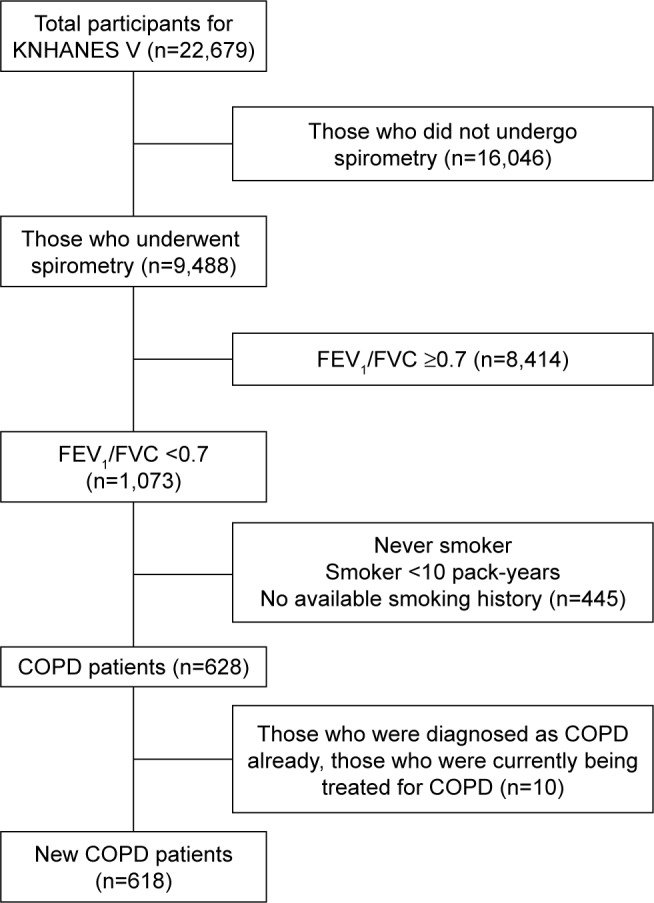
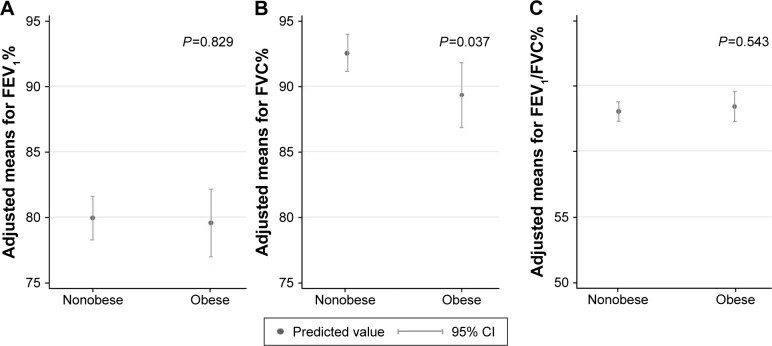
그림 출처: PubMed Central 공개 논문 (PMC5338838)
Conflict of interest statement
Disclosure The authors report no conflicts of interest in this work.
그 밖의 정보
- 출판 형태
- Journal Article
- 저널
- International journal of chronic obstructive pulmonary disease · eISSN 1178-2005
- 전자 출판
- 2017-02-24
- MeSH
- Aged · Body Mass Index · Comorbidity · Cross-Sectional Studies · Databases, Factual · Female · Forced Expiratory Volume · Humans · Lung / physiopathology · Male · Middle Aged · Nutrition Surveys · Obesity / diagnosis / epidemiology / physiopathology · Phenotype · Pulmonary Disease, Chronic Obstructive / diagnosis / epidemiology / physiopathology · Republic of Korea / epidemiology · Risk Factors · Severity of Illness Index · Vital Capacity
- 참고문헌
- 43편