
Gut Liver. 2018;12(1):102-110.
Tumor Marker Kinetics as Prognosticators in Patients with Unresectable Gallbladder Adenocarcinoma Undergoing Palliative Chemotherapy.
제1저자 이재우 · 교신저자 이상협
소속 (5)
- Department of Internal Medicine and Liver Research Institute, Seoul National University College of Medicine, Seoul, Korea.
- Department of Internal Medicine, Seoul National University Hospital, Seoul, Korea.
- Department of Internal Medicine, Dongguk University Ilsan Medical Center, Goyang, Korea.
- Department of Internal Medicine, Inje University Ilsan Paik Hospital, Inje University School of Medicine, Goyang, Korea.
- Department of Internal Medicine, Gimhae Jungang Hospital, Gimhae, Korea.
Abstract
BACKGROUND/AIMS To determine the prognostic value of carcinoembryonic antigen (CEA) and carbohydrate antigen (CA) 19-9 in gallbladder cancer (GBC) during palliative chemotherapy.
METHODS One hundred and twenty-three patients with pathologically confirmed unresectable GBC were included. Differences in serum CEA and CA 19-9 levels before and after chemotherapy were measured. Receiver operating characteristic curve analysis, Kaplan-Meier analyses of CEA, CA 19-9, and combined changes were performed to assess the optimal cutoff values and survival rates.
RESULTS Patients with decreased tumor markers had significantly better progression-free survival (PFS) and overall survival (OS) than patients with increased tumor markers. The pre- and postchemotherapy CA 19-9 ratio had the highest area-under-the-curve values for predicting 3-month PFS and 1-year OS. In the multivariate analysis, increases in serum CA 19-9 during palliative chemotherapy in patients with unresectable GBC was an independent prognosticator of poor PFS and OS, with hazard ratios of 2.20 (p=0.001) and 1.67 (p=0.020), respectively. Patients with increases >10-fold were considered to have progressive disease, whereas individuals with increases >3-fold were likely to benefit from early imaging follow-up.
CONCLUSIONS CA 19-9 kinetics was a reliable prognosticator of PFS and OS in patients with unresectable GBC who underwent palliative chemotherapy.
Keywords
CA-19-9 antigenCarcinoembryonic antigenGallbladder neoplasmsOverall survivalProgression-free survival
Figures

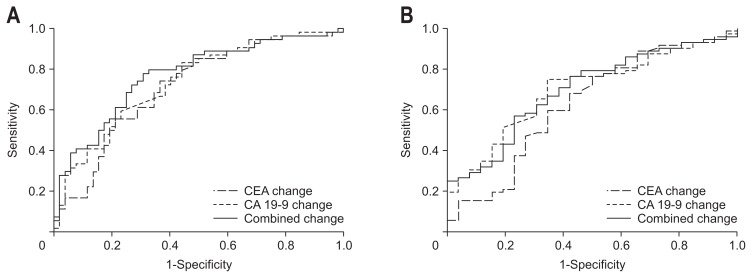
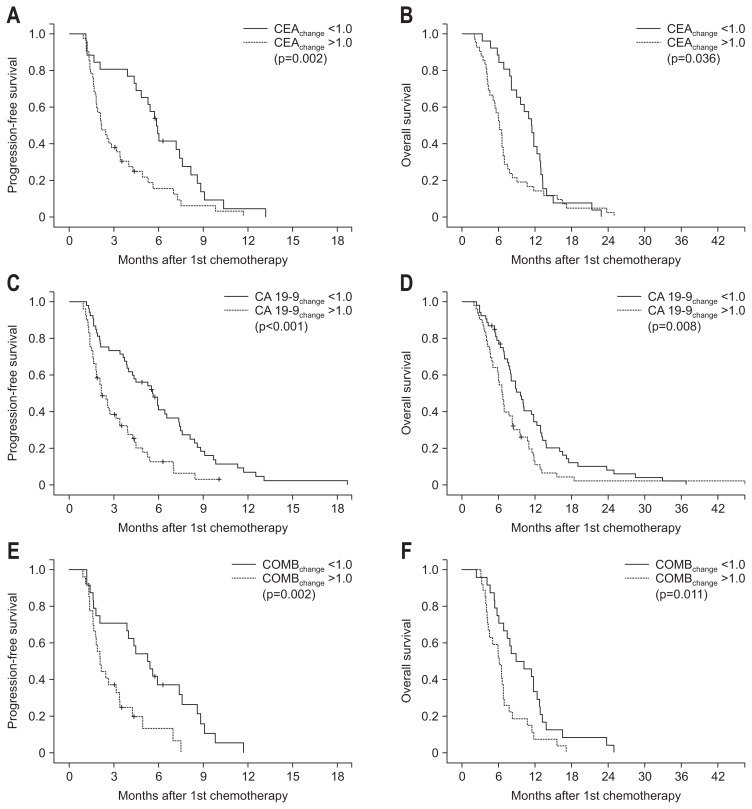

그림 출처: PubMed Central 공개 논문 (PMC5753691)
Conflict of interest statement
CONFLICTS OF INTEREST. No potential conflict of interest relevant to this article was reported.
그 밖의 정보
- 출판 형태
- Journal Article
- 저널
- Gut and liver · eISSN 2005-1212
- MeSH
- Adenocarcinoma / blood / drug therapy / mortality · Aged · Antineoplastic Agents / therapeutic use · CA-19-9 Antigen / blood · Carcinoembryonic Antigen / blood · Disease-Free Survival · Female · Gallbladder Neoplasms / blood / drug therapy / mortality · Humans · Kaplan-Meier Estimate · Male · Middle Aged · Palliative Care / methods · Prognosis · Proportional Hazards Models · ROC Curve · Retrospective Studies
- Substances
- Antineoplastic Agents · CA-19-9 Antigen · Carcinoembryonic Antigen
- 참고문헌
- 23편