
Am J Gastroenterol. 2015;110(10):1440-9.
Covered metallic stents with an anti-migration design vs. uncovered stents for the palliation of malignant gastric outlet obstruction: a multicenter, randomized trial.
제1저자 이혁, 민병훈 · 교신저자 이상협
소속 (6)
- Department of Medicine, Samsung Medical Center, Sungkyunkwan University School of Medicine, Seoul, Republic of Korea.
- Department of Gastroenterology, University of Ulsan College of Medicine, Asan Medical Center, Seoul, Republic of Korea.
- Department of Internal Medicine, Seoul National University Bundang Hospital, Seongnam, Republic of Korea.
- Division of Gastroenterology, Department of Internal Medicine, Korea Cancer Center Hospital, Korea Institute of Radiological and Medical Sciences, Seoul, Republic of Korea.
- Department of Internal Medicine, Yonsei University College of Medicine, Seoul, Republic of Korea.
- Department of Internal Medicine and Liver Research Institute, Seoul National University Hospital, Seoul National University College of Medicine, Seoul, Republic of Korea.
Abstract
OBJECTIVES Previous studies reported comparable stent patency between covered self-expandable metallic stents (SEMS) and uncovered SEMS (UCS) for palliation of malignant gastric outlet obstruction (GOO). The aim of this study was to evaluate the efficacy and safety of the newly developed WAVE-covered SEMS (WCS), which has an anti-migration design, compared with UCS in gastric cancer patients with symptomatic GOO.
METHODS A total of 102 inoperable gastric cancer patients with symptomatic GOO were prospectively enrolled from five referral centers and randomized to undergo UCS or WCS placement. Stent patency and recurrence of obstructive symptoms were assessed at 8 weeks and 16 weeks after stent placement.
RESULTS At the 8-week follow-up, both stent patency rates (72.5% vs. 62.7%) and re-intervention rates (19.6% vs. 19.6%) were comparable between the WCS and the UCS groups. Both stent stenosis (2.4% vs. 8.1%) and migration rates (9.5% vs. 5.4%) were comparable between WCS and UCS groups. At the 16-week follow-up, however, the WCS group had a significantly higher stent patency rate than the UCS group (68.6% vs. 41.2%). Re-intervention rates in the WCS and UCS groups were 23.5% and 39.2%, respectively. Compared with the UCS group, the WCS group had a significantly lower stent restenosis rate (7.1% vs. 37.8%) and a comparable migration rate (9.5% vs. 5.4%). Overall stent patency was significantly longer in the WCS group than in the UCS group. No stent-associated significant adverse events occurred in either the WCS or UCS groups. In the multivariate analysis, WCS placement and chemotherapy were identified as independent predictors of 16-week stent patency.
CONCLUSIONS WCS group showed comparable migration rate and significantly more durable long-term stent patency compared with UCS group for the palliation of GOO in patients with inoperable gastric cancer.
Figures
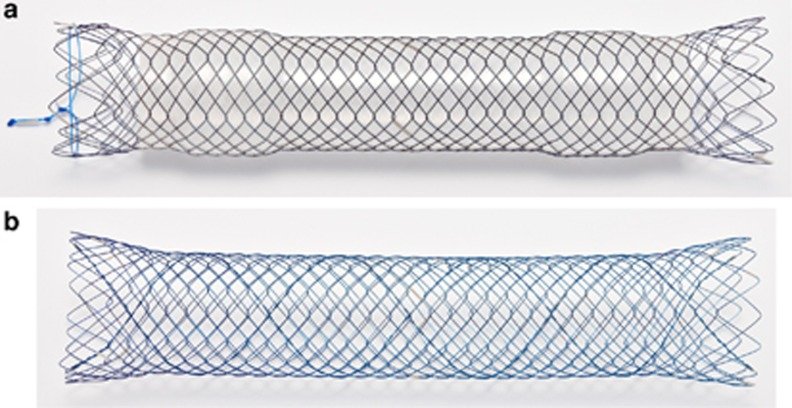
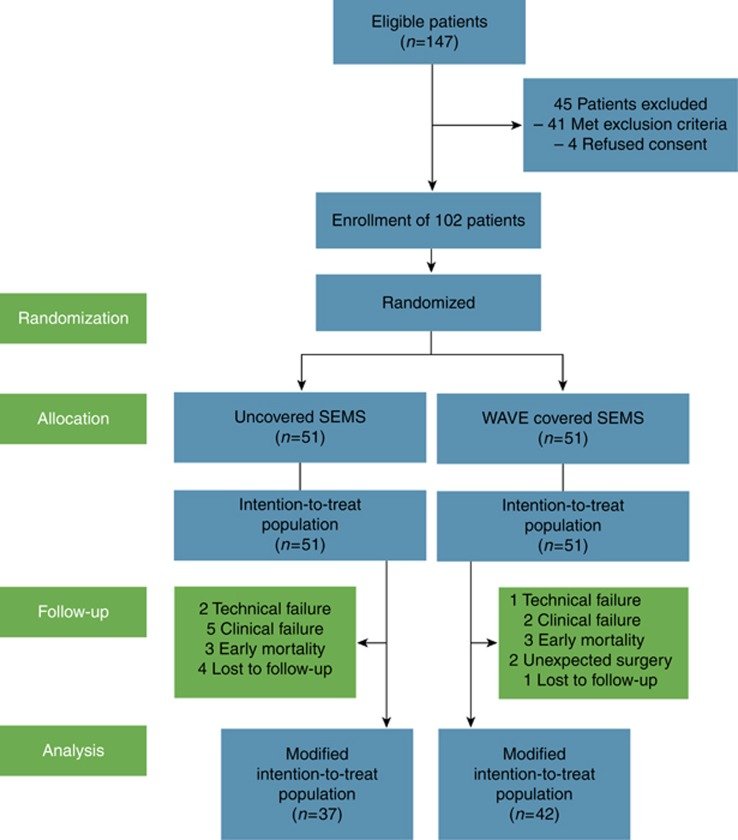
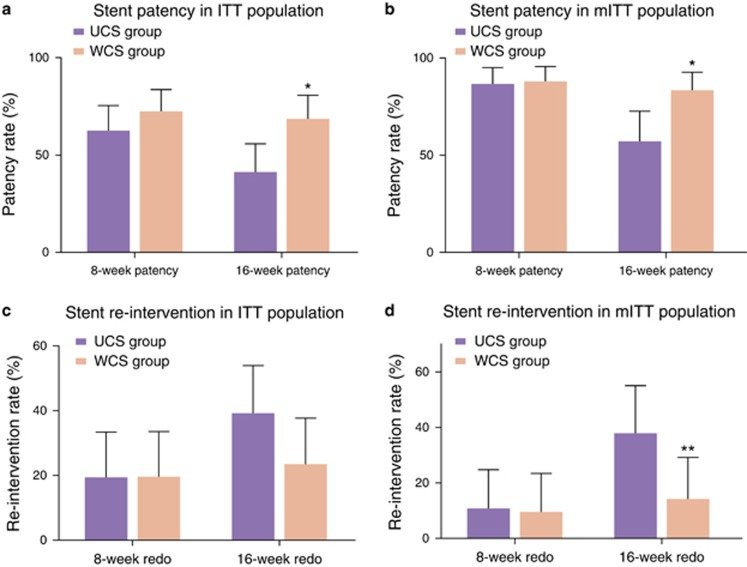
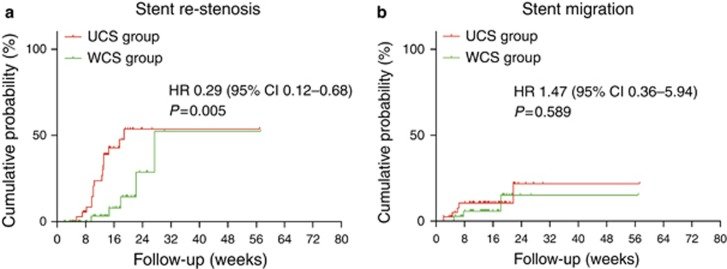
그림 출처: PubMed Central 공개 논문 (PMC4697131)
그 밖의 정보
- 출판 형태
- Comparative Study, Journal Article, Multicenter Study, Randomized Controlled Trial
- 저널
- The American journal of gastroenterology · eISSN 1572-0241
- 전자 출판
- 2015-09-15
- MeSH
- Adenocarcinoma / complications / surgery · Aged · Equipment Design* · Female · Foreign-Body Migration / prevention & control · Gastric Outlet Obstruction / etiology / surgery · Gastroscopy / instrumentation / methods · Humans · Male · Middle Aged · Palliative Care / methods · Self Expandable Metallic Stents* · Stents · Stomach Neoplasms / complications / surgery · Treatment Outcome
- 참고문헌
- 33편