
PLoS One. 2016;11(8):e0160607.
Pre-Transplant Cardiovascular Risk Factors Affect Kidney Allograft Survival: A Multi-Center Study in Korea.
제1저자 안정남, 안성복 · 교신저자 김영훈, 임춘수
소속 (8)
- Division of Nephrology, Department of Internal Medicine, Seoul National University Boramae Medical Center, Seoul, Korea.
- Department of Critical Care Medicine, Seoul National University Boramae Medical Center, Seoul, Korea.
- Department of Preventive Medicine, Yonsei University Wonju College of Medicine, Wonju, Gangwon-do, Korea.
- Department of Internal Medicine, Gyeongsang National University Hospital, Changwon, Korea.
- Division of Nephrology, Department of Internal Medicine, Seoul National University College of Medicine, Seoul, Korea.
- Division of Cardiology, Department of Internal Medicine, Seoul National University Boramae Medical Center, Seoul, Korea.
- Division of Cardiology, Department of Internal Medicine, Seoul National University College of Medicine, Seoul, Korea.
- Department of Surgery, Asan Medical Center and University of Ulsan College of Medicine, Seoul, Korea.
Abstract
BACKGROUND Pre-transplant cardiovascular (CV) risk factors affect the development of CV events even after successful kidney transplantation (KT). However, the impact of pre-transplant CV risk factors on allograft failure (GF) has not been reported.
METHODS AND FINDINGS We analyzed the graft outcomes of 2,902 KT recipients who were enrolled in a multi-center cohort from 1997 to 2012. We calculated the pre-transplant CV risk scores based on the Framingham risk model using age, gender, total cholesterol level, smoking status, and history of hypertension. Vascular disease (a composite of ischemic heart disease, peripheral vascular disease, and cerebrovascular disease) was noted in 6.5% of the patients. During the median follow-up of 6.4 years, 286 (9.9%) patients had developed GF. In the multivariable-adjusted Cox proportional hazard model, pre-transplant vascular disease was associated with an increased risk of GF (HR 2.51; 95% CI 1.66-3.80). The HR for GF (comparing the highest with the lowest tertile regarding the pre-transplant CV risk scores) was 1.65 (95% CI 1.22-2.23). In the competing risk model, both pre-transplant vascular disease and CV risk score were independent risk factors for GF. Moreover, the addition of the CV risk score, the pre-transplant vascular disease, or both had a better predictability for GF compared to the traditional GF risk factors.
CONCLUSIONS In conclusion, both vascular disease and pre-transplant CV risk score were independently associated with GF in this multi-center study. Pre-transplant CV risk assessments could be useful in predicting GF in KT recipients.
Figures

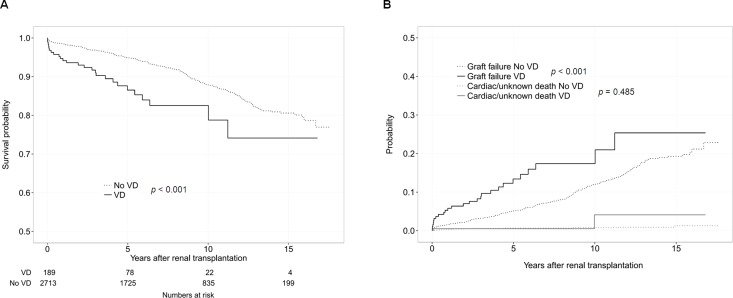
그림 출처: PubMed Central 공개 논문 (PMC4976895)
Conflict of interest statement
Competing Interests:The authors have declared that no competing interests exist.
그 밖의 정보
- 출판 형태
- Journal Article, Multicenter Study
- 저널
- PloS one · eISSN 1932-6203
- 전자 출판
- 2016-08-08
- MeSH
- Adult · Cardiovascular Diseases / etiology · Female · Graft Rejection / etiology · Humans · Kidney Transplantation / adverse effects · Male · Middle Aged · Republic of Korea · Risk Assessment · Treatment Outcome
- 참고문헌
- 25편