
PLoS One. 2016;11(6):e0156444.
Frailty as a Predictor of Acute Kidney Injury in Hospitalized Elderly Patients: A Single Center, Retrospective Cohort Study.
제1저자 백선하 · 교신저자 김세중
소속 (1)
- Department of Internal Medicine, Seoul National University Bundang Hospital, Seongnam, Republic of Korea.
Abstract
BACKGROUND Elderly patients have an increased risk for acute kidney injury (AKI). However, few studies have reported on predictors for AKI in geriatric patients. Therefore, we aimed at determining the effect of frailty as a predictor of AKI.
METHODS We retrospectively enrolled 533 hospitalized elderly patients (aged ≥ 65 years) who had their creatinine levels measured (≥ 1 measurement) during admission for a period of 1 year (2013) and conducted a comprehensive geriatric assessment (CGA) within 1 year before the index hospitalization. We examined five variables (activity of daily living [ADL] and instrumental ADL dependence, dementia, nutrition, and polypharmacy) from CGA. We categorized the patients into 3 groups according to the tertile of aggregate frailty scores: Group 1, score 1-2; Group 2, score 3-4; Group 3, score 5-8).
RESULTS Fifty-four patients (10.1%) developed AKI (median duration, 4 days). The frailest group (Group 3) showed an increased risk of AKI as compared to Group 1, (hazard ratio [HR] = 3.536, P = 0.002). We found that discriminatory accuracy for AKI improved with the addition of the tertile of aggregate frailty score to covariates (area under the receiver operator characteristics curves [AUROC] 0.641, AUROC 0.739, P = 0.004). Forty-six patients (8.6%) were transferred to nursing facilities and 477 patients (89.5%) were discharged home. The overall 90-day and 1-year mortality for elderly inpatients were 7.9% and 26.3%. The frailest group also demonstrated an increased risk of discharge to nursing facilities, and 90-day and 1-year mortality as compared to Group 1, independent of AKI severity (nursing facilities: odd ratio = 4.843, P = 0.002; 90-day mortality: HR = 6.555, P = 0.002; 1-year mortality: HR = 3.249, P = 0.001).
CONCLUSIONS We found that frailty may independently predict the development of AKI and adverse outcomes in geriatric inpatients.
Figures

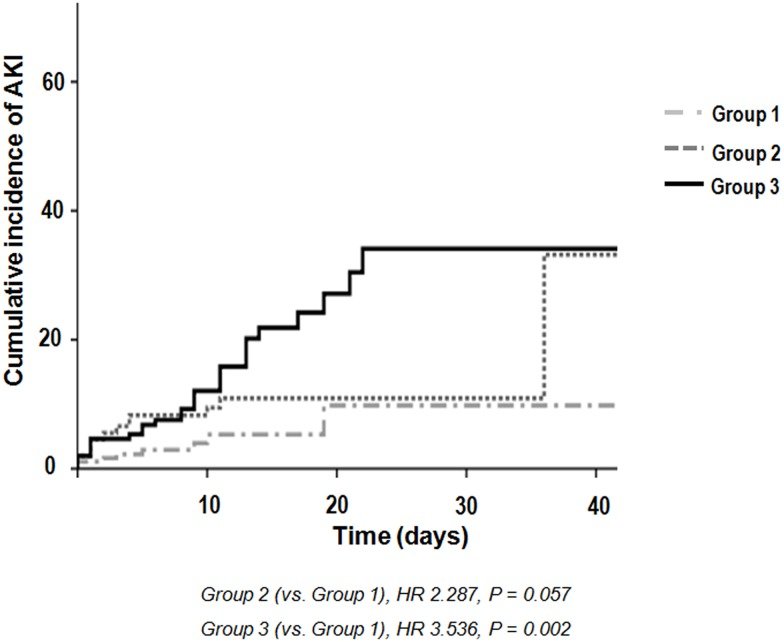
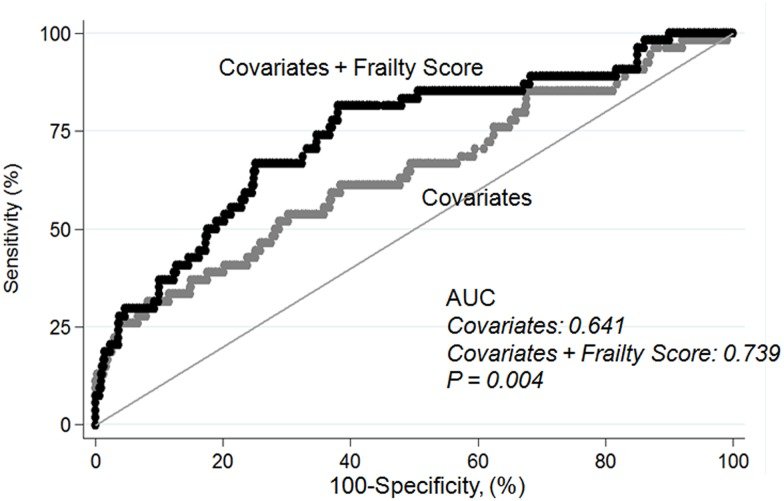
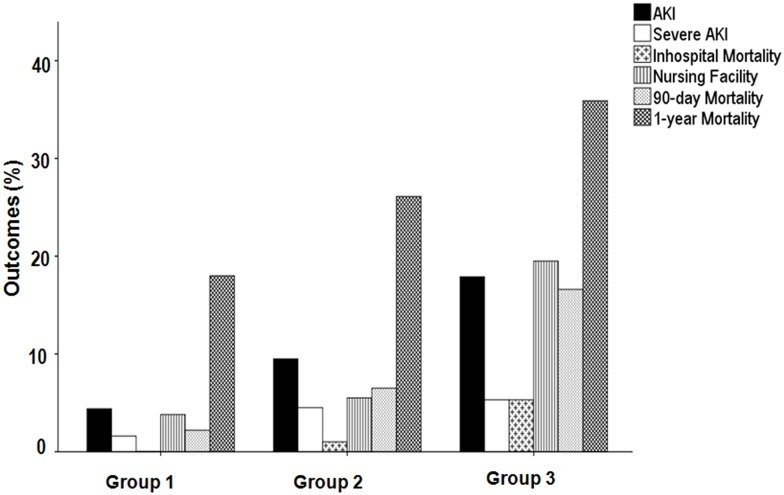
그림 출처: PubMed Central 공개 논문 (PMC4892677)
Conflict of interest statement
Competing Interests:The authors have declared that no competing interests exist.
그 밖의 정보
- 출판 형태
- Journal Article
- 저널
- PloS one · eISSN 1932-6203
- 전자 출판
- 2016-06-03
- MeSH
- Acute Kidney Injury / epidemiology / mortality · Aged · Aged, 80 and over · Female · Frail Elderly / statistics & numerical data · Geriatric Assessment / methods · Hospital Mortality · Hospitalization / statistics & numerical data · Humans · Male · Odds Ratio · Retrospective Studies · Risk Factors
- 참고문헌
- 37편