
PLoS One. 2016;11(5):e0156050.
Posttransplant Hyponatremia Predicts Graft Failure and Mortality in Kidney Transplantation Recipients: A Multicenter Cohort Study in Korea.
제1저자 한승석 · 교신저자 이정표
소속 (7)
- Department of Internal Medicine, Seoul National University College of Medicine, Seoul, Korea.
- Department of Internal Medicine, Seoul National University Boramae Medical Center, Seoul, Korea.
- Department of Critical Care Medicine, Seoul National University Boramae Medical Center, Seoul, Korea.
- Department of Internal Medicine, Asan Medical Center and University of Ulsan College of Medicine, Seoul, Korea.
- Department of Surgery, Asan Medical Center and University of Ulsan College of Medicine, Seoul, Korea.
- Department of Internal Medicine, Seoul National University Bundang Hospital, Seongnam, Korea.
- Kidney Research Institute, Seoul National University College of Medicine, Seoul, Korea.
Abstract
Although hyponatremia is related to poorer outcomes in several clinical settings, its significance remains unresolved in kidney transplantation. Data on 1,786 patients who received kidney transplantations between January 2000 and December 2011 were analyzed. The patients were divided into two groups according to the corrected sodium values for serum glucose 3 months after their transplantations (<135 mmol/L vs. ≥135 mmol/L). Subsequently, the hazard ratios (HRs) for biopsy-proven acute rejection, graft failure, and all-cause mortality were calculated after adjustments for several immunological and non-immunological covariates. 4.0% of patients had hyponatremia. Patients with hyponatremia had higher risks for graft failure and all-cause mortality than did the counterpart normonatremia group; the adjusted HRs for graft failure and mortality were 3.21 (1.47-6.99) and 3.03 (1.21-7.54), respectively. These relationships remained consistent irrespective of heart function. However, hyponatremia was not associated with the risk of acute rejection. The present study addressed the association between hyponatremia and graft and patient outcomes in kidney transplant recipients. Based on the study results, our recommendation is to monitor serum sodium levels after kidney transplantations.
Figures

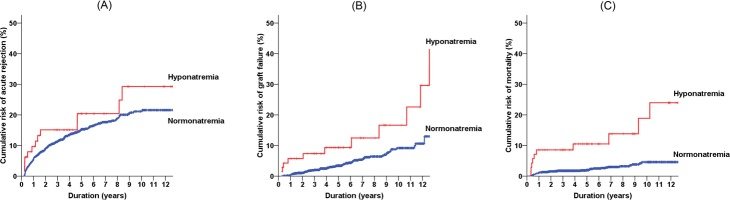

그림 출처: PubMed Central 공개 논문 (PMC4877062)
Conflict of interest statement
Competing Interests:The authors have declared that no competing interests exist.
그 밖의 정보
- 출판 형태
- Journal Article, Multicenter Study
- 저널
- PloS one · eISSN 1932-6203
- 전자 출판
- 2016-05-23
- MeSH
- Adult · Cohort Studies · Female · Graft Rejection / diagnosis / etiology / mortality · Humans · Hyponatremia / diagnosis / etiology / mortality · Kidney Transplantation / adverse effects / mortality · Male · Middle Aged · Prognosis · Republic of Korea / epidemiology · Severity of Illness Index · Sodium / blood · Survival Analysis · Transplant Recipients* / statistics & numerical data · Treatment Outcome
- Substances
- Sodium
- 참고문헌
- 24편