
Eur Heart J Cardiovasc Pharmacother. 2025;11(5):403-411.
Apixaban outcomes in atrial fibrillation patients with a single-dose reduction criterion: ASPIRE 1-year results.
제1저자 이소령, 최정민 · 교신저자 최의근
소속 (18)
- Department of Internal Medicine, Seoul National University Hospital, 101, Daehak-ro, Jongno-gu, Seoul 03080, Republic of Korea.
- Department of Internal Medicine, Seoul National University College of Medicine, 103, Daehak-ro, Jongno-gu, Seoul 03080, Republic of Korea.
- Department of Internal Medicine, Division of Cardiology, Korea University College of Medicine and Korea University Anam Hospital, Seoul 02841, Republic of Korea.
- Division of Cardiology, Department of Internal Medicine, Kangbuk Samsung Hospital, Sungkyunkwan University School of Medicine, Seoul 03181, Republic of Korea.
- Department of Internal Medicine, Kosin University Gospel Hospital, Busan 49267, Republic of Korea.
- Department of Internal Medicine, Seoul National University Bundang Hospital, Gyeonggi 13620, Republic of Korea.
- Department of Cardiology, Heart Vascular Stroke Institute, Samsung Medical Center, Sungkyunkwan University School of Medicine, Seoul 06351, Republic of Korea.
- Department of Internal Medicine, Severance Cardiovascular Hospital, Yonsei University College of Medicine, Seoul 03722, Republic of Korea.
- Department of Cardiology, Ajou University School of Medicine, Suwon 16499, Republic of Korea.
- Department of Internal Medicine, Wonkwang University Hospital, Iksan 54538, Republic of Korea.
- Department of Internal Medicine, Chonnam National University Hospital, Gwangju 61469, Republic of Korea.
- Department of Cardiovascular medicine, Chonnam National University Medical School, Gwangju 61469, Korea.
- Cardiovascular & Arrhythmia Center, Chung-Ang University Hospital, Seoul 06973, Republic of Korea.
- Division of Cardiology, Department of Internal Medicine, Keimyung University Dongsan Hospital, Daegu 41931, Republic of Korea.
- Gangsim Heart Clinic, Daegu 41942, Republic of Korea.
- Liverpool Center for Cardiovascular Science at University of Liverpool, Liverpool John Moores University and Liverpool Chest and Heart Hospital, Liverpool L7 8TX, UK.
- Department of Clinical Medicine, Aalborg University, Aalborg 9220, Denmark.
- Department of Cardiology, Dong-A University Hospital, 26, Daesingongwon-ro, Seo-gu, Busan 49201, Republic of Korea.
Abstract
AIMS This study, using a prospective cohort, evaluated the effectiveness and safety of off-label reduced-dose apixaban vs. the on-label dose in atrial fibrillation (AF) patients meeting a single-dose reduction criterion.
METHODS AND RESULTS The efficAcy and Safety of aPixaban In REal-world practice in Korean frail patients with AF (ASPIRE) study is a multicentre, prospective observational cohort involving AF patients who met a single-dose reduction criterion of apixaban. Patients were divided into two groups: an on-label standard dose (5 mg twice daily) and an off-label reduced dose (2.5 mg twice daily). The primary effectiveness outcome was stroke/systemic embolism (SSE), and the primary safety outcome was major bleeding. Of 1944 patients (mean age 74.3 ± 7.9 years, 56% women), 997 (51%) were receiving off-label reduced-dose apixaban. The off-label reduced-dose group was older, had more comorbidities, higher concomitant antiplatelet use, and higher CHA2DS2-VASc and HAS-BLED scores. During follow-up (1.0 ± 0.2 year), crude incidence rates were 0.9 vs. 0.7 per 100 person-years for SSE and 0.5 vs. 1.0 for major bleeding in the on-label vs. off-label groups. After inverse probability of treatment weighting, the off-label reduced-dose group showed no significant differences in the risk of SSE [hazard ratio (HR) 0.67, 95% confidence interval (CI) 0.28-1.59, P = 0.370] and major bleeding (HR 1.38, 95% CI 0.44-4.35, P = 0.578) compared with the on-label standard dose group.
CONCLUSION In Korean patients with AF meeting a single-dose reduction criterion of apixaban, off-label reduced-dose apixaban showed no significant differences in SSE and major bleeding compared with the on-label standard dose. These findings suggest that individualized anticoagulation strategies, such as reduced-dose apixaban, may be beneficial for patients with a high risk of bleeding.
© The Author(s) 2025. Published by Oxford University Press on behalf of the European Society of Cardiology.
Keywords
ApixabanAtrial fibrillationOff-label reduced doseOn-label standard dose
Figures
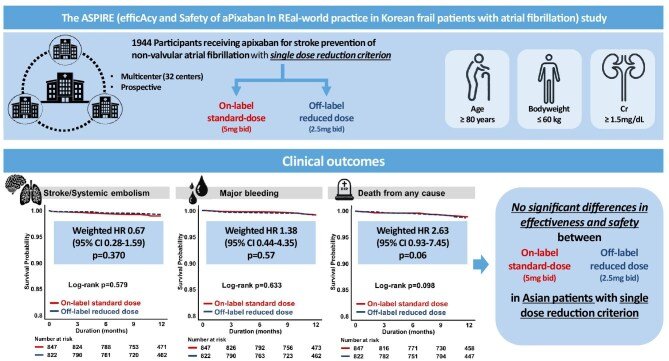
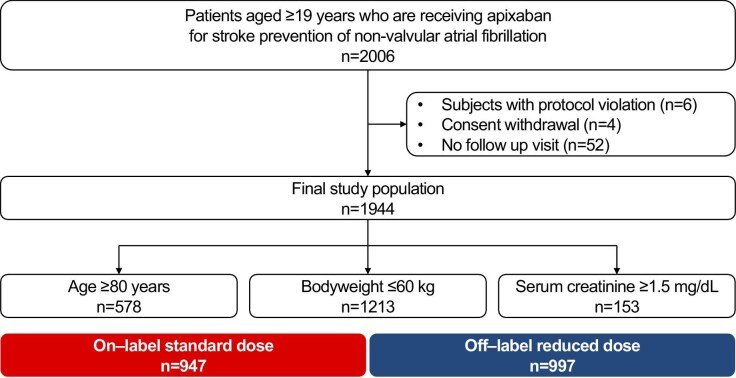
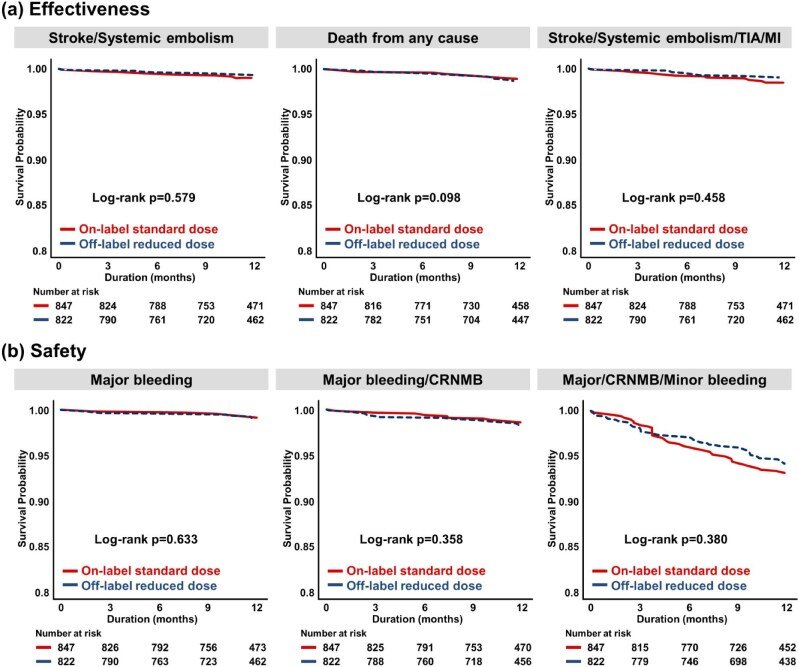
그림 출처: PubMed Central 공개 논문 (PMC12343049)
그 밖의 정보
- 출판 형태
- Journal Article, Observational Study, Multicenter Study, Comparative Study
- 저널
- European heart journal. Cardiovascular pharmacotherapy · eISSN 2055-6845
- MeSH
- Humans · Atrial Fibrillation* / drug therapy / diagnosis / epidemiology · Pyridones* / administration & dosage / adverse effects · Female · Male · Aged · Pyrazoles* / administration & dosage / adverse effects · Factor Xa Inhibitors* / administration & dosage / adverse effects · Hemorrhage / chemically induced · Treatment Outcome · Prospective Studies · Stroke* / prevention & control / diagnosis / epidemiology · Time Factors · Aged, 80 and over · Republic of Korea / epidemiology · Risk Factors · Off-Label Use · Embolism* / prevention & control / diagnosis / epidemiology · Risk Assessment · Drug Tapering · Frail Elderly · Middle Aged
- Substances
- apixaban · Pyridones · Pyrazoles · Factor Xa Inhibitors
- 연구비
- NIEHS NIH HHS 27302C0028 · Ministry of Food and Drug Safety HI20C1662 · Ministry of Food and Drug Safety 1711138358 · Ministry of Food and Drug Safety KMDF_PR_20200901_0173 · Ministry of Health and Welfare HC21C0028 · Korea Medical Device Development Fund
- 참고문헌
- 28편