
PLoS One. 2016;11(3):e0151069.
Diagnostic Performance of Alpha-Fetoprotein, Protein Induced by Vitamin K Absence, Osteopontin, Dickkopf-1 and Its Combinations for Hepatocellular Carcinoma.
제1저자 장은선 · 교신저자 정숙향
소속 (3)
- Department of Internal Medicine, Seoul National University College of Medicine, Seoul National University Bundang Hospital, Seoul, Republic of Korea.
- Medical Diagnostics Discovery Department, bioMérieux, Marcy l'Etoile, France.
- Mérieux Institute, Lyon, France.
Abstract
BACKGROUND & AIMS Alpha-fetoprotein (AFP) is the most widely used serum biomarker for hepatocellular carcinoma (HCC), despite its limitations. As complementary biomarkers, protein induced by vitamin K absence (PIVKA-II), osteopontin (OPN), and Dickkopf-1 (DKK-1) have been proposed. This study aimed to perform a head-to-head comparison of the diagnostic performance of AFP, PIVKA-II, OPN and DKK-1 as single or in combination to seek the best biomarker or panel, and to investigate the clinical factors affecting their performance.
METHODS Using 401 stored plasma samples obtained from 208 HCC patients and 193 liver cirrhosis control patients, plasma AFP, PIVKA-II, OPN and DKK-1 levels were measured by ELISA, and receiver operating characteristic curve analyses were performed for each biomarker and for every combination of two to four markers.
RESULTS Of the four biomarkers, AFP showed the highest area under the curve (0.786). The sensitivity and specificity for each single biomarker was 62% and 90.2% (AFP>20 ng/mL), 51.0% and 91.2% (PIVKA-II>10 ng/mL), 46.2% and 80.3% (OPN>100 ng/mL), and 50.0% and 80.8% (DKK-1>500 pg/mL), respectively. Among the combinations of two biomarkers, AFP>20 ng/mL or DKK-1>500 pg/mL showed the best diagnostic performance (sensitivity 78.4%, specificity 72.5%). Triple or quadruple combination did not improve the diagnostic performance further. The patient's age, etiology and tumor invasiveness of HCC affected the performance of each marker.
CONCLUSIONS AFP was the most useful single biomarker for HCC diagnosis, and the combined measurement of AFP and DKK-1 could maximize the diagnostic yield. Clinical decision should be based on the consideration of various factors affecting the diagnostic performance of each biomarker. Efforts to seek novel HCC biomarkers should be continued.
Figures
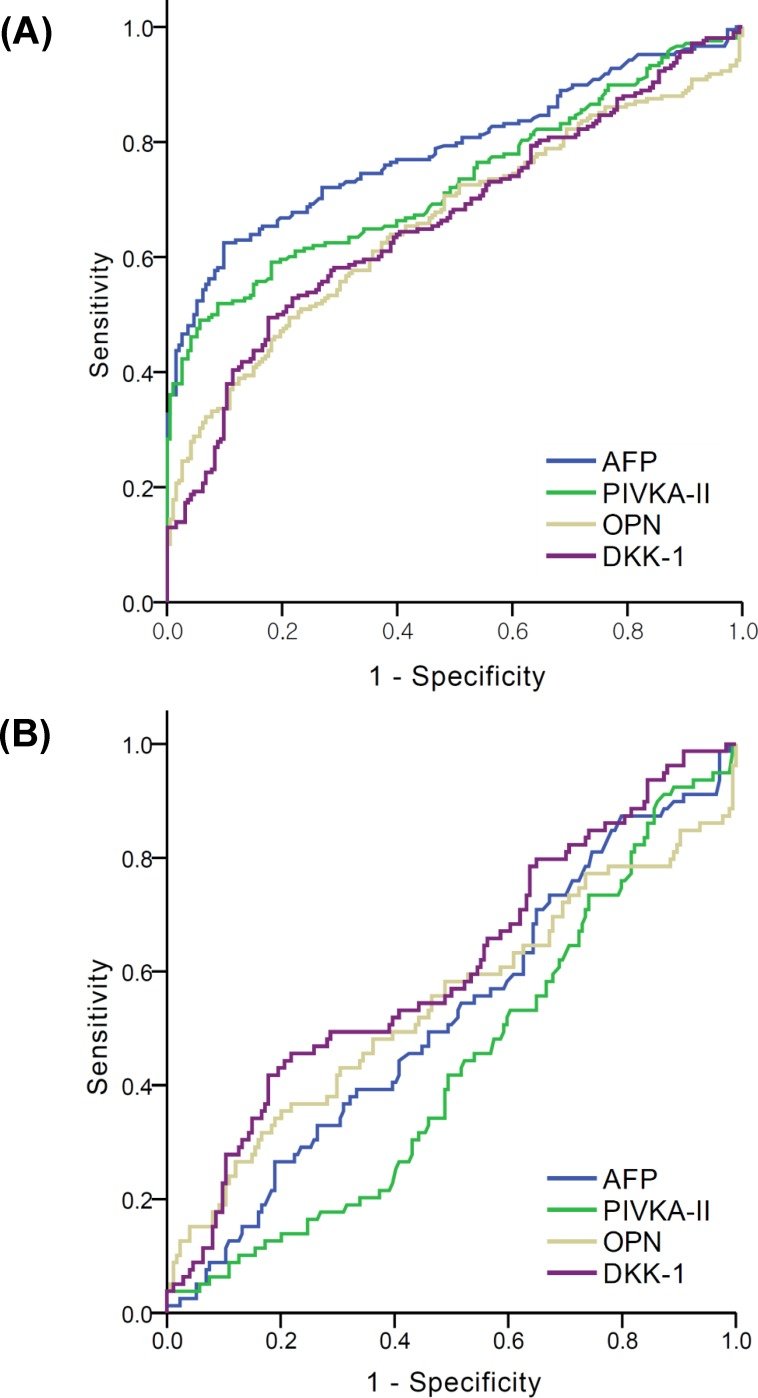
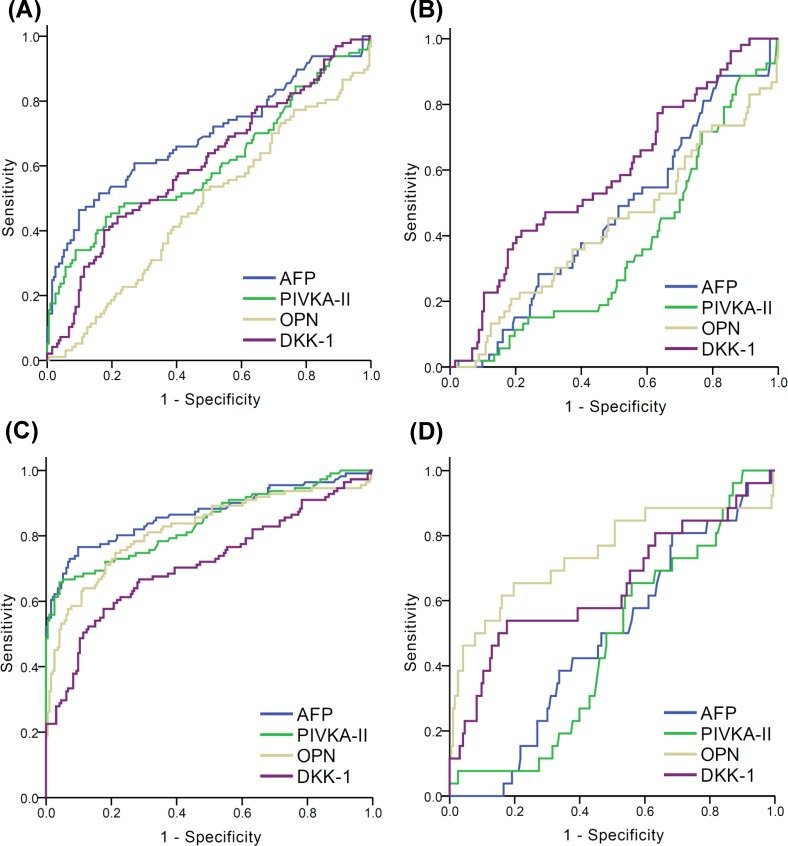
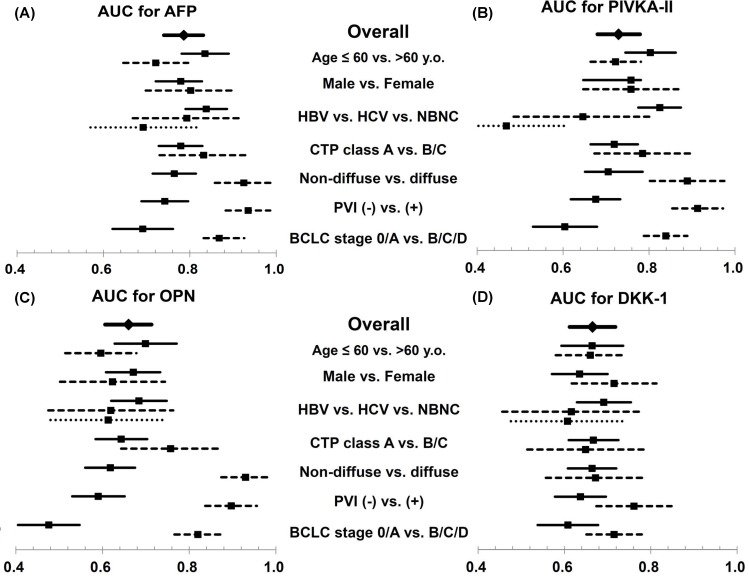
그림 출처: PubMed Central 공개 논문 (PMC4795737)
Conflict of interest statement
Competing Interests:PL and CB were employed by bioMérieux. The others had no conflicts of interest. This does not alter the authors' adherence to PLOS ONE policies on sharing data and materials.
그 밖의 정보
- 출판 형태
- Journal Article, Research Support, Non-U.S. Gov't
- 저널
- PloS one · eISSN 1932-6203
- 전자 출판
- 2016-03-17
- MeSH
- Aged · Biomarkers / blood · Biomarkers, Tumor / blood · Carcinoma, Hepatocellular / blood / diagnosis / pathology · Case-Control Studies · Female · Humans · Intercellular Signaling Peptides and Proteins / blood · Liver / pathology · Liver Cirrhosis / blood / diagnosis · Liver Neoplasms / blood / diagnosis / pathology · Male · Middle Aged · Osteopontin / blood · Protein Precursors / blood · Prothrombin · alpha-Fetoproteins / analysis
- Substances
- Biomarkers · Biomarkers, Tumor · DKK1 protein, human · Intercellular Signaling Peptides and Proteins · Protein Precursors · alpha-Fetoproteins · Osteopontin · acarboxyprothrombin · Prothrombin
- 데이터
- Dryad: 10.5061/dryad.3N901
- 참고문헌
- 30편