
Clin Transl Gastroenterol. 2020;11(3):e00145.
A Novel Susceptibility Locus Near GRIK2 Associated With Erosive Esophagitis in a Korean Cohort.
제1저자 진은효 · 교신저자 정성애
소속 (5)
- Department of Internal Medicine, Healthcare Research Institute, Seoul National University Hospital Healthcare System Gangnam Center, Seoul, Korea.
- Department of Public Health Sciences, Seoul National University, Seoul, Korea.
- Department of Surgery, Healthcare Research Institute, Seoul National University Hospital Healthcare System Gangnam Center, Seoul, Korea.
- Department of Internal Medicine, Liver Research Institute, Seoul National University College of Medicine, Seoul, Korea.
- Department of Internal Medicine, College of Medicine, Ewha Womans University, Seoul, Korea.
Abstract
INTRODUCTION The male-predominant sex difference through the spectrum of erosive esophagitis to Barrett's esophagus is widely known. We conducted a genome-wide association study (GWAS) stratified by sex for identifying factors that can predict the endoscopically diagnosed erosive esophagitis.
METHODS Erosive esophagitis was diagnosed by endoscopy and assessed for severity. We identified genetic factors associated with erosive esophagitis that accounted for the sex differences in a cohort of 4,242 participants via a GWAS. After quality control and imputation, genetic associations with erosive esophagitis were investigated by multivariate linear regression in 3,620 subjects. Single-nucleotide polymorphisms (SNPs) with P < 5.0 × 10 were considered significant genome wide, and a genetic risk score was constructed for the prediction of erosive esophagitis risk.
RESULTS Six genome-wide significant SNPs near the GRIK2 gene on chromosome 6 were found to be associated with erosive esophagitis only in male subjects. These were predictive of severity through a genetic risk score (P < 0.05), and the findings were validated in a cohort of 622 subjects (P < 0.05).
DISCUSSION This is the first GWAS of erosive esophagitis, and we identified 6 genome-wide significant SNPs in male subjects. These SNPs could help explain the pathogenesis of erosive esophagitis and contribute to the understanding of sex differences. Further genetic investigation could allow for the prediction of high risk for erosive esophagitis and development of new treatment options.
Figures
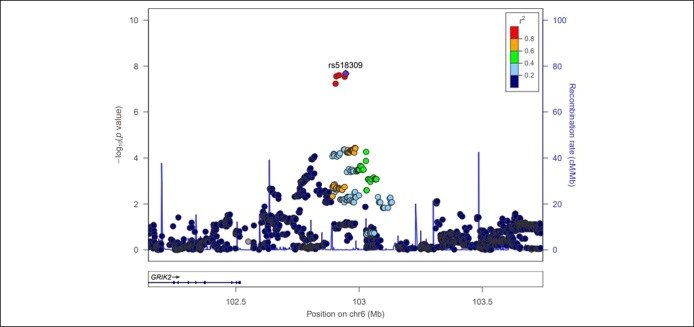
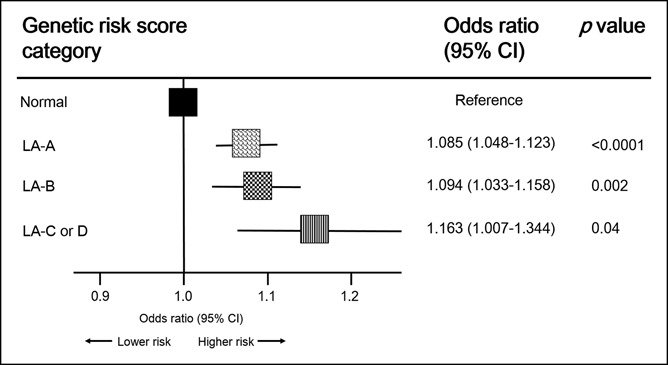
그림 출처: PubMed Central 공개 논문 (PMC7145042)
그 밖의 정보
- 출판 형태
- Journal Article, Observational Study, Validation Study
- 저널
- Clinical and translational gastroenterology · eISSN 2155-384X
- MeSH
- Biomarkers · Case-Control Studies · Chromosomes, Human, Pair 6 / genetics · Esophageal Mucosa / diagnostic imaging / pathology · Esophagitis, Peptic / diagnosis / epidemiology / genetics / pathology · Esophagoscopy · Female · Gastroesophageal Reflux / complications / genetics · Genetic Loci* · Genetic Predisposition to Disease* · Genome-Wide Association Study · Humans · Male · Middle Aged · Polymorphism, Single Nucleotide · Predictive Value of Tests · Prevalence · Kainic Acid Receptors / genetics · Republic of Korea / epidemiology · Risk Assessment / methods · Severity of Illness Index · Sex Factors · GluK2 Kainate Receptor
- Substances
- Biomarkers · Kainic Acid Receptors · GluK2 Kainate Receptor
- 참고문헌
- 35편