
J Am Heart Assoc. 2022;11(23):e028040.
Prognostic Implications of Mechanical Phenotypes in Heart Failure Characterized by 3-Chamber Strain Echocardiography.
제1저자 박지석 · 교신저자 조구영
소속 (4)
- Department of Cardiology, Cardiovascular Center Seoul National University Bundang Hospital Seongnam Gyeonggi-do Republic of Korea.
- Department of Internal Medicine Seoul National University College of Medicine Seoul Republic of Korea.
- Cardiovascular Center and Department of Internal Medicine Seoul National University Hospital Seoul Republic of Korea.
- Department of Cardiology, Internal Medicine Chungnam National University Hospital Daejeon Republic of Korea.
Abstract
Background Heart failure (HF) involves dysfunction of the left ventricle (LV) as well as left atrium and right ventricle. We characterized mechanical phenotypes of HF using 3-chamber strain echocardiography and compared their clinical outcomes. Methods and Results We retrospectively analyzed 3574 patients (median age, 74 years; male 52.8%) with acute HF who underwent 3-chamber strain echocardiography. Patients were classified as with LV, left atrium, or right ventricle myopathy if their corresponding strain values (LV global longitudinal strain, left atrium reservoir strain, and right ventricle global longitudinal strain) were lower than median cutoffs, respectively. The mechanical phenotypes of individual patients were characterized according to the combined myopathy. The primary outcome was a composite end point of 5-year all-cause mortality and HF hospitalization. During follow-up (median, 25.8 months), the primary outcome occurred in 1877 (52.5%) patients. Three-chamber strain values were independent predictors for the primary outcome. An incremental trend was observed for the primary outcome, along with the increasing numbers of combined myopathy. Each mechanical phenotype exhibited an increased risk of the primary outcome, with the highest risk observed in patients with 3-chamber myopathy (hazard ratio, 1.67 [95% CI, 1.42-1.96]). The prognostic significance of the mechanical phenotypes was feasible across the conventional HF subtypes stratified by LV ejection fraction. In HF with preserved ejection fraction, the presence of left atrium and right ventricle myopathy significantly increased the primary outcome, regardless of combined left ventricle myopathy. Conclusions Assessment of 3-chamber strain in HF enables characterization of distinctive mechanical phenotypes, which provides an independent prognostic value that may support long-term risk stratification.
Keywords
echocardiographyheart failuremyopathystrain
Figures

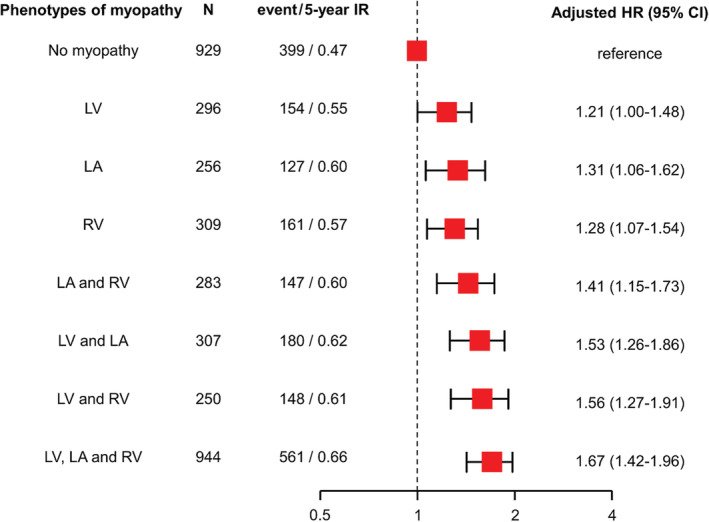
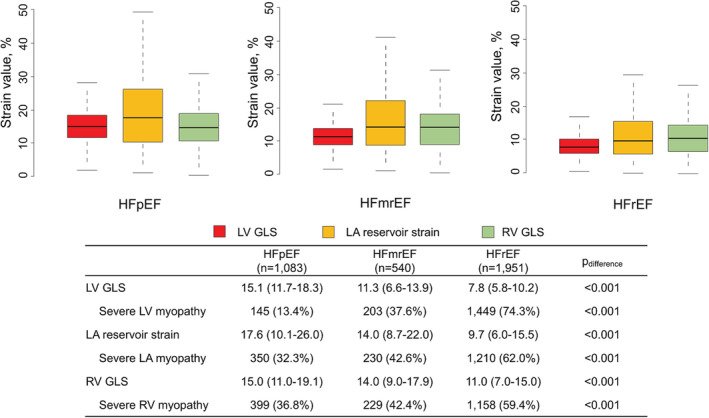
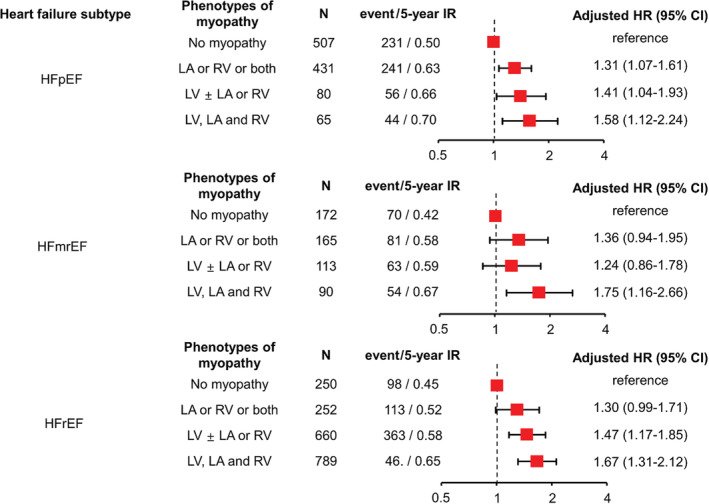
그림 출처: PubMed Central 공개 논문 (PMC9851439)
그 밖의 정보
- 출판 형태
- Journal Article
- 저널
- Journal of the American Heart Association · eISSN 2047-9980
- 전자 출판
- 2022-11-23
- MeSH
- Male · Humans · Prognosis · Retrospective Studies · Echocardiography · Heart Failure* / diagnostic imaging · Muscular Diseases*
- 참고문헌
- 25편