SCI 발표논문

SCI 발표논문

← SCI 발표논문 목록

Gut Liver. 2017;11(2):243-252.

Açaí Berries Inhibit Colon Tumorigenesis in Azoxymethane/Dextran Sulfate Sodium-Treated Mice.

, , , , , , , ,

제1저자 최윤진, 최윤정 · 교신저자 김나영

소속 (4)
  1. Department of Internal Medicine, Seoul National University Bundang Hospital, Seongnam, Korea.
  2. Department of Internal Medicine and Liver Research Institute, Seoul National University College of Medicine, Seoul, Korea.
  3. Department of Pathology, Seoul National University Bundang Hospital, Seongnam, Korea.
  4. Tumor Microenvironment Global Core Research Center, Seoul National University College of Pharmacy, Seoul, Korea.

Abstract

BACKGROUND/AIMS The aim of this study was to investigate the protective effect of açaí against azoxymethane (AOM)/dextran sulfate sodium (DSS)-induced colorectal cancer development.

METHODS The effect of açaí on tumorigenesis was assessed by evaluating tumor incidence, multiplicity and invasiveness in the mouse colon. The levels of myeloperoxidase (MPO) and proinflammatory cytokines (tumor necrosis factor α [TNF-α], interleukin [IL]-1β, and IL-6) were measured via enzyme-linked immunosorbent assay. Protein levels of cyclooxygenase 2 (COX-2), proliferating cell nuclear antigen (PCNA), B-cell lymphoma 2 (Bcl-2), Bcl-2-associated death promoter (Bad) and cleaved-caspase-3 were assessed by immunoblotting.

RESULTS Administration of pellets containing 5% açaí powder reduced the incidences of both colonic adenoma and cancer (adenoma, 23.1% vs 76.9%, respectively, p=0.006; cancer, 15.4% vs 76.9%, respectively, p=0.002). In the açaí-treated mice, the MPO, TNF-α, IL-1β and IL-6 levels in the colon were significantly down-regulated. Açaí inhibited PCNA and Bcl-2 expression and increased Bad and cleaved-caspase-3 expression. In vitro studies demonstrated that açaí treatment reduced lipopolysaccharide-induced expression of TNF-α, IL-1β, IL-6 and COX-2 in murine macrophage RAW 264.7 cells.

CONCLUSIONS Açaí demonstrated protective effects against AOM/DSS-induced colon carcinogenesis, which suggests that the intake of açaí may be beneficial for the prevention of human colon cancer.

Keywords

Anti-inflammatoryAçaí berryColorectal neoplasmsProapoptotic

Figures
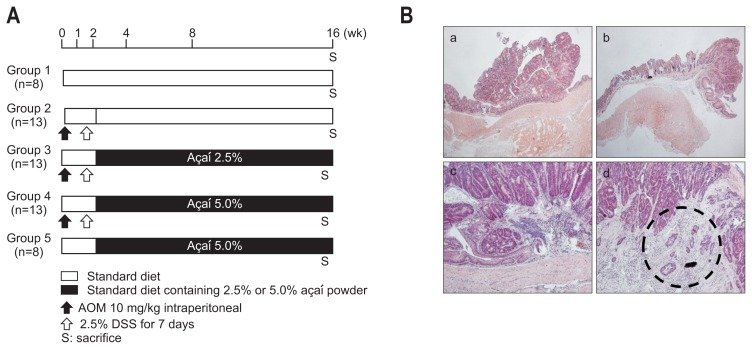
Fig. 1
Fig. 1 Azoxymethane (AOM)/dextran sulfate sodium (DSS)-induced mouse colon carcinogenesis model. (A) Total experimental protocols. (B) Representative histological images of (a) adenoma, (b) cancer, (c) mucosal cancer, and (d) submucosal invasion of cancer (H&E stain; a, b, ×40; c, d, ×100). Cancer cells were identified in the submucosa (circle).
Fig. 2
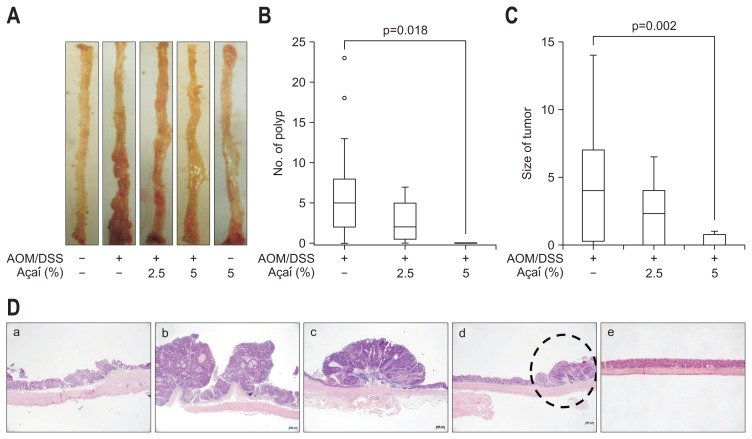
Fig. 2 Açaí inhibits azoxymethane (AOM)/dextran sulfate sodium (DSS)-induced mouse colon carcinogenesis. (A) Representative macroscopic view of the mouse colon in each group. (B) More colonic tumors were identified in the distal colon and rectum of the AOM/DSS-only-treated group than in those of the AOM/DSS+açaí 5% group (p=0.018). (C) Larger colonic tumors were identified in the distal colon and rectum of the AOM/DSS-only-treated group than in those of the AOM/DSS+açaí 5% group (p=0.002). (D) Representative histological images (H&E stain, ×40, and scale bar, 200 μm) in (a) control, (b) AOM/DSS, (c) AOM/DSS+açaí 2.5%, (d) AOM/DSS+açaí 5% with the tumor portion indicated in a circle, and (e) açaí 5% alone. Animal treatments and other experimental conditions are described in the MATERIALS AND METHODS section.
Fig. 3
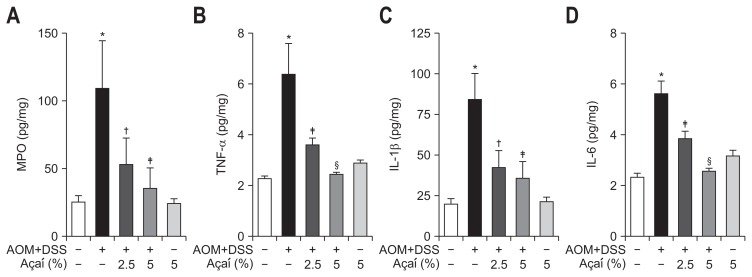
Fig. 3 Açaí downregulates the myeloperoxidase (MPO) and proinflammatory cytokine levels in the mouse colon. (A) MPO, (B) tumor necrosis factor α (TNF-α), (C) interleukin (IL)-1β, and (D) IL-6 levels in the supernatants of colon strips of control mice (n=5), azoxymethane (AOM)/dextran sulfate sodium (DSS)-treated mice (n=10), AOM/DSS plus açaí-treated mice (n=10) and açaí-only-treated mice (n=5). The data are expressed as the mean±standard errors. *p<0.05 compared with the control; †p<0.05, ‡p<0.01, §p<0.001 compared with the AOM/DSS-only-treated group.
Fig. 4
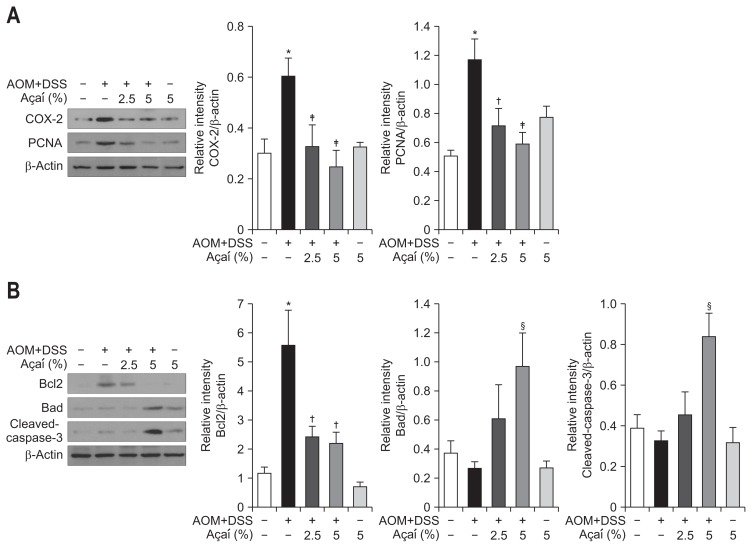
Fig. 4 Açaí inhibits cyclooxygenase 2 (COX-2) and proliferating cell nuclear antigen (PCNA) expression and promotes apoptosis. (A) COX-2 and PCNA and (B) B-cell lymphoma 2 (Bcl-2), Bcl-2-associated death promoter (Bad) and cleaved caspase-3 levels in the supernatants of colon strips of control mice (n=5), azoxymethane (AOM)/dextran sulfate sodium (DSS)-treated mice (n=10), AOM/DSS plus açaí-treated mice (n=10) and acai-only-treated mice (n=5). The data are expressed as the mean±standard errors. *p<0.05 compared with the control; †p<0.05, ‡p<0.01, §p<0.001 compared with the AOM/DSS-only-treated group.
Fig. 5
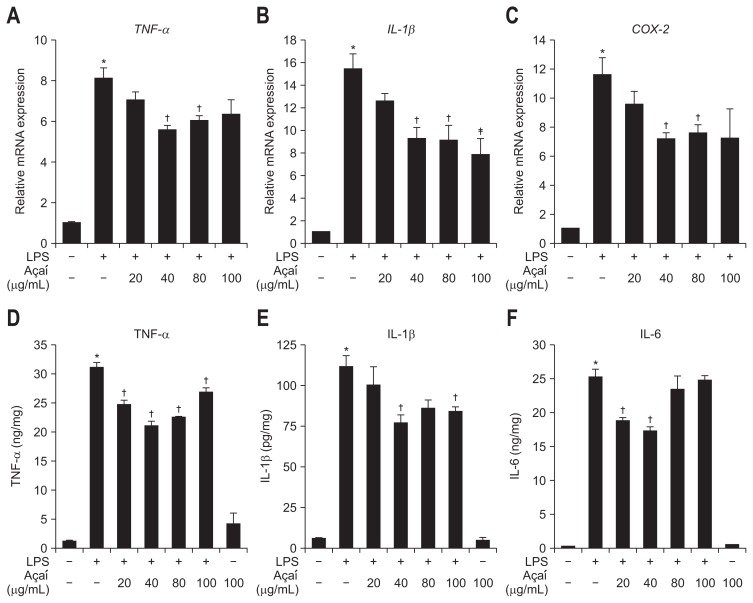
Fig. 5 Açaí reduces lipopolysaccharide (LPS)-induced proinflammatory gene expression in RAW 264.7 cells. Reverse transcription-polymerase chain reaction (RT-PCR) analysis of LPS-induced mRNA expression of tumor necrosis factor α (TNF-α) (A), interleukin (IL)-1β (B) and cyclooxygenase 2 (COX-2) (C) and protein levels of TNF-α (D), IL-1β (E) and IL-6 (F) in RAW 264.7 cells. The data represent three independent experiments (n=3). The results are expressed as the mean±standard errors. *p<0.05 compared with the control; †p<0.05 and ‡p<0.01 compared with the LPS-only-treated group.
Fig. 6
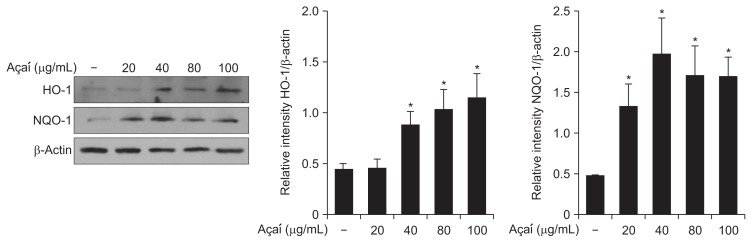
Fig. 6 Açaí induces the expression of antioxidant enzymes in CCD841CoN cells. CCD841CoN cells were treated with the indicated concentrations of açaí for 24 hours. Total cellular lysates were collected for the detection of heme oxygenase-1 (HO-1) and NAD(P)H:quinone oxidoreductase 1 (NQO-1) protein expression by Western blot analysis. The data represent three independent experiments (n=3). The results are expressed as the mean±standard errors. *p<0.05 compared with the control.

그림 출처: PubMed Central 공개 논문 (PMC5347649)

Conflict of interest statement

CONFLICTS OF INTEREST. No potential conflict of interest relevant to this article was reported.

그 밖의 정보
출판 형태
Journal Article
저널
Gut and liver · eISSN 2005-1212
MeSH
Animals · Anticarcinogenic Agents / pharmacology · Azoxymethane · Carcinogenesis / drug effects · Carcinogens · Colon / metabolism / pathology · Colorectal Neoplasms / chemically induced / prevention & control · Cytokines / metabolism · Dextran Sulfate · Down-Regulation / drug effects · Euterpe* · Genes, bcl-2 / drug effects · Male · Mice · Peroxidase / metabolism · Phytotherapy / methods · Powders / pharmacology · Proliferating Cell Nuclear Antigen / drug effects
Substances
Anticarcinogenic Agents · Carcinogens · Cytokines · Powders · Proliferating Cell Nuclear Antigen · Dextran Sulfate · Peroxidase · Azoxymethane
참고문헌
39편