
Gut Liver. 2017;11(2):209-215.
Dynamic Changes in Helicobacter pylori Status Following Gastric Cancer Surgery.
제1저자 윤기철 · 교신저자 김나영
소속 (6)
- Department of Internal Medicine, Seoul National University Bundang Hospital, Seongnam, Korea.
- Department of Internal Medicine, Seoul Adventist Hospital, Seoul, Korea.
- Department of Internal Medicine and Liver Research Institute, Seoul National University College of Medicine, Seoul, Korea.
- Department of Pathology, Seoul National University Bundang Hospital, Seongnam, Korea.
- Department of Surgery, Seoul National University Bundang Hospital, Seongnam, Korea.
- Department of Radiology, Seoul National University Bundang Hospital, Seongnam, Korea.
Abstract
BACKGROUND/AIMS Helicobacter pylori eradication is recommended in patients with early gastric cancer. However, the possibility of spontaneous regression raises a question for clinicians about the need for "retesting" postoperative H. pylori status.
METHODS Patients who underwent curative gastrectomy at Seoul National University Bundang Hospital and had a positive H. pylori status without eradication therapy at the time of gastric cancer diagnosis were prospectively enrolled in this study. H. pylori status and atrophic gastritis (AG) and intestinal metaplasia (IM) histologic status were assessed pre- and postoperatively.
RESULTS One hundred forty patients (mean age, 59.0 years; 60.7% male) underwent subtotal gastrectomy with B-I (65.0%), B-II (27.1%), Roux-en-Y (4.3%), jejunal interposition (0.7%), or proximal gastrectomy (4.3%). Preoperative presence of AG (62.9%) and IM (72.9%) was confirmed. The mean period between surgery and the last endoscopic follow-up was 38.0±25.6 months. Of the 140 patients, 80 (57.1%) were found to be persistently positive for H. pylori, and 60 (42.9%) showed spontaneous negative conversion at least once during follow-up. Of these 60 patients, eight (13.3%) showed more complex postoperative dynamic changes between negative and positive results. The spontaneous negative conversion group showed a trend of having more postoperative IM compared to the persistent H. pylori group.
CONCLUSIONS A high percentage of spontaneous regression and complex dynamic changes in H. pylori status were observed after partial gastrectomy, especially in individuals with postoperative histological IM. It is better to consider postoperative eradication therapy after retesting for H. pylori.
Keywords
EradicationHelicobacter pyloriPostoperation
Figures
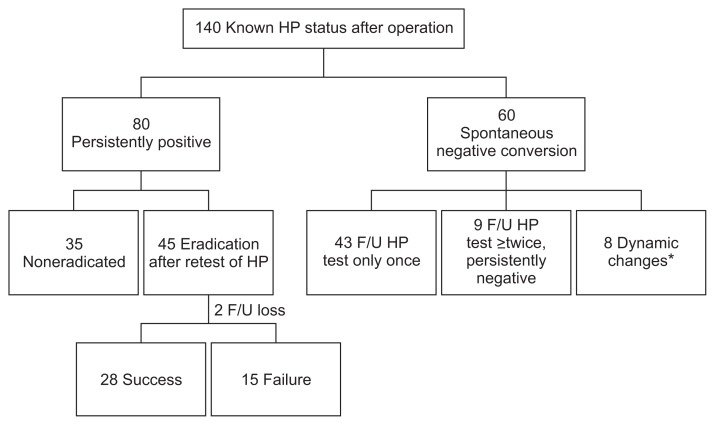
그림 출처: PubMed Central 공개 논문 (PMC5347644)
Comment · 정정
Conflict of interest statement
CONFLICTS OF INTEREST. No potential conflict of interest relevant to this article was reported.
그 밖의 정보
- 출판 형태
- Evaluation Study, Journal Article
- 저널
- Gut and liver · eISSN 2005-1212
- MeSH
- Aged · Female · Gastrectomy / methods · Gastritis, Atrophic / diagnosis · Helicobacter Infections / microbiology · Helicobacter pylori* · Humans · Intestines / pathology · Male · Metaplasia / diagnosis · Middle Aged · Postoperative Complications / diagnosis / microbiology · Postoperative Period · Preoperative Period · Prospective Studies · Seoul · Stomach Neoplasms / microbiology / pathology / surgery · Treatment Outcome
- 참고문헌
- 27편