
J Am Heart Assoc. 2022;11(13):e025554.
Left Ventricular Diastolic Dysfunction and Progression of Chronic Kidney Disease: Analysis of KNOW-CKD Data.
제1저자 강은정, 이성우 · 교신저자 오국환
소속 (10)
- Department of Internal Medicine Ewha Womans University Seoul Hospital, Ewha Womans University College of Medicine Seoul South Korea.
- Department of Internal Medicine Uijeongbu Eulji University Medical Center, Uijeongbu-si Gyeonggi-do South Korea.
- Department of Internal Medicine Seoul National University College of Medicine Seoul South Korea.
- Department of Preventive Medicine Seoul National University College of Medicine Seoul South Korea.
- Cancer Research Institute Seoul National University Seoul South Korea.
- Integrated Major in Innovative Medical Science Seoul National University College of Medicine Seoul South Korea.
- Department of Internal Medicine Gachon University Gil Medical Center, Gachon University College of Medicine Incheon South Korea.
- Department of Internal Medicine Kangbuk Samsung Hospital, Sungkyunkwan University School of Medicine Seoul South Korea.
- Department of Internal Medicine Institute of Kidney Disease Research, College of Medicine, Yonsei University Seoul South Korea.
- Department of Internal Medicine National Medical Center Seoul South Korea.
Abstract
Background Few studies have examined the association between the early diastolic mitral inflow velocity/early diastolic mitral annulus velocity ratio (E/e') and chronic kidney disease progression. Methods and Results We reviewed data from 2238 patients with nondialysis chronic kidney disease from the KNOW-CKD (Korean Cohort Study for Outcome in Patients With Chronic Kidney Disease); data from 163 patients were excluded because of missing content. A >50% decrease in estimated glomerular filtration rate from baseline, doubling of serum creatinine, or dialysis initiation and/or kidney transplantation were considered renal events. At baseline, median (interquartile range) ejection fraction and E/e' were 64.0% (60.0%-68.0%) and 9.1 (7.4-11.9), respectively. Proportions of ejection fraction <50% and E/e' ≥15 were 1.3% and 9.6%, respectively. More than one quarter of patients (27.2%) had an estimated glomerular filtration rate <30 mL/min per 1.73 m2. During the mean 59.1-month follow-up period, 724 patients (34.9%) experienced renal events. In multivariable Cox proportional hazard regression analysis, the hazard ratio with 95% CI per 1-unit increase in E/e' was 1.027 (1.005-1.050; P=0.016). Penalized spline curve analysis yielded a suggested threshold of E/e' for renal events of 12; in our data set, the proportion of E/e' ≥12 was 4.1%. Conclusions Increased E/e' was associated with an increased hazard of renal events, suggesting that diastolic heart dysfunction is a novel risk factor for chronic kidney disease progression.
Keywords
cardiorenal syndromechronic kidney diseasediastolic heart dysfunctionearly predictorprogression
Figures


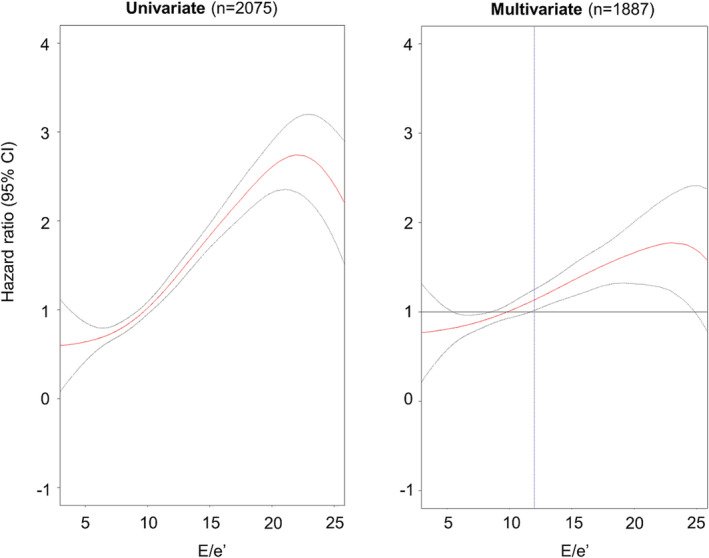
그림 출처: PubMed Central 공개 논문 (PMC9333375)
Comment · 정정
그 밖의 정보
- 출판 형태
- Journal Article, Review, Research Support, Non-U.S. Gov't
- 저널
- Journal of the American Heart Association · eISSN 2047-9980
- 전자 출판
- 2022-06-29
- MeSH
- Cohort Studies · Diastole · Humans · Renal Insufficiency, Chronic* / complications / diagnosis / epidemiology · Ventricular Dysfunction, Left* / etiology · Ventricular Function, Left
- 참고문헌
- 28편