
Microorganisms. 2023;11(12):microorganisms11122882.
Evaluation of Bacterial and Fungal Biomarkers for Differentiation and Prognosis of Patients with Inflammatory Bowel Disease.
제1저자 윤혁 · 교신저자 윤혁, 박성혁
소속 (4)
- Department of Internal Medicine, Seoul National University Bundang Hospital, Seongnam 13620, Republic of Korea.
- Department of Internal Medicine and Liver Research Institute, Seoul National University College of Medicine, Seoul 03080, Republic of Korea.
- Department of Manufacturing Pharmacy, Natural Products Research Institute, College of Pharmacy, Seoul National University, Seoul 08826, Republic of Korea.
- Department of Biological Sciences, College of Natural Sciences, Seoul National University, Seoul 08826, Republic of Korea.
Abstract
This study aimed to evaluate bacterial and fungal biomarkers to differentiate patients with inflammatory bowel disease (IBD), predict the IBD prognosis, and determine the relationship of these biomarkers with IBD pathogenesis. The composition and function of bacteria and fungi in stool from 100 IBD patients and 97 controls were profiled using next-generation sequencing. We evaluated the cumulative risk of relapse according to bacterial and fungal enterotypes. The microbiome and mycobiome alpha diversity in IBD patients were significantly lower and higher than in the controls, respectively; the micro/mycobiome beta diversity differed significantly between IBD patients and the controls. Ruminococcus gnavus, Cyberlindnera jadinii, and Candida tropicalis increased in IBD patients. Combining functional and species analyses revealed that lower sugar import and higher modified polysaccharide production were associated with IBD pathogenesis. Tricarboxylic acid cycling consuming acetyl CoA was higher in IBD patients than the controls, leading to lower short-chain fatty acid (SCFA) fermentation. Bacterial and fungal enterotypes were not associated with IBD relapse. We found differences in bacterial and fungal species between IBD patients and controls. A working model for the role of gut bacteria in IBD pathogenesis is proposed, wherein bacterial species increase modified N-glycan production and decrease SCFA fermentation.
Keywords
biomarkersinflammatory bowel diseasemicrobiomemycobiome
Figures


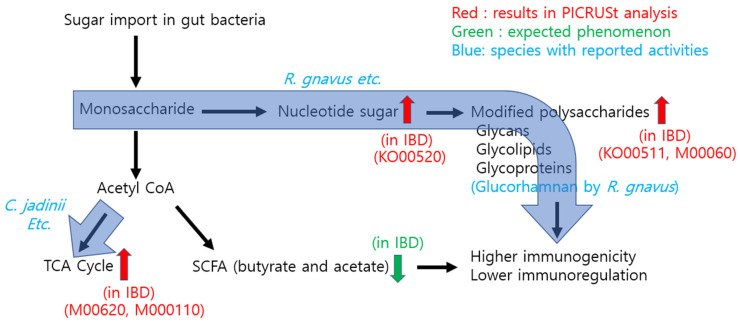
그림 출처: PubMed Central 공개 논문 (PMC10745905)
Conflict of interest statement
The authors declare that they have no conflicts of interest or financial arrangements that could influence the present research. The funder had no role in the study design, data collection and interpretation, or the decision to submit the work for publication.
그 밖의 정보
- 출판 형태
- Journal Article
- 저널
- Microorganisms · ISSN 2076-2607
- 전자 출판
- 2023-11-29
- 연구비
- National Research Foundation of Korea 2021R1C1C1004170
- 참고문헌
- 60편