
PLoS One. 2016;11(11):e0166245.
Prognostic Impact of IPSS-R and Chromosomal Translocations in 751 Korean Patients with Primary Myelodysplastic Syndrome.
제1저자 서경진 · 교신저자 김인호
소속 (9)
- Department of Internal Medicine, Seoul National University Hospital, Cancer Research Institute, Seoul National University College of Medicine, Seoul, Korea.
- Department of Internal Medicine, Yonsei University Severance Hospital, Seoul, Korea.
- Department of Internal Medicine, Chonnam National University Hwasun Hospital, Hwasun, Chonnam, Korea.
- Department of Internal Medicine, Kangbuk Samsung Hospital, Seoul, Korea.
- Department of Internal Medicine, Seoul National University Bundang Hospital, Seongnam, Gyeonggi, Korea.
- Department of Internal Medicine, Ewha Womans University Mokdong Hospital, Seoul, Korea.
- Departmenet of Internal Medicine, Korea University Anam Hospital, Seoul, Korea.
- Department of Internal Medicine, Gachon University Gil Medical Center, Incheon, Korea.
- Department of Internal Medicine, Konkuk University School of Medicine, Seoul, Korea.
Abstract
Chromosomal translocations are rare in myelodysplastic syndrome (MDS) and their impact on overall survival (OS) and response to hypomethylating agents (HMA) is unknown. The prognostic impact of the revised International Prognostic Scoring System (IPSS-R) and for chromosomal translocations was assessed in 751 patients from the Korea MDS Registry. IPSS-R effectively discriminated patients according to leukaemia evolution risk and OS. We identified 40 patients (5.3%) carrying translocations, 30 (75%) of whom also fulfilled complex karyotype criteria. Translocation presence was associated with a shorter OS (median, 12.0 versus 79.7 months, P < 0.01). Multivariate analysis demonstrated that translocations (hazard ratio [HR] 1.64 [1.06-2.63]; P = 0.03) as well as age, sex, IPSS-R, and CK were independent predictors of OS. In the IPSS-R high and very high risk subgroup (n = 260), translocations remained independently associated with OS (HR 1.68 [1.06-2.69], P = 0.03) whereas HMA treatment was not associated with improved survival (median OS, 20.9 versus 21.2 months, P = 0.43). However, translocation carriers exhibited enhanced survival following HMA treatment (median 2.1 versus 12.4 months, P = 0.03). Our data suggest that chromosomal translocation is an independent predictor of adverse outcome and has an additional prognostic value in discriminating patients with MDS having higher risk IPSS-R who could benefit from HMA treatment.
Figures

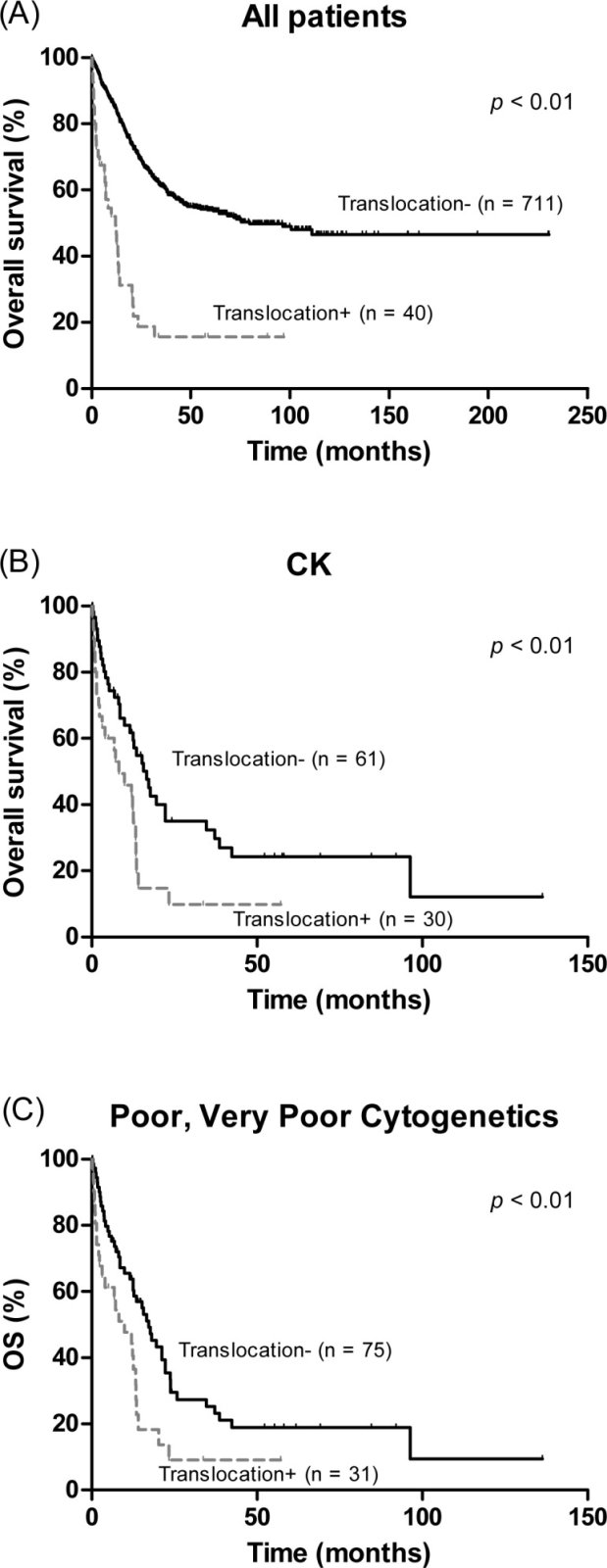

그림 출처: PubMed Central 공개 논문 (PMC5100959)
Conflict of interest statement
The authors have declared that no competing interests exist.
그 밖의 정보
- 출판 형태
- Journal Article
- 저널
- PloS one · eISSN 1932-6203
- 전자 출판
- 2016-11-08
- MeSH
- Antineoplastic Agents / therapeutic use · DNA Methylation / drug effects · Female · Humans · Male · Middle Aged · Multivariate Analysis · Myelodysplastic Syndromes / drug therapy / genetics / pathology · Prognosis · Proportional Hazards Models · Republic of Korea · Retrospective Studies · Risk Factors · Severity of Illness Index · Translocation, Genetic / drug effects / genetics · Treatment Outcome
- Substances
- Antineoplastic Agents
- 참고문헌
- 31편