
PLoS One. 2016;11(10):e0163998.
The Impact of Methylenetetrahydrofolate Reductase C677T Polymorphism on Patients Undergoing Allogeneic Hematopoietic Stem Cell Transplantation with Methotrexate Prophylaxis.
제1저자 변자민 · 교신저자 김인호
소속 (6)
- Department of Internal Medicine, Seoul National University College of Medicine, Seoul National University Hospital, Seoul, Korea.
- Graduate School of Public Health, Seoul National University, Seoul, Korea.
- Cancer Research Institute, Seoul National University, Seoul, Korea.
- Department of Laboratory Medicine, Seoul National University Hospital, Seoul, Korea.
- Department of Integrative Bioscience and Biotechnology, Sejong University, Seoul, Korea.
- Department of Internal Medicine, Kangbuk Samsung Hospital, Sungkyunkwan University School of Medicine, Seoul, Korea.
Abstract
Pharmacogenomics can explain the inter-individual differences in response to drugs, including methotrexate (MTX) used for acute graft-versus-host disease (aGVHD) prophylaxis during hematopoietic stem cell transplantation (HSCT). In real-world practice, preplanned MTX dose is arbitrarily modified according to observed toxicity which can lead to unexpected and severe aGVHD development. We aimed to validate the influence of MTHFR C677T polymorphism on the outcomes of allogenic HSCT in a relatively under-represented homogenous Asian population. A total of 177 patients were divided into 677TT group versus 677C-carriers (677CT+677CC), and clinical outcomes along with baseline characteristics were analyzed and compared. Although there was a tendency towards increased peak liver function test results and accordingly greater delta values between the highest and the baseline in 677TT group, we found no associations between genotypes and hepatotoxicity. However, the incidence of acute liver GVHD (≥ grade 2) was significantly higher in the 677TT group than in the 677CC + 677CT group (P = 0.016). A total of 25 patients (14.1%) expired due to transplantation related mortality (TRM) during the first 180 days after HSCT. Patients carrying 677TT genotype were more likely to experience early TRM than 677C-carriers. The same pattern was observed in the cumulative TRM rate, and 677TT genotype patients were more prone to cumulative TRM (P = 0.010). This translated into shorter OS for patients with 677TT compared to 677C-carriers (P = 0.010). The 3-year survival after HSCT was 29.9% for 677TT cases and 47.1% for 677C-carriers. The multivariate analysis identified 677TT genotype (HR = 1.775. 95% CI 1.122-2.808, P = 0.014) and non-CR state (HR = 2.841. 95% CI 1.627-4.960, P<0.001) as predictors for survival. In conclusion, the MTHFR 677TT genotype appears to be associated with acute liver GVHD, and represent a risk factor for TRM and survival in patients undergoing HSCT with MTX as GVHD prophylaxis.
Figures

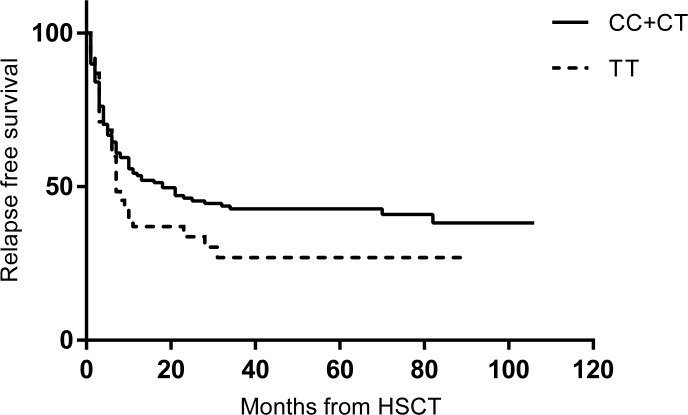

그림 출처: PubMed Central 공개 논문 (PMC5081210)
Conflict of interest statement
The authors have declared that no competing interests exist.
그 밖의 정보
- 출판 형태
- Journal Article
- 저널
- PloS one · eISSN 1932-6203
- 전자 출판
- 2016-10-26
- MeSH
- Adult · Female · Genotype · Graft vs Host Disease / mortality / prevention & control · Hematopoietic Stem Cell Transplantation* · Humans · Male · Methotrexate / therapeutic use · Methylenetetrahydrofolate Reductase (NADPH2) / genetics · Middle Aged · Multivariate Analysis · Polymorphism, Single Nucleotide · Proportional Hazards Models · Recurrence · Survival Rate · Transplantation, Homologous
- Substances
- MTHFR protein, human · Methylenetetrahydrofolate Reductase (NADPH2) · Methotrexate
- 참고문헌
- 24편